
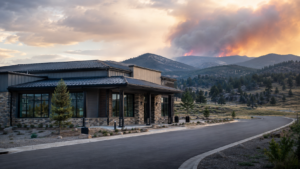

The Quick Read
On July 1, 2026, Colorado statewide Wildfire Resiliency Code became fully effective, making Colorado one of the first western states after California to require mandatory wildfire construction standards. Commercial and multifamily properties in wildland-urban interface zones face requirements including up to 100 feet of clearance, fire-resistant roofing, siding, and venting, and clear road access for responders.
Treat this as an underwriting signal, not just a compliance task. Enforced hardening turns mitigation into a verifiable, priceable data point in a two-speed market where high-hazard assets increasingly must show proof of mitigation or face non-renewal. The catch: meeting code on inspection day is not the same as staying resilient, because defensible space only works if it is maintained.
How Property Guardian Helps: Property Guardian mitigation and active fire intelligence services, together with our wildfire risk insight reports, help commercial teams document where they stand today, prioritize the improvements that most reduce exposure, and keep that picture current as codes and conditions change.
On July 1, 2026, Colorado statewide Wildfire Resiliency Code became fully effective. It is a milestone that reaches well beyond Colorado. With this step, Colorado becomes one of the first western states after California to adopt mandatory statewide wildfire construction standards, and it signals a broader shift that commercial property underwriters and risk managers should be tracking closely.
For years, wildfire hardening was largely voluntary and uneven. A well-built property might sit next to one with combustible siding and no defensible space, and the insurance market often struggled to tell them apart. Codes like Colorado change that picture. They create a documented, enforceable baseline for how structures in high-hazard areas are built and maintained, and that baseline is exactly the kind of signal underwriting has been missing.
What the Code Actually Requires
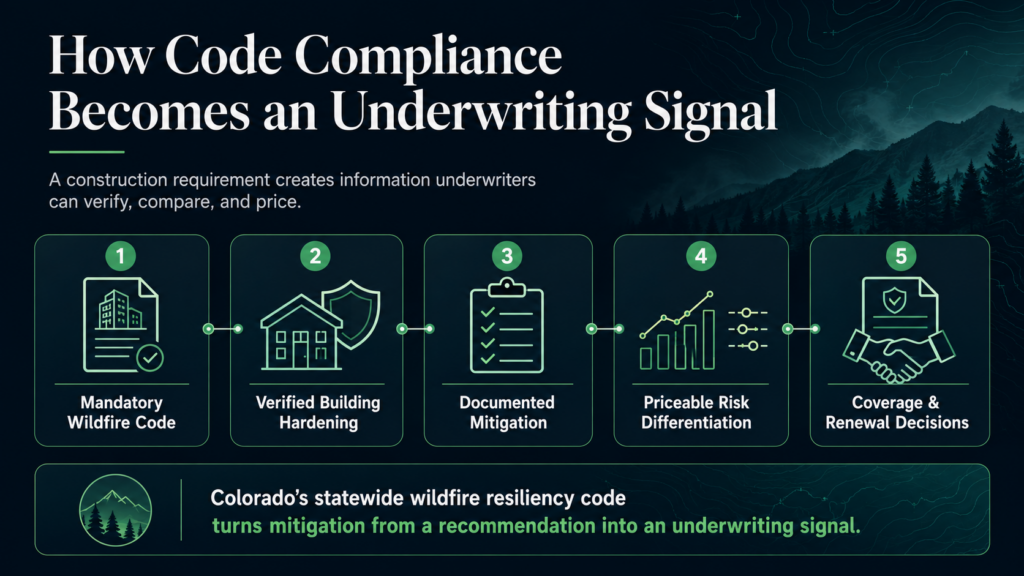
The Wildfire Resiliency Code sets minimum requirements for structures in designated wildland-urban interface zones. It covers fire-resistant construction materials, structure hardening, and defensible space. For commercial buildings and multifamily properties, the requirements include up to 100 feet of clearance around structures, fire-resistant roofing, siding, and venting, and clear road access so emergency responders can reach the site.
None of these measures is exotic. Each one targets a well-understood pathway by which buildings ignite during a wildfire. Embers land on a combustible roof or drift into an unscreened vent. Radiant heat from burning vegetation too close to the wall ignites the structure directly. Crews cannot reach a property because the access road is blocked or too narrow. The code addresses these failure points systematically, and it does so as a requirement rather than a suggestion.
Why This Matters for Underwriting
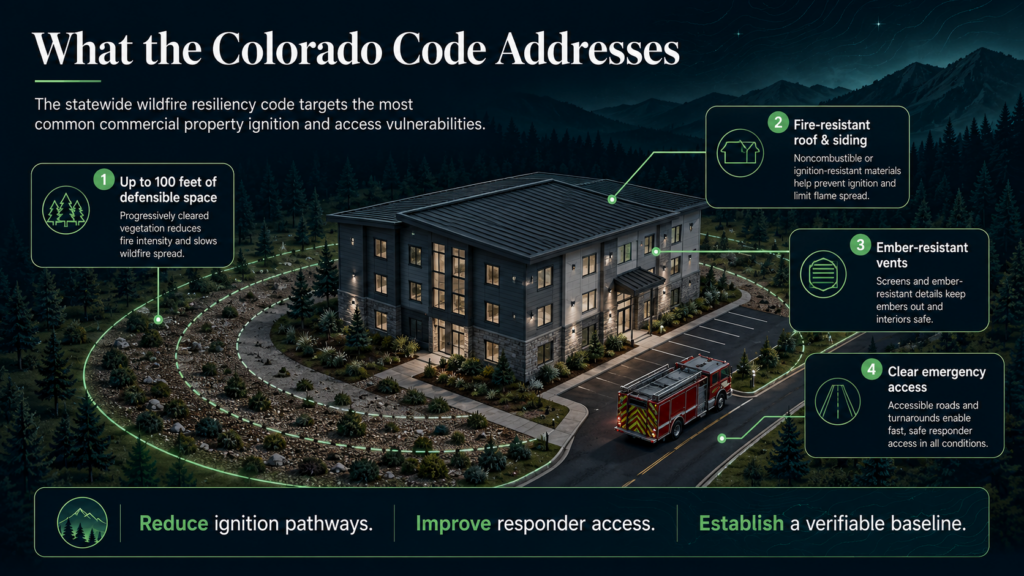
The value of a code like this is not only in the buildings it improves. It is in the information it creates. When a jurisdiction enforces a hardening standard, compliance becomes a data point that can be verified, documented, and priced. That helps close the gap between properties that look similar on a map but perform very differently when fire arrives.
It also reflects where the wider market is heading. Across North America, wildfire coverage has split into a two-speed market. Low-hazard, urban locations are seeing rates stabilize, while properties in the wildland-urban interface remain tightly underwritten. High-hazard assets increasingly face a new condition of coverage: proof of active mitigation, or non-renewal. A statewide code gives commercial property owners a concrete framework for producing that proof, and it gives underwriters a clearer standard against which to measure it.
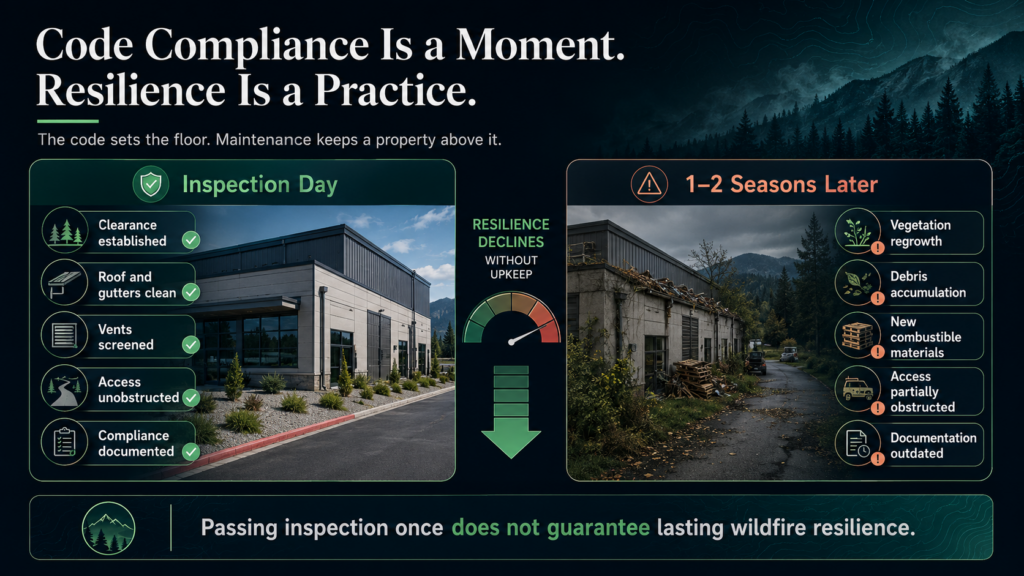
There is a caution worth naming. Compliance at the time of construction is not the same as resilience over time. Defensible space is one of the most cost-effective ways to protect a building, but it only works if it is maintained. Vegetation grows back. Debris accumulates on roofs and in gutters. A property that met the standard on inspection day can drift out of compliance within a season or two. The code sets the floor. Keeping a property above that floor is an ongoing operational task, not a one-time box to check.
Practical Takeaways for Commercial Property Teams
For underwriters, treat code adoption as a reason to sharpen questions, not to relax them. Ask whether a property was built or retrofitted to the applicable standard, and ask how mitigation is maintained year over year. A building in a code-governed jurisdiction that can document ongoing upkeep is a materially different risk from one that met the standard once and has not been touched since.
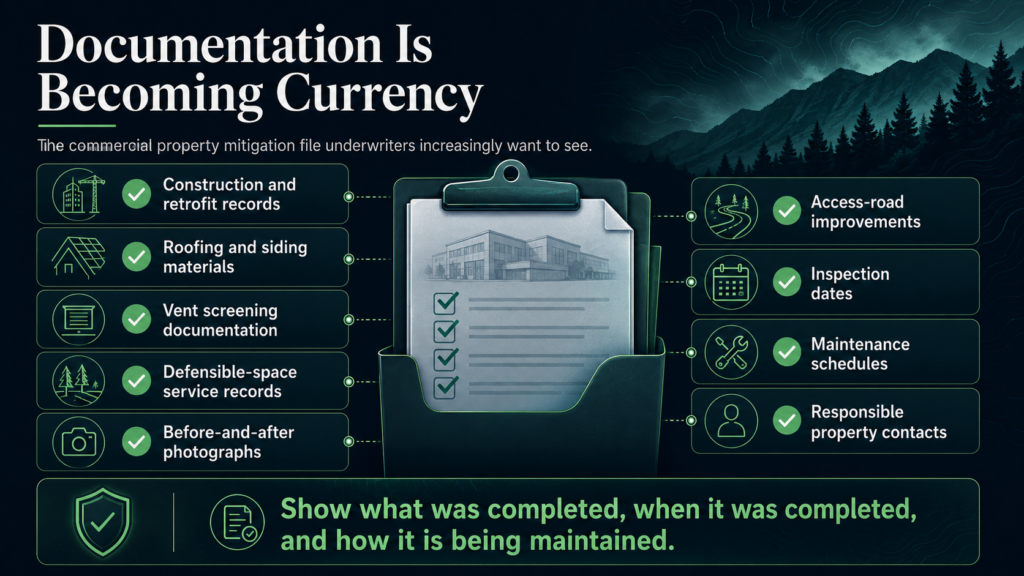
For risk managers and property operators, the message is more direct. Documentation is becoming currency. Keep records of construction materials, defensible space work, vent screening, and access improvements, and keep them current. As more states follow Colorado and California, the ability to show verified, maintained mitigation will increasingly separate the accounts that secure competitive terms from those that struggle to place coverage at all.
For portfolios that span multiple states, watch the regulatory map. Colorado is unlikely to be the last western state to adopt mandatory standards. Teams that understand which of their assets sit in code-governed wildland-urban interface zones, and how each one measures against the applicable requirements, will be able to plan capital improvements deliberately rather than scrambling in response to a non-renewal notice.
The Bottom Line
Colorado new code turns wildfire hardening from a nice-to-have into a documented, enforceable standard, and it points to a future where mitigation is expected rather than rewarded as an exception. That is good news for commercial property teams that have already invested in resilience, and a clear prompt for those that have not. The properties that will fare best are the ones that can prove, on paper and on the ground, that hardening is real and maintained.
At Property Guardian, our mitigation and active fire intelligence services, together with our wildfire risk insight reports, help commercial property teams document where they stand today, prioritize the improvements that most reduce exposure, and keep that picture current as codes and conditions change. Resilience is not a seasonal effort. We help make it a standing one.
Sources
Property Guardian, Resilience Cannot Be Seasonal: Colorado New Wildfire Code
Oregon Building Codes Division, Home hardening and wildfire hazard mitigation
