
June 17, 2026
By Brian Bastian, Head of Product
By March 31 of this year, 1.6 million acres had already burned across the United States, about 231 percent of the ten-year average for that date, after an unusually early-season heat wave dried fuels weeks ahead of schedule. The numbers are a reminder of something wildfire researchers have been saying for a while: the idea of a tidy, bounded fire season no longer describes the risk. And increasingly, the wildfire problem is not a wildland problem at all. It is a built-environment problem.
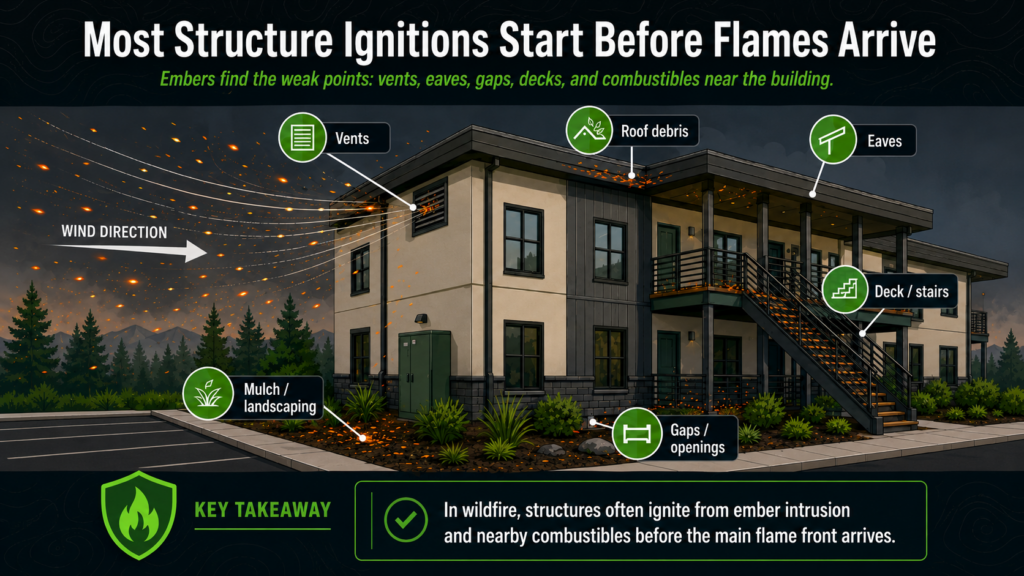
That framing matters because of where the losses actually happen. According to CAL FIRE, somewhere between 60 and 90 percent of structures that ignite in a wildfire do so because of embers, not direct flame contact. Embers travel ahead of the fire front, find the vents, eaves, gaps, and combustible material around a building, and start the fire from the inside out. The implication is direct: whether a structure survives depends far less on luck and far more on how it was built and what surrounds it.
States are now codifying that lesson. Colorado’s statewide Wildfire Resiliency Code becomes fully effective on July 1, 2026, making Colorado one of the first western states after California to adopt mandatory statewide wildfire construction standards. The code sets minimum requirements for structures in designated wildland-urban interface zones, covering fire-resistant construction materials, structure hardening, and defensible space. Local jurisdictions such as Arvada have already adopted their own resiliency codes with hardening and defensible-space requirements for structures in WUI areas.
California continues to tighten its own rules. Commercial buildings and multifamily properties must meet wildfire requirements that include up to 100 feet of clearance, fire-resistant roofing, siding, and venting, and clear road access for emergency responders. The most scrutinized new requirement is Zone 0, the zero-to-five-foot band immediately around a structure, which must be kept completely free of combustibles. Demand for non-combustible building materials is rising in step with these codes, a market shift industry groups have flagged repeatedly through 2026.
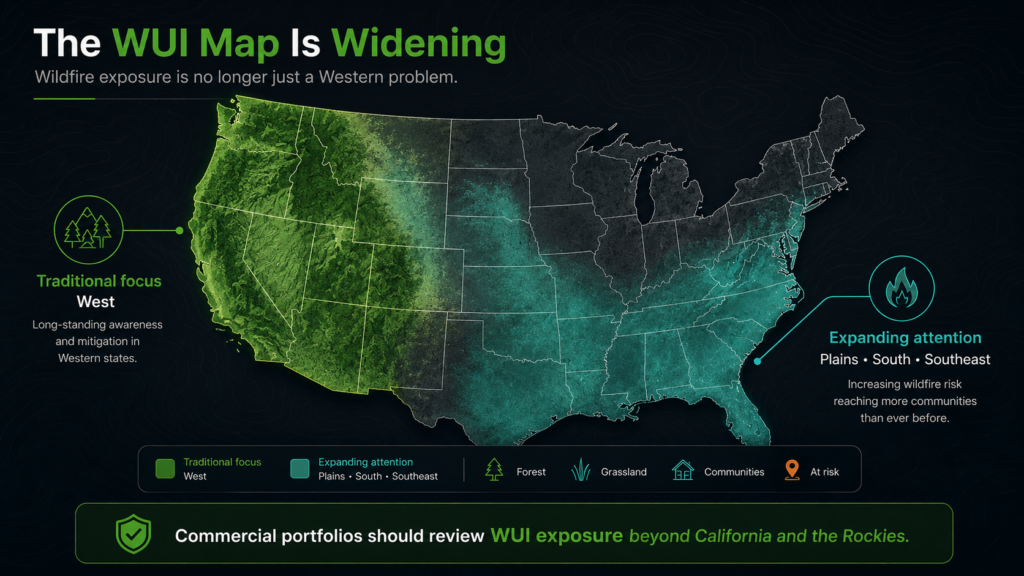
None of this is confined to the West. The same national outlook that logged the early-season acreage also projected above-normal fire potential across parts of the Plains, the South, and the Southeast. The U.S. Fire Administration counts more than 60,000 communities at risk nationwide. Many of them do not think of themselves as wildfire communities until a wind-driven event proves otherwise. For a commercial portfolio with geographically dispersed assets, that breadth is the point: WUI exposure is showing up in places that historically priced it at zero.
For underwriters and risk managers, codified resilience is genuinely good news, but it comes with two caveats. First, codes mostly govern new construction and major renovations, so the bulk of the existing commercial building stock in WUI zones still reflects older, weaker standards. Code adoption raises the floor slowly, parcel by parcel, as buildings are built or rebuilt. Second, and more fundamentally, even the best hardening code addresses the building. It does not tell you whether a fire could actually be fought at that location. Two hardened, code-compliant buildings can sit in very different positions when it comes to road access, water supply, terrain, and the sheer difficulty of getting crews and equipment to the site during a major event. That difficulty is one of the strongest real-world drivers of whether a fire becomes a total loss, and it is invisible to both a hardening checklist and a traditional protection class score.
“A property in a code-adopting state is not automatically hardened.”
Practical Takeaways for Commercial Property Teams
- Use code status as a risk signal, but verify the building, not just the jurisdiction. A property in a code-adopting state is not automatically hardened. Confirm when it was built or last renovated and what was actually done.
- Distinguish hardening from defensibility. Ask two separate questions about every WUI asset: how well can this building resist embers and radiant heat, and how realistically could a fire be suppressed at this location?
- Watch the map widen. Review portfolio exposure in the Plains, the South, and the Southeast, not just California and the Rockies. Communities that never priced WUI risk are now in the national outlook.
- Reward documented, ongoing mitigation. Defensible space is a maintained condition, not a one-time project. Build re-verification into renewals rather than trusting a single inspection.
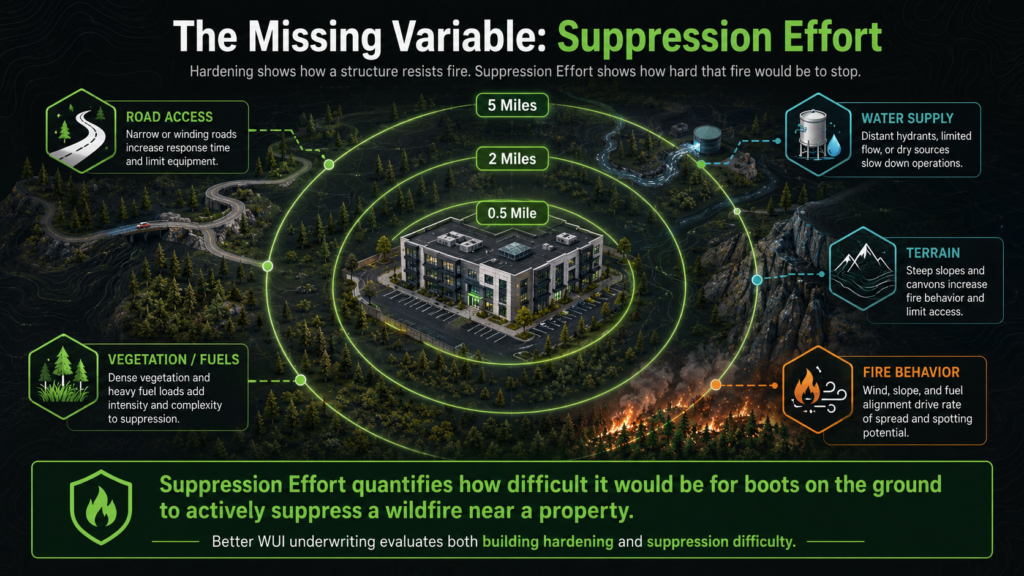
This is exactly where Property Guardian’s Wildfire Risk Insight Reports add a dimension that codes and legacy scores leave out. Our Suppression Effort measure simulates large wildfires around a property and quantifies how difficult it would be for boots on the ground to actively suppress a fire within the 0.5-mile, 2-mile, and 5-mile radii of the asset. Hardening codes tell you how well a structure is built to resist a fire. Suppression Effort tells you how hard that fire would be to stop once it arrives, the variable that ISO and protection class scores, designed for structure fires, were never built to measure. Together, that is a far more complete picture of WUI risk than either a code stamp or a static score can provide on its own.
Sources
International Code Council, 2026’s Fire Season Is a Warning Light (May 6, 2026): https://www.iccsafe.org/building-safety-journal/bsj-dives/2026s-fire-season-is-a-warning-light-building-wildfire-resilience-beyond-fire-season/
City of Arvada, CO, Building Code updates coming in 2026: https://www.arvadaco.gov/1388/Building-Code-updates-coming-in-2026
GlobeNewswire, New Wildfire Code Spotlights Growing Market for Non-Combustible Building Materials (May 21, 2026): https://www.globenewswire.com/news-release/2026/05/21/3299291/0/en/New-Wildfire-Code-Spotlights-Growing-Market-for-Non-Combustible-Building-Materials-like-Xeriant-s-NEXBOARD-Platform.html
CAL FIRE, Defensible Space: https://www.fire.ca.gov/dspace
