
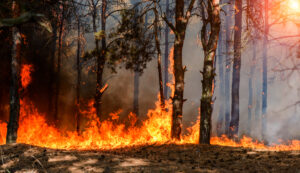
On November 1st, a fire took hold in the Wild River valley of New Hampshire’s White Mountains, a mile from the Maine line. A week later it covers 856 acres, the largest fire the White Mountain National Forest has seen since it was established, and it is the most interesting fire in the country for a reason that has nothing to do with size. It is burning in a region that sits outside every national risk flag, at a moment when the national risk map has gone blank.
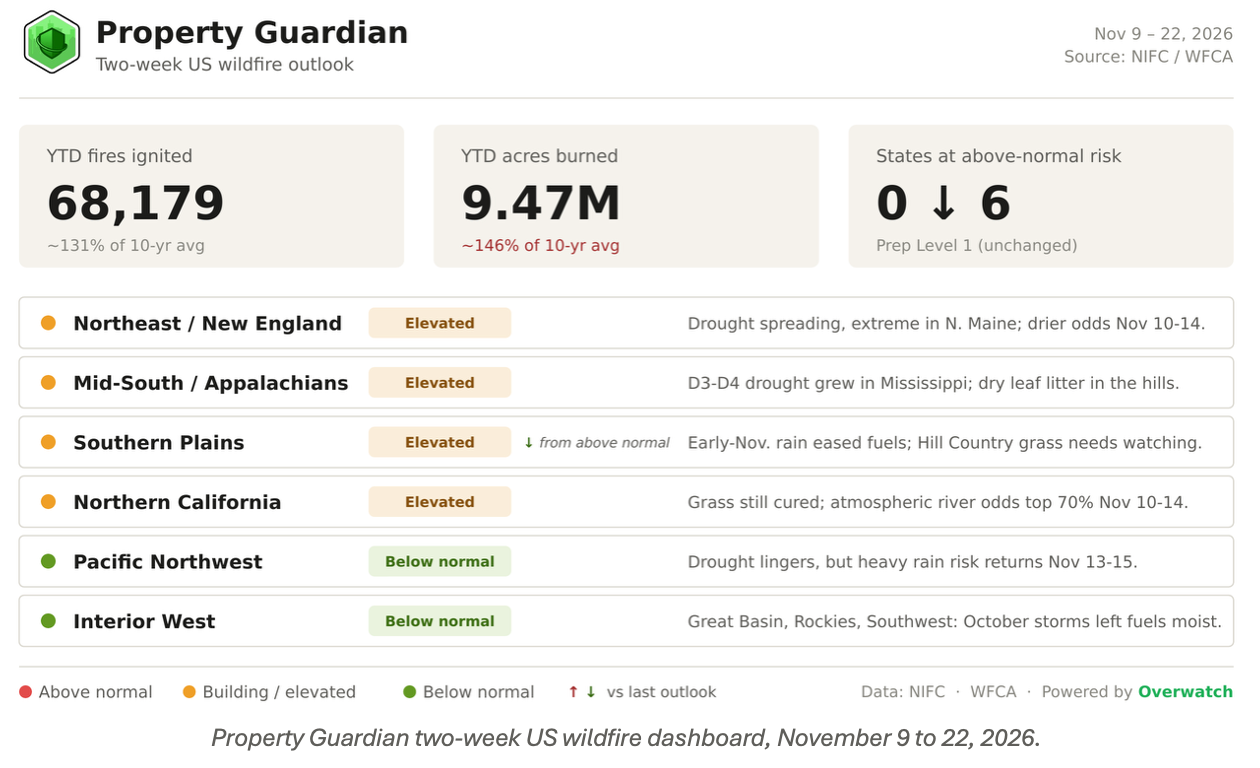
Zero states in the Lower 48 open this outlook at above-normal fire risk, down from six two weeks ago.
NIFC’s November 2 outlook carries normal significant fire potential across the contiguous US for November and December, with above-normal potential confined to Puerto Rico and the U.S. Virgin Islands.
The National Preparedness Level stays at 1, where it has been since October 14. The 2026 totals are close to final: 68,179 fires and 9,471,008 acres as of November 6, about 131% and 146% of the 10-year average for the date.
An empty map, redrawn
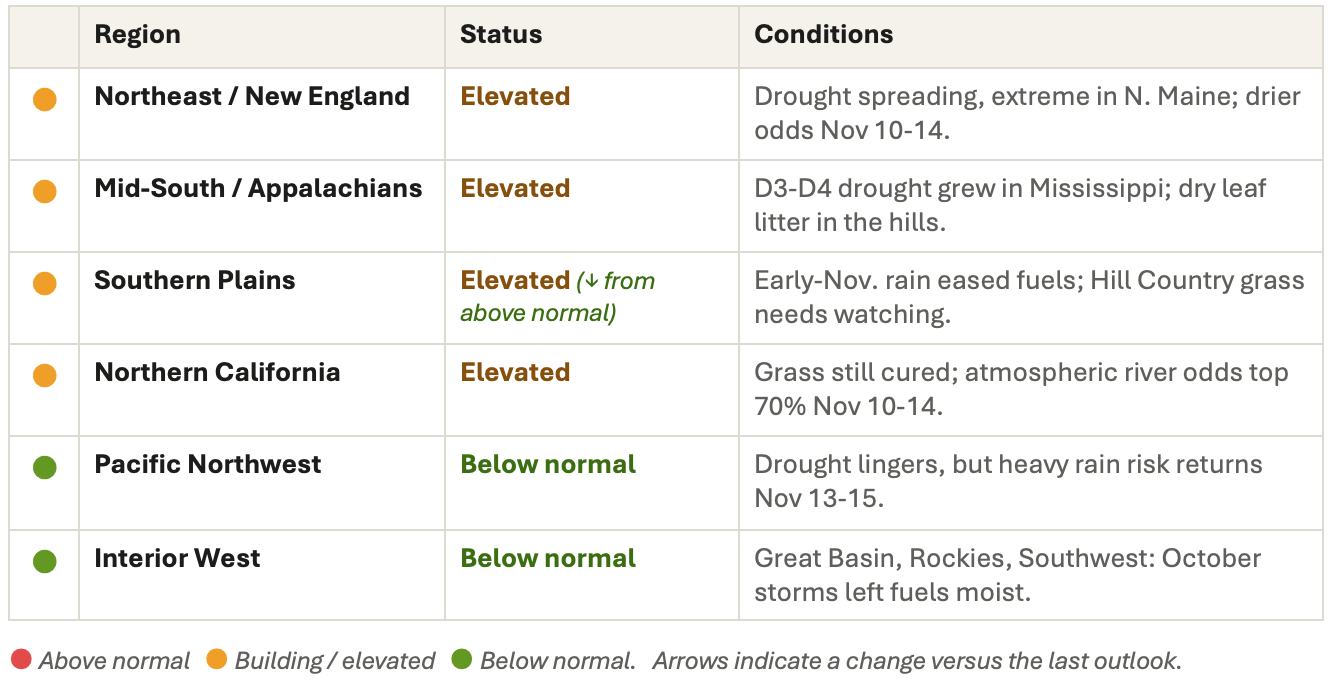
Normal is the right call nationally, but it flattens real differences in where a fire can still start and run, so we have redrawn our regional rows to follow the drought rather than the summer’s fire geography.
The Southern Plains ease from above normal to elevated. Rain and Gulf moisture arrived in early November, and NIFC notes that warm weather afterward could green up roadside grasses. The Texas Hill Country is the caveat: two summers of flooding grew a heavy grass crop that has since cured, and it becomes a real concern after the first hard freeze.
Two regions join the map at elevated. The Northeast and New England moved the wrong way on the November 5 Drought Monitor, with moderate drought spreading across northern New Hampshire and Vermont and extreme drought appearing in northern Maine. The Mid-South and Appalachians carry the deepest drought in the country: extreme to exceptional drought expanded in Mississippi, pockets of exceptional drought surfaced along the Virginia and North Carolina border, and NIFC points out that the Appalachians entered November after more than three weeks without wetting rain, with leaf drop under way.
Northern California holds at elevated while low-elevation grass waits on steady rain. The Great Basin, Northern Rockies, and Southwest were all below normal at our last outlook and remain there, so they now share a single Interior West row. The Pacific Northwest stays below normal.
November 9 to 15: offshore winds out, Pacific moisture in
The fortnight opens on the back end of a Santa Ana event. Saturday’s Red Flag Warning covered the Santa Clarita Valley, the Santa Monica and Santa Susana Mountains, and the western San Gabriels, with northeast winds of 20 to 30 mph, gusts of 45 mph and higher, and relative humidity between 8% and 20%. Offshore flow weakens through Tuesday, with temperatures above normal through midweek before a gradual cooling. NIFC’s southern California outlook explains why this event mattered less than a similar one in mid-October: dead fuel moisture is well above normal after an unusually wet October, and new grass is coming up across the lower elevations.
Then the pattern flips. CPC’s 6 to 10 day outlook for November 10 to 14 gives much of California and the Pacific Northwest better than a 60% chance of above-normal precipitation, rising above 70% over northern California and southwest Oregon, as an atmospheric river becomes increasingly likely. Wetter odds also extend over the Great Basin, Southwest, Rio Grande Valley, and Florida. The dry side of the same pattern falls on the Northern and Central Plains, the Midwest, and the Northeast, with above-normal temperatures favored for nearly the entire contiguous US.
November 16 to 22: a murkier East
CPC’s week-two hazards outlook opens with a moderate risk of heavy precipitation for the Pacific Northwest and northern and central California from November 13 to 15, which should be enough to end any lingering grass-fire concern in northern California and finish off the season’s slow western holdouts.
East of the Rockies, confidence drops. NIFC’s Eastern Area outlook allows for brief spikes in fire potential during the second half of November if warm, dry, and breezy days line up, and the Southern Area outlook expects a possible extended drier stretch for eastern Oklahoma and east Texas after early-month rain. Forecasters also flag an unusual wild card: a weakening polar vortex and possible sudden stratospheric warming, which has never been observed during a very strong El Niño. A cold outbreak would shut fire activity down, while lingering warmth over dry leaf litter would do the opposite.
Fire in focus: Wild River
The Wild River Fire (NH) sits on the Androscoggin Ranger District in Coos County, about seven miles southeast of Gorham. It started November 1 and spread through steep, rugged terrain during dry weather. Early reports put it near 1,000 acres; the Forest Service’s later mapping shows 856, and containment reached 20% by November 6. Roughly 89 personnel, supported by helicopters and drones, are working under a full suppression strategy aimed at holding the fire inside its current footprint. The cause is under investigation, and officials suspect people started it.
No homes are threatened. Wild River Road, the full Shelburne Trail, and sections of nearby trails are closed, and the Forest Service reported significant progress over the weekend with rain expected to help. The trouble is what comes next: CPC leans drier than normal for the Northeast through mid-November, with warmth favored, and that is the setup in which a fire like this stays smoldering in deep duff rather than going out.
What NIFC is tracking
NIFC’s November 6 report lists four large fires nationwide, with 342 personnel assigned. Each is below:
- Sisi (WA) — 4,816 acres, 50% contained. A lightning start 10 miles northwest of Stehekin in the North Cascades, burning since mid-August on the Okanogan-Wenatchee National Forest and now the largest active fire in the country.
- Bee Haven 2 24-06 (FL) — 2,060 acres, 85% contained. Twenty-eight miles northwest of Lake City on Florida Forest Service land, winding down as record rain erases Florida’s drought.
- Wild River (NH) — 856 acres, 20% contained. Seven miles southeast of Gorham in the White Mountain National Forest, the largest fire in the forest’s history and the least contained large fire on the list.
- Ridge (MI) — 496 acres, 85% contained. Six miles north of Negaunee in the Upper Peninsula, managed by the Michigan DNR inside one of the Upper Midwest’s lingering drought areas.
Regional risk outlook
Season context
Drought covers 43.4% of the Lower 48 as of November 3, down from 50.67% at our last outlook, with the gains concentrated in the Four Corners, Nevada, and Texas. El Niño keeps strengthening: NIFC reports central Pacific sea surface anomalies near 2.5°C, and CPC gives an 83% chance the event surpasses the strongest on record since 1950.
Sources
- NIFC National Fire News (Nov 6, 2026)
https://www.nifc.gov/fire-information/nfn - NIFC National Significant Wildland Fire Potential Outlook (issued Nov 2, 2026)
https://www.nifc.gov/nicc-files/predictive/outlooks/monthly_seasonal_outlook.pdf - NIFC Predictive Services Outlooks
https://www.nifc.gov/nicc/predictive-services/outlooks - NBC Los Angeles: LA County red flag warning in effect this weekend
https://www.nbclosangeles.com/weather-news/red-flag-warning-la-county-weekend-weather-forecast/3967030/ - Drought.gov Outlooks & Forecasts (CPC 6-10 day, Nov 10-14)
https://www.drought.gov/forecasts - CPC 6-10 Day Outlook
https://www.cpc.ncep.noaa.gov/products/predictions/610day/ - CPC 8-14 Day Outlook
https://www.cpc.ncep.noaa.gov/products/predictions/814day/ - CPC Week-2 Hazards Outlook
https://www.cpc.ncep.noaa.gov/products/predictions/threats/threats.php - Drought.gov National Current Conditions (Nov 3, 2026)
https://www.drought.gov/current-conditions - Coyote Gulch: Drought news, November 5, 2026
https://coyotegulch.blog/2026/11/05/drought-news-november-5-2026-widespread-precipitation-0-5-to-2-inches-locally-more-resulted-in-1-category-improvements-to-the-western-third-of-colorado-along-with-parts-of-the-northern-to-centr/ - USDA Forest Service: Fire crews work to suppress Wild River Fire
https://www.fs.usda.gov/r09/whitemountain/newsroom/releases/fire-crews-work-suppress-wild-river-fire - WCAX: White Mountain National Forest wildfire now 20% contained
https://www.wcax.com/2026/11/06/white-mountain-national-forest-wildfire-now-20-contained/ - NHPR: Additional resources sent to fight Wild River Fire
https://www.nhpr.org/wildfire-whitemountains-gorham-white-mountains-newhampshire - Sun Journal: Crews fight wildfire in White Mountain National Forest for seventh day
https://www.sunjournal.com/2026/11/08/crews-fight-wildfire-in-white-mountain-national-forest-for-seventh-day/ - Patch: Santa Ana winds blast SoCal with hot, fire weather
https://patch.com/california/san-diego/thousands-face-power-shutoffs-santa-ana-winds-blast-socal-hot-fire-weather
