
The Quick Read
Bloomberg reporting republished by Insurance Journal on October 16 describes Malibu heading into what scientists say could be one of the strongest El Niño winters since the 1950s. Properties already hit by the January 2025 Palisades Fire face waves, erosion and sinkholes, and California’s governor has declared a statewide emergency. One sinkhole ruptured a gas line, compromised a neighborhood’s only access road and prompted evacuation orders for 31 properties.
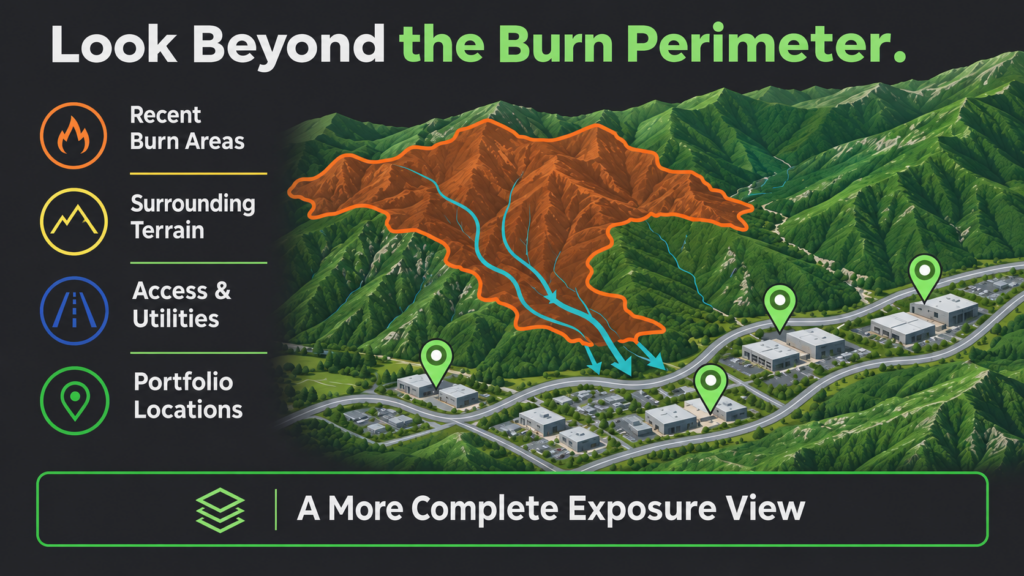
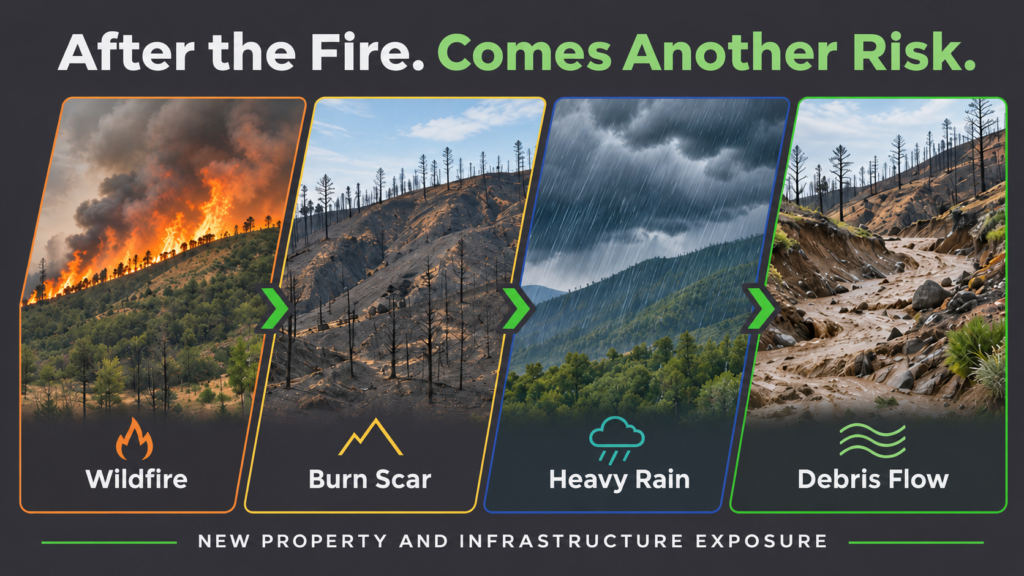
The story is residential and luxury in tone, but the mechanism applies to commercial portfolios. A wildfire loss is often not the end of the exposure. Burn scars, damaged infrastructure and weakened access change what the next storm can do.
How Property Guardian Helps: Property Guardian’s portfolio-level exposure and accumulation views help teams see which locations sit in or near recent burn areas, so compound-hazard planning starts before the rain does.
Wildfire risk is usually discussed as a summer and fall problem. This winter may be a reminder that a fire’s consequences can arrive months or years later, and in a different form. A recent Bloomberg report, republished by Insurance Journal on October 16, looks at Malibu as El Niño approaches. It is a vivid picture of compound risk, and it carries lessons well beyond beachfront homes.
What the Reporting Describes
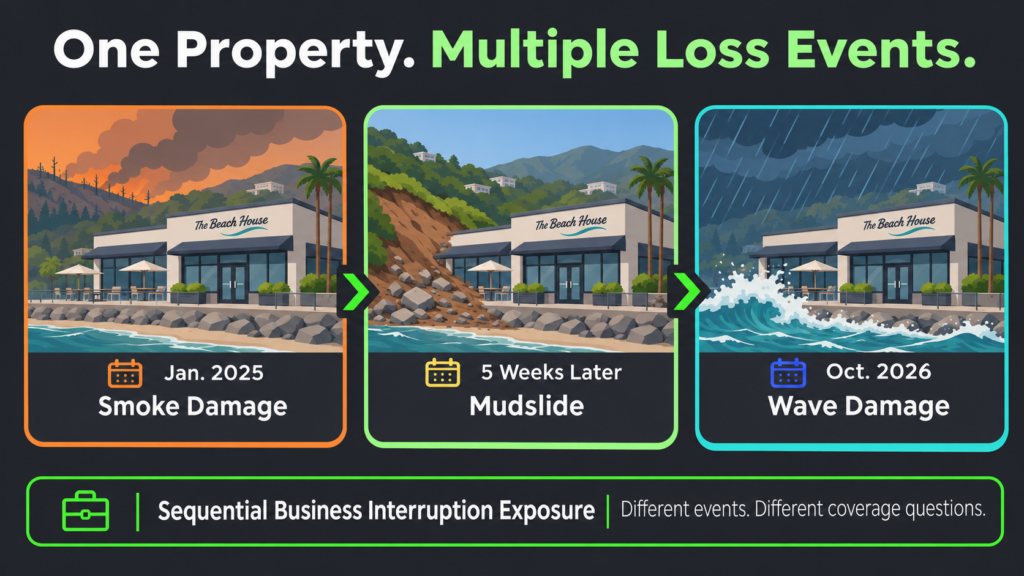
The Palisades Fire in January 2025 destroyed about 700 homes in Malibu. The article describes how one restaurant, Duke’s Malibu, survived the fire but was badly damaged by smoke, then was closed for 13 months after a mudslide five weeks later. In October 2026, waves broke through its windows and flooded the interior.
The article notes that the coming El Niño could rank among the strongest since the 1950s, and that Governor Gavin Newsom has declared a statewide emergency. NOAA oceanographer Billy Sweet describes the situation as decades worth of sea level rise in a month or two. UC Santa Cruz researcher Patrick Barnard says it is lining up to be a really significant winter for California.
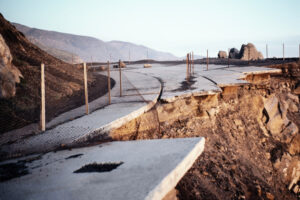
Erosion has already opened a sinkhole at a $10 million Malibu house. According to the report, it ruptured a gas line, compromised the neighborhood’s only access road and led to evacuation orders for 31 properties. The article also reports emergency repair costs, including a seawall repair above $80,000, with permanent repairs potentially reaching seven figures.
The market has noticed. Through September 2026, 19 single-family beachfront properties sold in Malibu at a median of $8.5 million, compared with 27 at a median of $13.5 million in the same period of 2024. Malibu’s population fell more than 9% in the year after the fire, to about 6,200, according to California Department of Finance estimates cited in the piece.
Why This Belongs in a Commercial Wildfire Conversation
The Malibu examples are mostly residential, and the coastal flooding element is specific to that shoreline. The underlying idea is not. A fire can change the ground, the vegetation, the drainage and the access routes around a property. Those changes persist after the smoke clears, and they alter how the next weather event plays out.
For commercial property, the same pattern shows up in several ways. A site that survived a fire may now sit below a burn scar. A building that was never damaged may depend on a road, a utility line or a water system that was. A tenant that reopened may be exposed to a second interruption within a year. The restaurant in the story is a clean illustration: smoke damage, then a mudslide, then wave damage, each producing its own period of closure.
That is a business interruption and contingent business interruption question as much as a physical damage question. Policy forms, waiting periods and sublimits respond differently to each event. A sequence of events that would look like one long recovery to an operator can look like several separate claims to a carrier.
Compound Hazards and Accumulation
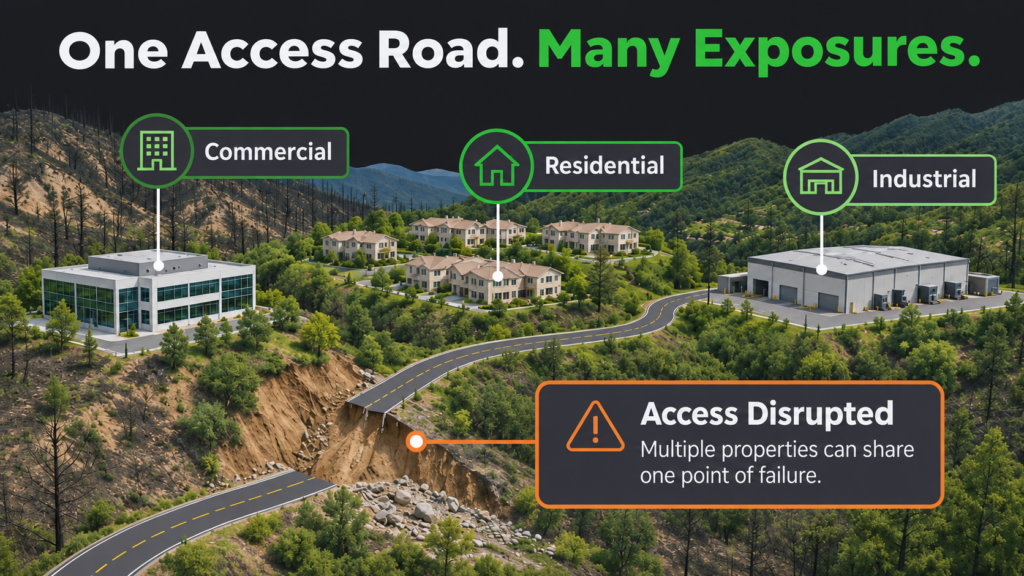
Accumulation is the other issue. Portfolios that were built to diversify away from wildfire may still hold concentrations in a single region that now faces storm, flood or debris flow risk on top of fire history. The access point in the report is telling. When a single road serves a neighborhood and that road is compromised, every property behind it shares the same operational problem, regardless of its individual condition.
This is not an argument that every burn-scar location is uninsurable, or that every El Niño winter produces major losses. Outcomes depend on rainfall, slope, soils and local drainage work. The practical point is narrower. Teams that identify which locations are exposed to this chain of events can plan for it. Teams that discover the connection after a storm cannot.
Practical Takeaways
- For underwriters: Identify locations in or downslope of recent burn areas, and confirm what the policy says about debris flow, flood and earth movement, which are often treated differently from fire.
- For underwriters: Look at access and utilities, not only the building. A single road or a single gas or water line can be the real point of failure.
- For corporate risk managers: Map locations against recent burn perimeters and ask site teams about drainage, erosion controls and emergency access before the wet season starts.
- For corporate risk managers: Review business interruption and contingent business interruption wording for sequential events, including how waiting periods and limits apply when a second event interrupts recovery from the first.
- For operators of insured properties: Document pre-storm condition, keep drainage and debris barriers maintained, and have a closure and reopening plan that assumes access may be limited.
- For brokers: Raise the question at renewal. Clients that were hit by a fire and rebuilt are often the ones least likely to be thinking about the next hazard.
The Season Ahead
The article also touches a longer horizon. It cites a 2019 USGS study finding that by the 2040s, 10 inches of sea level rise combined with an extreme storm could expose more than 150,000 California residents and over $30 billion in real estate to coastal flooding. That is outside the wildfire frame, but it underscores the broader point that hazards interact. Planning around one peril at a time leaves gaps.
Winter is when many teams relax on wildfire. The Malibu reporting is a useful prompt to use the quieter months to look at what the last fire season left behind.
Where Property Guardian Fits
Property Guardian helps commercial teams look at wildfire exposure across a portfolio, not just one address at a time. Portfolio-level exposure and accumulation views can show where locations cluster near recent burn areas or share a single access route, which is where compound-hazard planning starts. We would be glad to talk through how that looks for your footprint.