
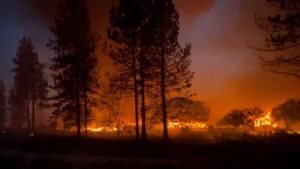
August 5, 2026 — On the afternoon of Saturday, August 1st, three separate wildfires broke out within hours of one another on the outskirts of Spokane, Washington. By the time the smoke settled over the weekend, more than 700 structures were gone, roughly 65,000 people had been ordered out of their homes, and officials were describing the event as one of the most destructive wildfires in the state’s history.
What makes the Spokane Complex worth studying is not its size. At roughly 8,000 acres it is modest by western U.S. standards. It is how fast a routine set of ingredients combined into a full-blown urban firestorm.
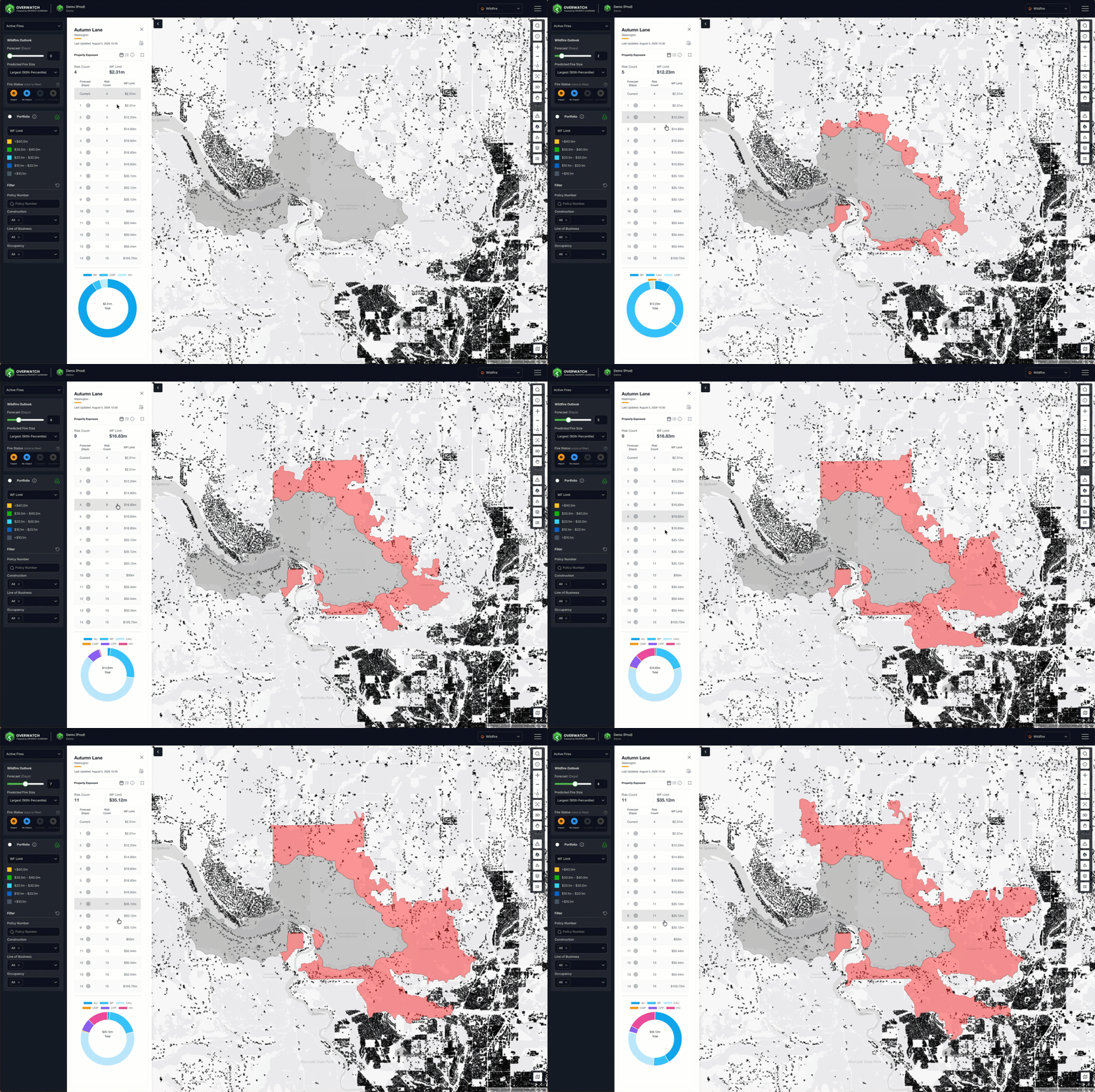
Timeline
The Old Trails Fire was reported first, just before noon Saturday near Old Trails and Euclid roads, north of Airway Heights. Driven by gusty winds and single-digit-to-low-20s humidity, it grew through the afternoon, jumped the Spokane River, and pushed into Riverside State Park and neighborhoods in northwest Spokane.
Within the same window two more fires ignited: the Autumn Lane Fire in the Nine Mile Falls area and the Fairview Fire near Mead and Peone Prairie.
By Monday, federal incident managers were tracking all three together as the Spokane Complex, with the fires largely uncontained and evacuation zones still expanding into Stevens County. Investigators have since arrested a suspect in connection with the Old Trails Fire on a first-degree arson charge; the causes of the Autumn Lane and Fairview fires remain under investigation.
Conditions Driving the Fire
This is where the Spokane Complex earns a closer look, because the meteorology explains everything about its behavior. A dry cold front swept through the region Saturday afternoon and stacked several hazards at once. Spokane’s airport recorded sustained winds near 33 mph gusting into the mid-40s, with some area reports of gusts as high as 50 mph. Temperatures sat around 86 degrees and relative humidity fell into the low 20s. Weather observers, including climate scientist Daniel Swain, tracked the dangerous wind shift moving across radar in real time as the fires expanded.
Those surface conditions were the trigger. The deeper cause was the fuel.
Eastern Washington entered the summer after a historic 2026 snow drought, with far below normal snowpack and an unusually warm winter. Snowpack normally acts as a slow-release reservoir well into early summer; without it, forests dried out weeks ahead of schedule and trees entered the season already water-stressed. At the same time, a wet spring had grown a heavy crop of grasses and light brush. Exposed to summer heat, that fine fuel cured into a continuous, highly flammable bed running right up to and through neighborhoods. Add a 40-plus mph wind, and any spark could travel from a grass field into a subdivision in minutes.
The Spokane Complex was not an anomaly for the week either; lightning and dry thunderstorms had ignited fires across the Northwest, part of a 2026 season that had already burned well above the ten-year average nationally by early August.
Human and Community Impact
The human toll was concentrated and fast.
Roughly 65,000 residents were placed under evacuation orders, many with little time to gather belongings, and more than 700 structures were destroyed across the three fires. Tens of thousands lost power. Smoke pushed Spokane’s air quality into the very unhealthy range, with an Air Quality Index reading above 200 on Sunday, at one point second-worst in the nation.
Spokane Mayor Lisa Brown called it the worst natural disaster the region has faced. Governor Bob Ferguson declared a state of emergency, issued a statewide burn ban, and requested federal assistance. That no deaths have been confirmed is a genuine credit to the speed and scale of the evacuation effort.
Historical Context
For anyone underwriting property in the Inland Northwest, the most sobering part is that this region has run this exact play before, and recently.
In August 2023, two fires burned the same landscape on a single red-flag day. The Gray Fire near Medical Lake destroyed roughly 240 structures and killed one person across about 10,000 acres. The Oregon Road Fire near Elk destroyed 384 structures, including 126 primary residences, and also claimed a life. Both were wind-driven interface fires that grew explosively under a warm, dry, gusty forecast.
Two years later, the Spokane Complex reassembled the same recipe of wind, drought-cured fuel, and homes built into the landscape, and produced a worse structural loss than either 2023 fire. The pattern is the point: this is a repeat exposure, not a freak event.
What This Means for the Industry
The Spokane Complex is a clean illustration of where static, annual risk scoring falls short. A parcel’s rating does not change when a cold front collides with cured grass in a wildland-urban interface, but its real-world probability of loss changes by the hour.
The properties that burned Saturday did not become riskier over a year; they became critically exposed over an afternoon. Underwriting and portfolio management increasingly need intelligence that operates on that same timescale: live heat detection, near-term weather, topography, and fuel condition, fused into a forward view of where a fire is actually likely to go.
That is precisely the problem Property Guardian’s Overwatch platform was built to solve, forecasting wildfire spread up to 14 days out so that carriers, MGAs, and their insureds can anticipate exposure rather than only respond to it.
Forward Look
The near-term signal is mixed.
Winds eased at the start of this week, giving crews their first real opening to build containment, and that is the good news. The bad news is the underlying setup has not changed. Heat is forecast to rebuild into the 80s and 90s midweek, afternoon humidity is expected to drop into the single digits, and there is no beneficial rain in sight.
Smoke and air-quality impacts will persist across eastern Washington regardless of fire growth. In other words, the conditions that produced this disaster are still loaded, and the same landscape remains primed.
The value of a forward-looking spread forecast is highest in exactly this window, when the fire is quieter but the ingredients for the next run are still on the board.
Sources
Washington State Department of Social and Health Services, Spokane Complex fires emergency updates (Aug. 2026).
KHQ / NonStop Local, Spokane Area Fires coverage and evacuation updates (Aug. 2-4, 2026).
CNN, Washington wildfires live coverage, Spokane County (Aug. 2-3, 2026).
NBC News, Washington state wildfires structure and evacuation totals (Aug. 3, 2026).
Yale Climate Connections, urban firestorm and dry-cold-front analysis (Aug. 2026).
The Conversation, why the Spokane wildfires became so catastrophic: snow drought and soil moisture (Aug. 3, 2026).
AccuWeather, weather-fueled Spokane wildfires and arson arrest (Aug. 2026).
Wikipedia, Gray Fire (2023) and Oregon Fire (2023) incident summaries.
