


• Skip to main content
  • Skip to header right navigation
  • Skip to site footer
Property Guardian

Property Guardian

  • About Us
    • About Us
    • Our Team
    • Our Partners
  • Solutions
        • Underwriting

        • Large Commercial Property
        • Specialty Lines
        • High-Volume & Transactional Property
        • Ultra-High Net Worth Homeowners
        • Loss Control & Risk Management

        • Loss Control Teams
        • Insurance Brokers
        • Corporate Risk Management
        • Wildfire Risk Mitigation & Response Vendors
        • Property Inspection Companies
        • CAT Modeling & Reinsurance
  • Products
        • Wildfire Risk Assessment

        • Wildfire Susceptibility Scores
        • Wildfire Resiliency Score
        • Canadian Wildfire Risk Score + Insights
        • Wildfire Risk Insight Reports
        • Wildfire Risk Mitigation

        • Wildfire Risk Insight Reports
        • Field Insights
        • Active Wildfire Intelligence

        • Overwatch
        • Wildfire Moratorium Insights
  • Resources
    • Brochures
    • White Papers & Case Studies
    • Videos
    • Preferred Vendors
  • News
  • Contact Us
    • Contact Us
    • Support
  • Active Wildfires
  • LinkedIn
  • YouTube
  • LinkedIn
  • YouTube
Active Wildfires
A modern glass building with wavy, curved lines reflecting the blue sky, viewed from below against a clear background reminiscent of wildfire’s unpredictable, flowing movement.

Reinsurance Rates Are Still Falling for 2027, But the Fine Print Is Getting Tighter

Green outline of a light bulb with a gear inside it, symbolizing innovation or technical ideas. Radiating lines suggest illumination or creativity spreading rapidly, like a wildfire.
The Quick Read

S&P’s latest outlook, published September 6, 2026, projects that property catastrophe reinsurance pricing will keep softening into the January 2027 renewal season, potentially by margins similar to 2026. The driver is familiar: reinsurers are sitting on more capital than they can deploy at prior pricing, and that weight keeps pushing rates down. What is less familiar, and more consequential for commercial property teams, is S&P’s warning that the same abundance of capital is now pressuring terms and conditions, including coverage provisions and attachment points, even as headline rates decline.

For wildfire-exposed commercial property portfolios, a softer number on the reinsurance side has rarely translated cleanly into easier renewals at the individual risk level, and this outlook suggests the gap may widen rather than close. Falling price and tightening terms can move in the same direction at once, and property teams that only track the headline rate risk missing the part of the renewal that actually determines what is covered.

How Property Guardian Helps: Our portfolio-level exposure and accumulation views give risk managers the granular, property-specific data that carriers increasingly want to see before they loosen attachment points or broaden coverage provisions, turning a defensive renewal conversation into an evidence-backed negotiation.
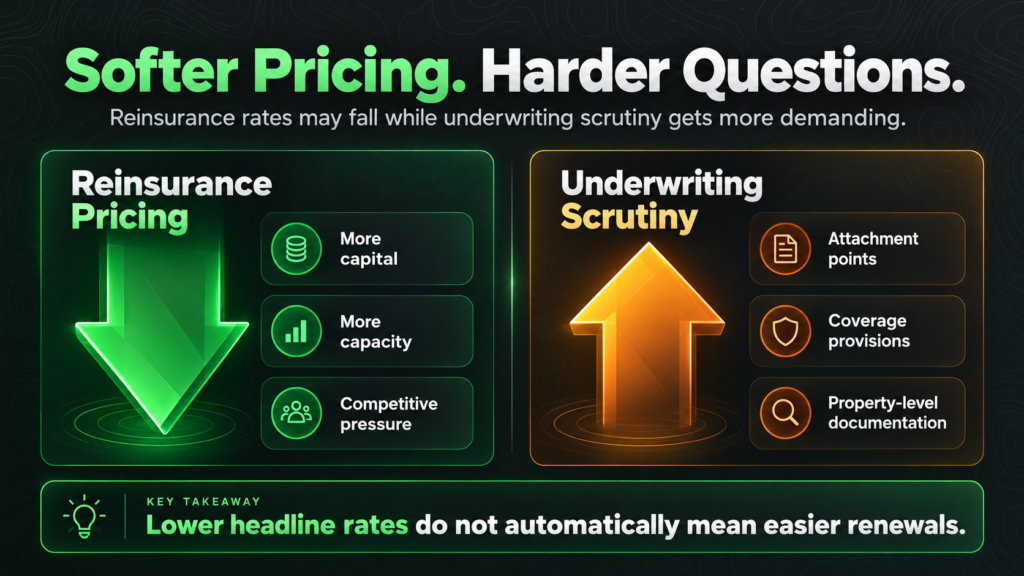
Infographic contrasts reinsurance pricing (more capital, capacity, pressure) with stricter underwriting scrutiny (higher attachment points, tighter coverage, more property and wildfire risk checks). Key: Lower headline rates don’t mean easier renewals.

The reinsurance market’s basic shape has been consistent for two straight renewal cycles now. Capital keeps flowing in, from both traditional reinsurers and alternative sources like catastrophe bonds, and that capital is chasing a shrinking number of attractive placements. S&P’s September report reaffirms that trend heading into 2027, noting that reinsurance and retrocession capacity continued to expand through 2025 and into 2026. Basic economics says that much supply should keep pushing price down, and S&P expects it will, provided catastrophe losses stay within reinsurers’ annual budgets.

The twist worth sitting with is what S&P says happens to terms and conditions in that same environment. Ample capacity does not just compress price. It also gives reinsurers less leverage to hold the line on the structural details of a treaty, things like where a layer attaches, what triggers coverage, and how broadly a policy defines a covered peril. S&P’s language is direct: ample reinsurance and retrocession capacity is likely to exert additional pressure on terms and conditions, including coverage provisions and attachment points. In plain terms, brokers and cedents are gaining negotiating room not just on what they pay, but on what they buy, and that pressure runs in the opposite direction from what a wildfire-exposed portfolio actually needs.
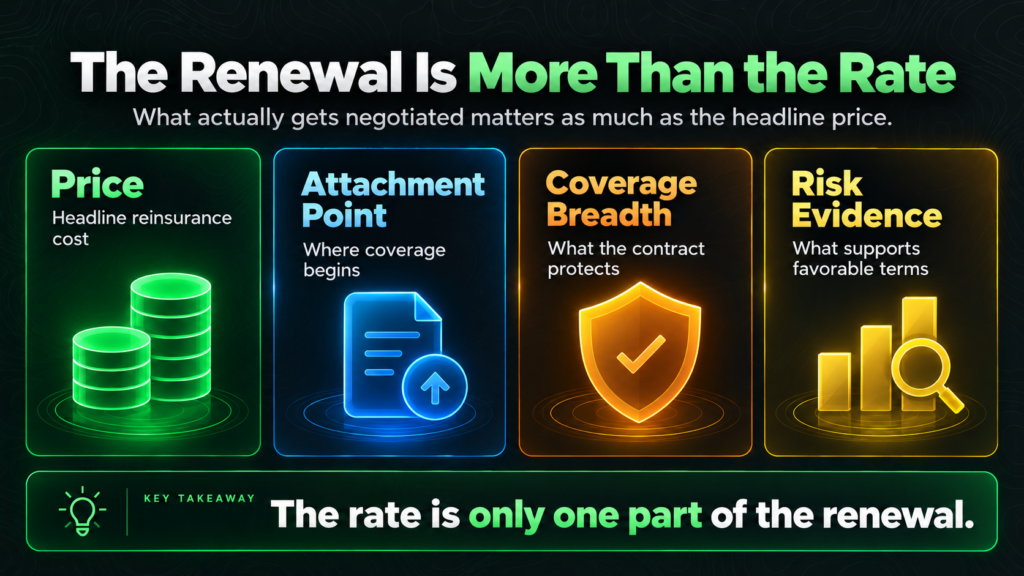
Infographic showing four insurance terms: Price, Attachment Point, Coverage Breadth, and Risk Evidence. The visual highlights how factors like wildfire exposure can impact each of these terms. Key takeaway emphasizes that the rate is only one part of the renewal process.

This is not a story about reinsurers losing discipline. S&P is explicit that underwriting discipline and contract structure remain stronger than in prior soft-market cycles, and that reinsurers are still expected to earn returns above their cost of capital. It is a story about where that discipline gets applied. A market with more capital than compelling opportunities tends to compete on the terms that are easiest to give ground on before it competes on the fundamentals that actually govern catastrophe exposure, and attachment points sit uncomfortably close to that line.

Why the Trickle-Down Problem Gets Sharper, Not Simpler

Commercial property teams with wildfire exposure have spent the past two renewal cycles learning that softer headline reinsurance pricing does not automatically show up as a lower premium or easier terms at the individual risk level. Capital does not move evenly from the top of the reinsurance tower down to a specific property in a specific wildfire-prone zip code. Primary carriers still underwrite each risk on its own merits, and a soft macro market has tended to benefit portfolios and geographies that already carry a favorable loss history far more than it benefits individually exposed properties.
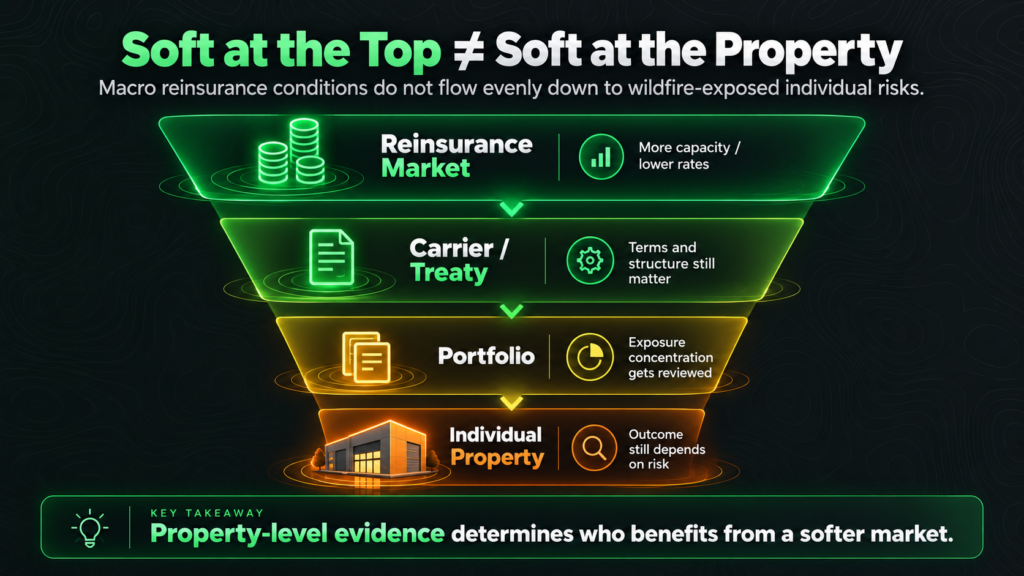
Four glowing funnels labeled Reinsurance Market, Carrier/Treaty, Portfolio, and Individual Property show how macro reinsurance conditions affect each level, highlighting that softer markets don’t evenly benefit wildfire-exposed properties impacted by wildfire risk.

S&P’s outlook adds a new layer to that dynamic rather than resolving it. If terms and conditions pressure is building at the reinsurance level even as price falls, primary carriers are absorbing a more complicated set of signals at their own renewals: cheaper reinsurance capacity, but potentially less favorable structural terms behind it, layered on top of loss experience that, for wildfire risk specifically, has not meaningfully improved. Carriers navigating that combination have every incentive to push the underwriting burden further down the chain, asking individual commercial property owners for more granular risk data, more documented mitigation evidence, and more justification for favorable attachment points and coverage breadth at their own renewal.
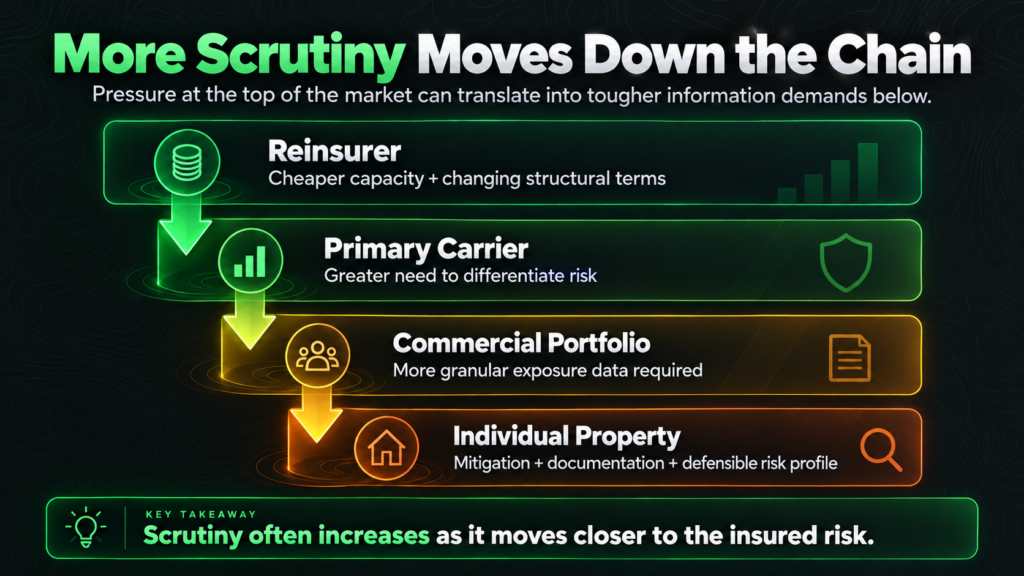
Infographic showing a chain from reinsurer to individual property, illustrating how scrutiny increases down the chain with colored boxes, arrows, and a key takeaway highlighting increased demands—especially in wildfire-prone areas—as you get closer to insurance holders.

For a risk manager overseeing a multi-property commercial portfolio, that means the 2027 renewal conversation is unlikely to be a simple “rates are softening” discussion, even if that is the headline your broker opens with. The properties that come out ahead will be the ones that can demonstrate, with real data rather than general geography, why their specific risk profile deserves the benefit of a softening market rather than getting caught in the terms-and-conditions squeeze S&P is describing.

Practical Takeaways for Commercial Property Teams

Start the renewal conversation earlier than the headline market commentary suggests you need to. If terms and conditions are the real battleground this cycle rather than price alone, the properties with documentation ready in September and October are better positioned than those scrambling in November. Push your broker for specifics on how attachment points and coverage provisions are trending for your particular asset class and geography, not just the aggregate market commentary, since S&P’s report makes clear that the aggregate and the individual outcome can diverge. And treat mitigation and exposure documentation as leverage rather than paperwork. In a market where carriers have more room to negotiate on structural terms, a portfolio that can prove a lower effective risk profile than its raw geography suggests has a real, usable argument at the table.
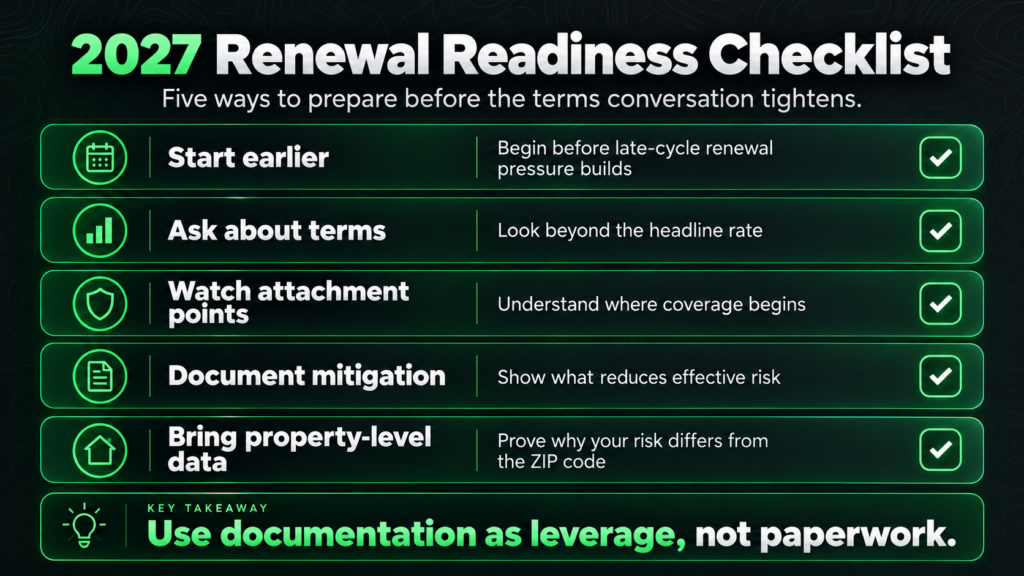
2027 Renewal Readiness Checklist with five steps and brief explanations, all checked off. The process is streamlined, ensuring your wildfire preparedness is up to standard for the upcoming cycle. Key takeaway at the bottom: “Use documentation as leverage, not paperwork.” Green and black color scheme.

None of this requires predicting exactly where reinsurance pricing lands in January. It requires recognizing that a softening headline number and a harder underwriting conversation can happen at the same time, and preparing your data accordingly. Property Guardian’s portfolio-level exposure and accumulation views exist for exactly this moment: turning general geographic risk into the kind of specific, defensible data that helps a commercial property team hold its ground on coverage terms even when the broader market is negotiating capacity, not certainty.


Sources

Reinsurance price softening to continue in 2027, with rising pressure on terms: S&P, Artemis.bm.

Share this post:
Category: Blog
A man with short brown hair and a beard is smiling, wearing a light gray suit with a white shirt and a dark polka dot tie. The background is plain white.

About Brian Bastian

Brian Bastian, Head of Product for Property Guardian, is a seasoned product leader and catastrophe risk management professional with deep expertise in wildfire risk solutions and enterprise SaaS development. As a key driver at Green Shield Risk Solutions, Brian has spearheaded the creation of the Property Guardian platform, delivering cutting-edge tools for superior risk selection, portfolio management, and active loss control. With a foundation built at industry leaders like Guy Carpenter and JLT Re, Brian brings a proven track record of transforming complex risk analytics into actionable insights that enhance resilience and drive value for clients. Passionate about innovation and collaboration, Brian also serves on the board of the International Society of Catastrophe Managers, where he champions technology advancements in catastrophe risk management.

Sidebar

Recent Posts

  • Reinsurance Rates Are Still Falling for 2027, But the Fine Print Is Getting Tighter
  • California’s New Smoke Damage Standards Put Insurers on the Clock, and Commercial Property Teams Should Pay Attention
  • U.S. Wildfire Outlook: September 29 to October 12, 2026
  • Canada’s Insurers Want a Shift From Recovery to Resilience: What That Means Across Every Line of Business
  • The Season Is Not Over: Why the Fall Fire Outlook Should Reshape Portfolio Thinking

Categories

Stay in the Know!

Stay connected with the Property Guardian team! Subscribe to get the latest updates on product launches, feature enhancements, wildfire news, expert mitigation tips, and much more. Don’t miss out on the insights that matter most!

Our Latest Posts

A modern glass building with wavy, curved lines reflecting the blue sky, viewed from below against a clear background reminiscent of wildfire’s unpredictable, flowing movement.
Category: Blog

Reinsurance Rates Are Still Falling for 2027, But the Fine Print Is Getting Tighter

Cars cross the Golden Gate Bridge under an orange sky caused by wildfire smoke, with fog partially obscuring the towers and hills visible in the background.
Category: Blog

California’s New Smoke Damage Standards Put Insurers on the Clock, and Commercial Property Teams Should Pay Attention

A ferocious wildfire spreads through a dense forest, engulfing trees and ground in bright orange flames, with smoke rising into the air and sunlight filtering through the trees.
Category: Active Wildfires

U.S. Wildfire Outlook: September 29 to October 12, 2026

Ready to Get Started?

Let us guide you through a personalized demo and create a customized solution that perfectly aligns with your needs. Protect what matters most with a solution built for you.

contact us

Stay in the Know!

Stay connected with the Property Guardian team! Subscribe to get the latest updates on product launches, feature enhancements, wildfire news, expert mitigation tips, and much more. Don’t miss out on the insights that matter most!

Home

About Us

Our Team

Partners

Contact Us

News

Active Wildfires

All Products

Resources

Brochures

White Papers & Case Studies

Videos

Preferred Vendors

  • LinkedIn
  • YouTube
A green hexagon logo with a shield and cityscape design, next to the text “PROPERTY GUARDIAN” and below it, “A Green Shield Company” on a light gray background.

Headquarters:
2551 N Clark St., Suite 302
Chicago, IL 60614

Copyright © 2026 · Property Guardian · All Rights Reserved · Terms of Use · Privacy Policy· Trust Center

By using this website, you agree to our use of cookies. We use cookies to provide you with a great experience and to help our website run effectively. To find out more, please read our Privacy Policy.