

The Quick Read
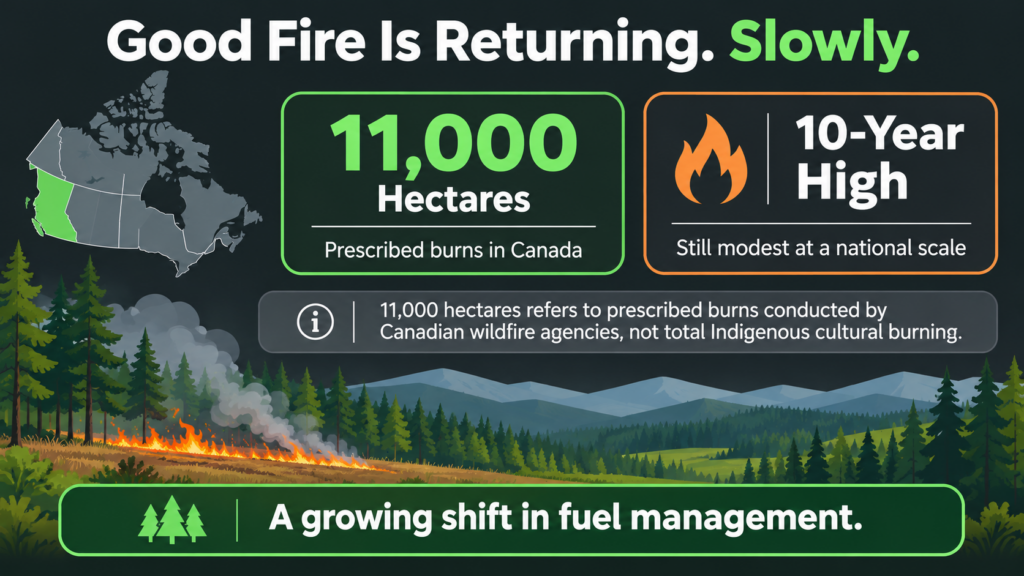
Canadian wildfire agencies set prescribed fires across roughly 11,000 hectares (about 110 square kilometres) in the past year, the highest total in a decade according to the Canadian Interagency Forest Fire Centre, as reported by The Canadian Press on November 9. Ontario now lets Indigenous communities carry out cultural burns without a permit if the province is notified in advance, and British Columbia relaxed its own fire legislation in 2023.
The shift matters because federal research scientists have found that parts of Canada’s forests are in a “fire deficit,” burning far less than they did historically and leaving fuels to build up near communities. For personal lines and commercial underwriters, reinsurers and cat modellers, the slow return of controlled fire is a real change to the fuel picture that hazard scores and portfolio views will need to keep pace with.
How Property Guardian Helps: Our Canadian Wildfire Risk Score + Insights models Fire Spread at 30-metre resolution alongside Fire Intensity and Wildfire Recurrence, giving underwriters a location-level read on how fuels and fire history shape exposure, not just whether a property sits near the forest edge.
Canada’s 2026 wildfire season was tracking as the fourth-worst on record by area burned as of mid-August, and British Columbia wildfires alone generated an estimated $550 million in insured losses over the summer. As the season winds down and the industry turns to 2027, one of the most promising tools for reducing future losses is also one of the oldest: fire itself.
A Canadian Press feature published on November 9 traced a growing movement among Indigenous fire keepers, researchers and provincial agencies to bring low-intensity, controlled burning back to Canadian landscapes. It is not a headline about a single event or a new loss number. It is a signal that the fuel conditions underneath Canada’s wildfire risk are starting, slowly, to be managed differently. That is worth the attention of anyone who prices, accumulates or transfers wildfire risk in this country.
What Is Changing
For more than a century, Canadian fire policy was built around near-total suppression. The Canadian Press notes that suppression efforts date back as far as 1610 in Newfoundland, and that Indigenous burning practices were outlawed for generations. Today that is shifting. Ontario has relaxed its rules so Indigenous communities no longer need a fire permit for cultural burns, provided the provincial ministry is notified in advance. British Columbia relaxed its fire legislation in 2023, and the BC Wildfire Service has partnered with several First Nations on cultural burns. A recent Senate report on Canada’s wildfire crisis recommended more federal support for Indigenous-led fire management.
The scale is growing, but it is still modest. According to CIFFC figures cited in the article, Canadian wildfire agencies conducted prescribed fires on about 110 square kilometres (roughly 11,000 hectares) this past year, mostly in British Columbia. That is the highest annual total in a decade, yet it is a small fraction of what is burned each year by wildfire, and far below the prescribed fire programs run in the United States.
Amy Cardinal Christianson, director of fire stewardship at the Indigenous Leadership Initiative and a former Canadian Forest Service research scientist, put the underlying problem plainly: “a fire put out is just a fire deferred.” She also noted that liability fears and past accidents have made Canada risk-averse about prescribed fire, which is one reason the practice has been slow to scale.
The Science: Fuel, Deficit & Intensity
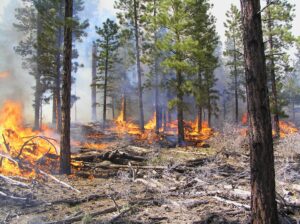
The case for controlled fire rests on fuel. Low, patchy burns conducted outside peak season remove dead brush and surface fuels that would otherwise feed a more intense wildfire later. A peer-reviewed study co-authored by federal research scientists found that parts of Canada’s forests are in a fire deficit, meaning they are burning far less than they did historically. When fire is excluded for decades, fuels accumulate, and the eventual wildfire tends to burn hotter and spread faster.
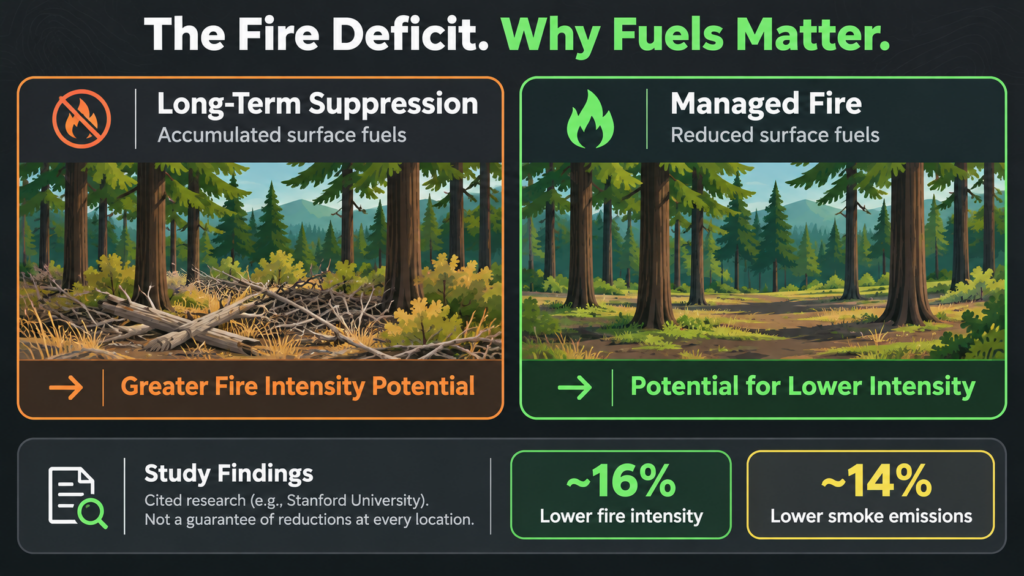
The evidence on outcomes is encouraging. The Canadian Press cites a Stanford University study linking controlled burns to roughly a 16% reduction in fire intensity and a 14% reduction in smoke emissions, and research from northern Australia connecting Indigenous-led burning to fewer and less severe bushfires. Lower intensity matters for insured losses because it changes how much heat and how many embers reach structures, and how quickly a fire can move from wildland fuels into a community.
It is important to be measured about what this means. Fuel treatments are local and time-limited. A treated area can regrow within years, burn windows are narrow, and many communities, especially remote First Nations, lack the funding and crews to plan and carry out burns. A decade-high total of about 11,000 hectares does not offset seasons that burn millions of hectares. The right takeaway is not that the risk is falling. It is that fuel conditions around specific communities are becoming more variable, and that variability is something risk assessment should be able to see.
Why This Matters to Insurance & Risk Professionals
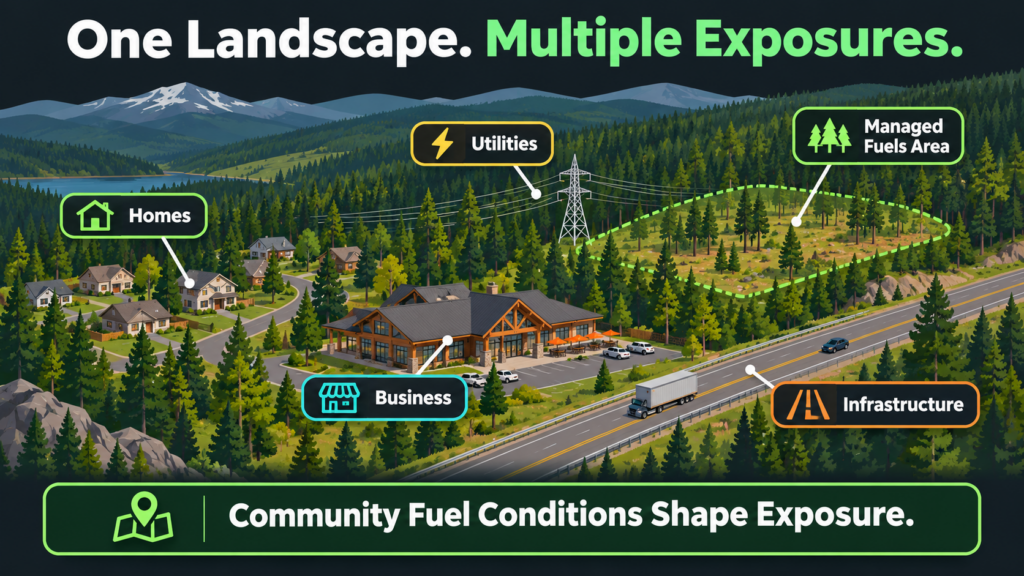
Wildfire losses are driven by where fire meets insured property, not by total area burned. The communities the article highlights, such as Merritt and the Nicola Valley in interior British Columbia, sit in exactly the kind of interface landscape where fuel condition in the surrounding few kilometres shapes fire intensity and ember exposure. The article references Lytton and Summerland as recent examples of destructive fires in the region. Leona Antoine, who chairs the Salish Firekeepers Society, has been displaced twice by wildfire in the last five years, and her field is bordered by a highway and crossed by the Trans Mountain pipeline. That is a reminder that the same fuels threaten homes, businesses and critical infrastructure at once.
There is also a protection gap dimension. Indigenous people make up about 5% of Canada’s population but account for 42% of wildfire-related evacuations. Many of these communities are remote, with limited insurance penetration and concentrated exposure for the commercial operations that serve them. For the industry, supporting community-level mitigation is not only good citizenship. It is one of the few levers that reduces the hazard itself rather than simply pricing it.
Practical Takeaways
- Personal lines underwriters and product leaders: Treat community-level fuel management as a real but local variable. Ask whether your hazard data reflects recent fire and fuel history, and remember that landscape treatments complement, but do not replace, structure-level FireSmart measures and defensible space.
- Commercial property and specialty underwriters: For interface risks such as lodges, resorts, forestry operations, energy assets and linear infrastructure, ask clients whether adjacent lands are under a fuel management plan or a partnership with a First Nation or provincial wildfire agency. Documented treatments are useful underwriting information.
- Brokers: Help clients tell the mitigation story. Community burn programs, FireSmart neighbourhood recognition and documented fuel work can strengthen a submission in a market where Aon reports underwriters are focusing on data quality and mitigation.
- Reinsurers and cat modellers: Fuel state is not static. If prescribed and cultural burning keep scaling, intensity distributions in treated regions could shift over a decade. Watch the data, but do not get ahead of it at today’s scale.
- Liability and specialty markets: Christianson’s comment about liability fears points to a gap. As burning expands, practitioners and land managers will need coverage solutions, and the specialty market has a role to play in making responsible controlled fire insurable.
Looking Ahead
The return of good fire will not change Canada’s wildfire picture overnight. What it does is introduce more variation, community by community, in the fuel conditions that drive intensity and ember exposure. Underwriting that treats every property near the forest edge the same way will miss that variation in both directions.
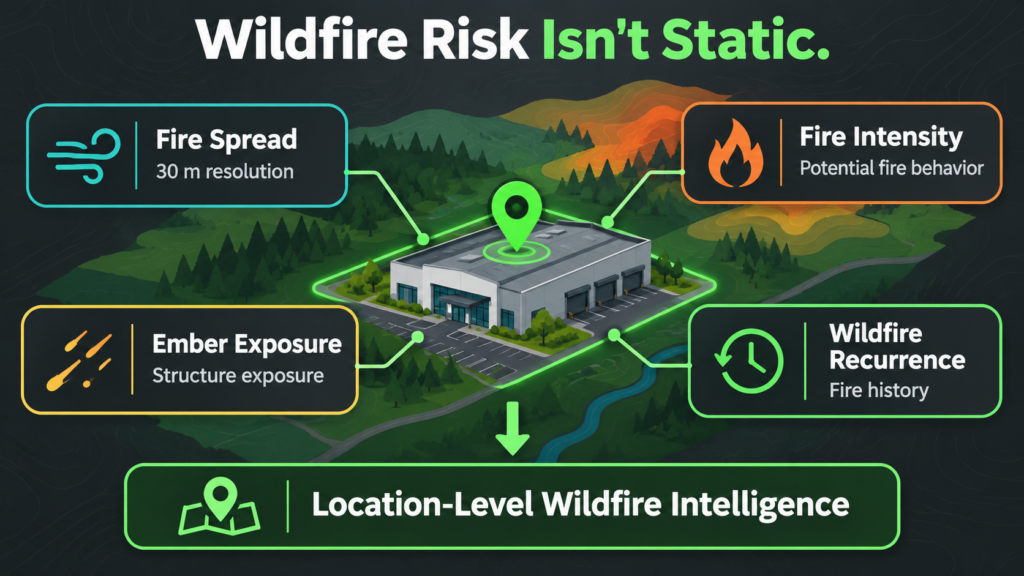
That is where location-level analytics earn their keep. Property Guardian’s Canadian Wildfire Risk Score + Insights brings together Fire Spread, modelled at 30-metre resolution, with Fire Intensity, Ember Exposure and Wildfire Recurrence, so underwriting, portfolio and risk teams can see how fuels and fire history actually shape a property’s exposure. As Canada’s fuel landscape starts to change, that kind of granular view helps insurers reward real risk reduction where it happens.
Sources
CP24, “Wildfire season tracking to be 4th worst on record” (August 18, 2026).
