
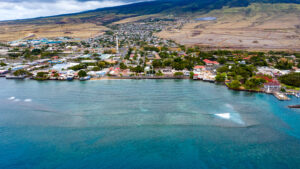
On the morning of August 8, 2023, Lahaina was a working town of roughly 13,000 people, a former whaling port and royal capital of the Hawaiian Kingdom, wedged between the West Maui Mountains and the sea. By nightfall, most of it was gone. The fire that swept through it killed 102 people, making it the deadliest U.S. wildfire in more than a century and the worst natural disaster in Hawaii’s history.
Today, marking three years after the fire, we’re reflecting on the factors that contributed to it, what happened during the event, and what we’ve learned as a result. For those whose job it is to understand the intricate details of wildfire risk, these lessons are important. The conditions that made Lahaina possible were decades in the making, and they did not burn away with the town.
A Century in the Making: Wildfire in the Hawaiian Islands
It is tempting to think of wildfire only as a mainland problem, a hazard of California chaparral or the drought-stricken interior West. Hawaii, with its rainforests and trade winds, rarely enters the conversation. That instinct is exactly what made Lahaina so catastrophic, and it was wrong long before 2023.
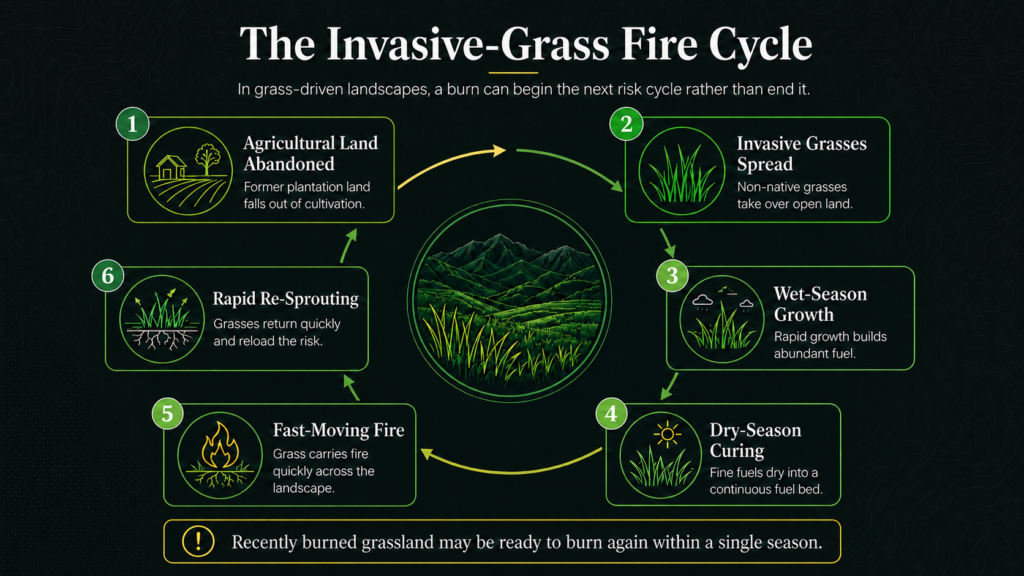
Hawaii’s fire problem is largely man-made, and it accelerated over the last century. Researchers found that the average area burned in Hawaii has increased roughly 400% over the past hundred years, a trend driven not by lightning or natural fuels but by land-use change. As the plantation economy collapsed (the last sugar operation closed in 2016, the final pineapple plantation in 2009), hundreds of thousands of acres of once-cultivated land fell fallow. Into that vacuum rushed non-native, fire-adapted grasses.
Species like guinea grass, buffel grass, and molasses grass now blanket close to a quarter of the state’s land area. They grow explosively in the wet season, then cure into a continuous carpet of fine, flashy fuel in the dry months. Guinea grass can grow several inches a day and reach heights well over a person’s head. When it dries, it becomes one of the most efficient fire carriers imaginable: igniting easily, spreading fast, and re-sprouting quickly after a burn to feed the next one. This is the invasive-grass fire cycle, and West Maui, with its leeward rain shadow and abandoned agricultural land above town, was a textbook setting for it.
Lahaina had burned before. Brush fires scorched the hills above town in 2018 and in prior years, and local officials had been warned repeatedly about the fuel load building on the fallow lands upslope. The ingredients were all in place: dry invasive grass, a drought-prone leeward location, an aging utility grid, and a dense historic town at the bottom of the slope. What was missing was the trigger and the wind.
August 8, 2023: A Timeline of the Lahaina Fire
The weather that week unfortunately supplied both of the factors needed to start a fire.
Hurricane Dora was tracking far to the south of the Islands, while a strong high-pressure system sat to the north. The steep pressure gradient between them funneled powerful, dry downslope winds across Maui, gusts of 60 to 90 mph, strong enough to tear off roofs, and, critically, down power lines.
Early morning, ignition. At around 6:30 a.m. HST, a fire broke out in unmaintained vegetation off Lahainaluna Road, near a utility pole later identified in the official investigation. Crews responded and, by mid-morning, believed they had contained and extinguished the blaze. For several hours there were no visible flames, no smoke, and no obviously combusting material.
Early afternoon, reignition. The prevailing conclusion of investigators is that a piece of smoldering material was carried by the extreme winds into a nearby gully, where it rekindled. By roughly 3:00 p.m., a fast-moving fire was again running through the dry grass toward town, pushed by gusts that made aerial suppression impossible and ground attack nearly futile.
Mid-to-late afternoon, the town. At about 4:45 p.m. the fire crossed Honoapiʻilani Highway and entered the heart of Lahaina. Residents self-evacuated with little or no official warning into gridlocked streets hemmed in by fire on one side and the ocean on the other. By 5:45 p.m. the fire had reached the shoreline. Some residents survived only by going into the water, where they waited for hours amid smoke and debris.
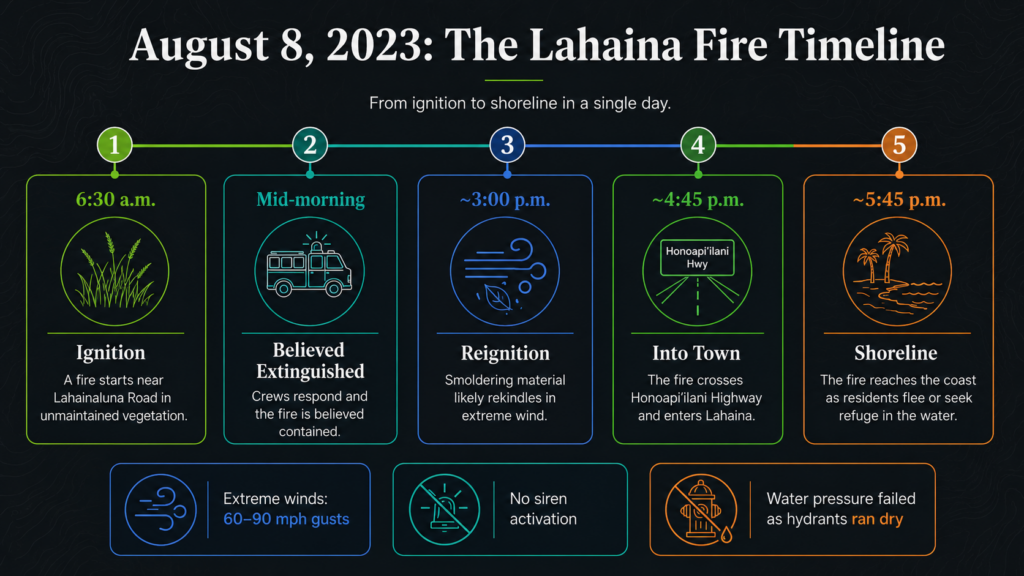
Two failures compounded the speed of the fire. Hawaii operates one of the largest outdoor siren warning networks in the world, with more than 80 sirens on Maui alone, but they were not activated, and many residents said they received no timely alert. And as the fire consumed homes, melting service pipes bled pressure out of the municipal water system, leaving hydrants running dry just as firefighters most needed them. Both of these factors turned a fast fire into a mass-casualty event.
What Went Wrong: Cause and Contributing Conditions
In October 2024, the Maui Fire Department and the U.S. Bureau of Alcohol, Tobacco, Firearms and Explosives released their joint origin-and-cause report. Their conclusion: the Lahaina fire was a single fire with a single origin, classified as accidental, caused by the re-energization of broken electrical lines. Molten metallic material (sparks) ejected from the downed conductors ignited the unmaintained vegetation below. The investigation described a single event that proceeded in two phases: the morning fire that was believed extinguished, and the afternoon fire that grew from smoldering remnants.
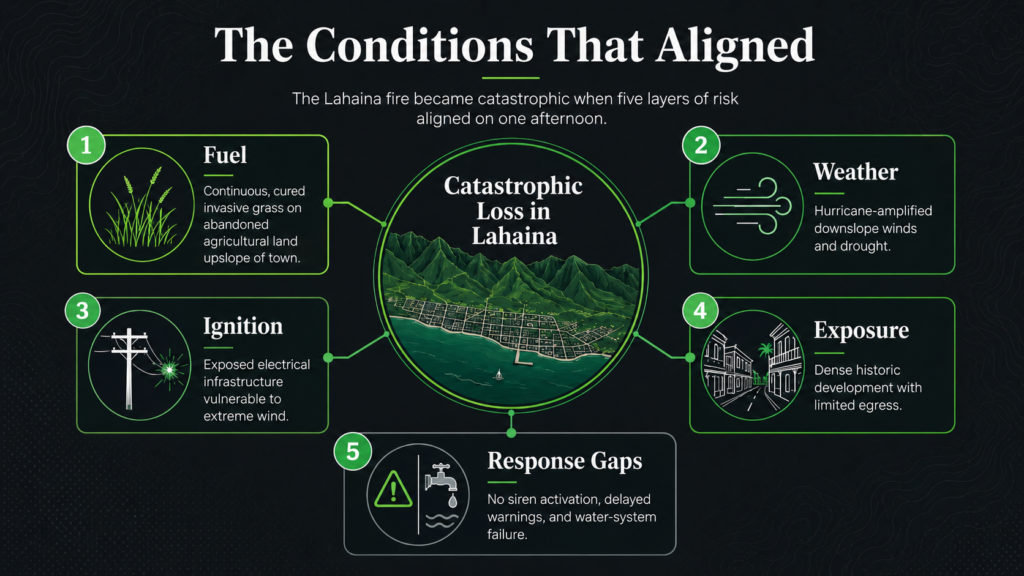
Hawaiian Electric acknowledged that its equipment was involved in the morning ignition while noting the utility’s position on the sequence of events. But the deeper causation is what matters for risk professionals, and it is not reducible to a single spark. Lahaina burned the way it did because of a stack of conditions that had been building for decades:
- Fuel: Continuous, cured invasive grass on abandoned agricultural land directly upslope of a dense town.
- Weather: Hurricane-amplified downslope winds gusting to destructive speeds during a regional drought.
- Ignition: An aging, exposed utility grid vulnerable to exactly those winds.
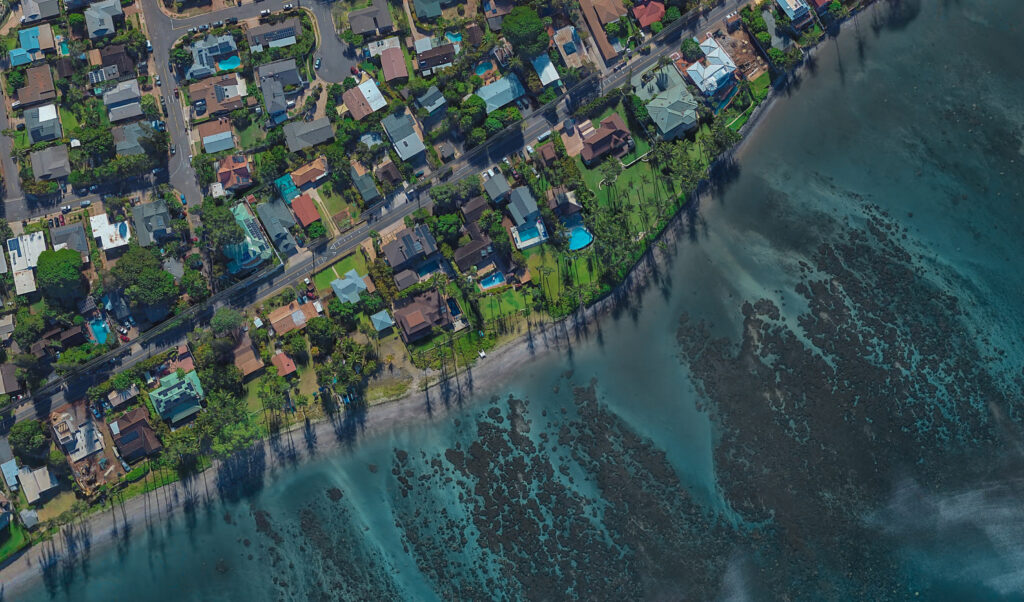
- Exposure: A historic wooden town, built long before modern wildfire codes, packed into a wildland-urban interface with limited egress.
- Response Gaps: Un-activated sirens, delayed warnings, and a water system that lost pressure at the worst moment.
No single one of these was unique to Lahaina. What was rare, and what every risk model should reckon with, was how completely they aligned on one afternoon.
The Toll
The loss of life was staggering. 102 people died, making this the fifth-deadliest wildfire in U.S. history and the deadliest in the country since 1918.
The physical and financial toll was also devastating. More than 2,200 structures were damaged or destroyed and roughly 2,170 acres burned, a small footprint by mainland standards, but almost entirely within a built-up town, which is why the destruction was so total. About 86% of the buildings exposed were residential. The U.S. Department of Commerce put the damage at $5.5 billion. Insured losses alone exceeded $3 billion. In 2024, Governor Josh Green announced a roughly $4 billion global settlement to resolve the hundreds of lawsuits that followed.
Behind those figures is a town that has been slow to return. Rebuilding a single destroyed home on Maui has averaged around $1 million, and federal recovery programs have committed well over a billion dollars, yet three years later, much of Lahaina remains a construction site rather than a community.
The Reckoning: Response, Reform, and the Insurance Market
The response to Lahaina has unfolded on two tracks: government reform and market reaction. Both are still in motion.
Policy and preparedness reform
Hawaii’s Attorney General commissioned an independent analysis by the Fire Safety Research Institute, whose multi-phase reports produced a comprehensive timeline and, ultimately, dozens of findings and well over a hundred recommendations for state and county leaders. Among the highest priorities: standing up an Office of the State Fire Marshal, a position Hawaii had long lacked, and closing the gaps in warning systems, evacuation planning, water infrastructure, and vegetation management that the fire exposed. The state has also moved to strengthen disaster-related consumer protections through new legislation.
A hardening insurance market
For the risk and insurance industry, Lahaina was a repricing event. It pushed Hawaii, already a hurricane-exposed market, firmly into the high-risk category, and it arrived just as national reinsurance costs were climbing sharply. The results have been severe, particularly in Hawaii’s condominium-heavy market:
- Some condominium associations have reported master-policy premium increases of 300%, 500%, or in extreme cases more than 1,000%.
- Single-family homeowners have faced increases ranging from roughly 30% to over 100%, in some cases thousands of dollars a year.
- Hundreds of condo buildings have been left underinsured, and some projects have struggled to obtain coverage at all, especially older buildings lacking sprinklers or with aging pipes.
Insurability increasingly follows mitigation. Properties that invest in fire-hardening and resilience are the ones most likely to keep, and afford, coverage.
The state responded in 2025 with comprehensive legislation reactivating and expanding the roles of state-backed entities such as the Hawaii Hurricane Relief Fund and the Hawaii Property Insurance Association, and creating financing programs to help buildings fund the repairs and safety upgrades that make them insurable in the first place. The through-line of that policy is important: insurability increasingly follows mitigation. Properties that invest in fire-hardening and resilience are the ones most likely to keep, and afford, coverage.
How Lahaina Changed the Way We Think About Wildfire Risk
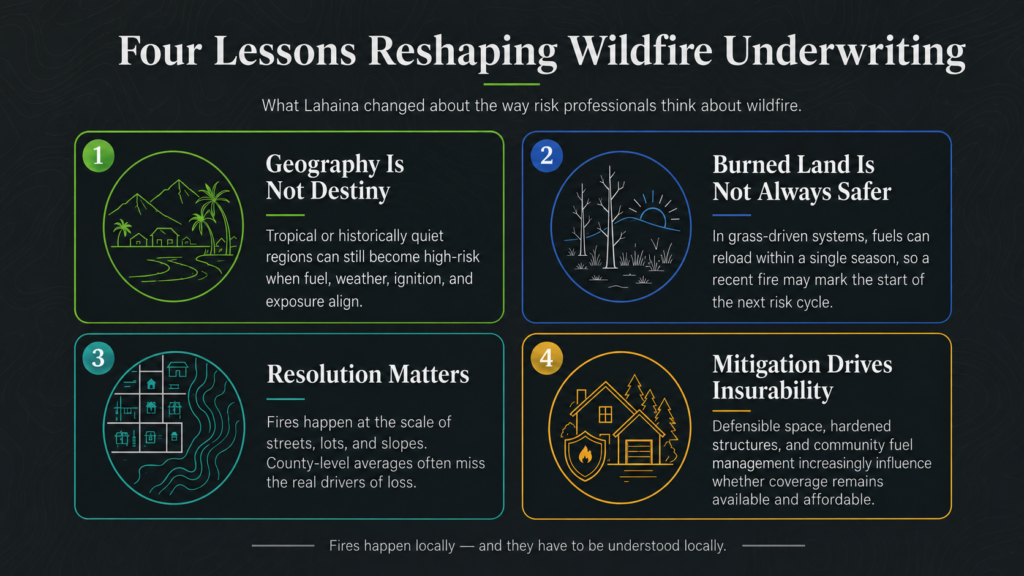
Every major disaster teaches something. Lahaina’s lessons are unusually clear, and they cut against several assumptions that were baked into how wildfire risk was modeled and underwritten before 2023.
First, geography is not destiny, but neglect is. The idea that a tropical island is safe from catastrophic fire was never true; it was an artifact of not looking closely. The real drivers were fuel, weather, ignition, and exposure, and those can assemble anywhere the landscape has been allowed to change. Any model that treats a region as low-risk because it is green on the map, or because it has no long fire record, is measuring the wrong thing.
Second, burned land is not safe land. One of the most durable misconceptions in wildfire modeling is that a recently burned area is lower-risk because its fuel is spent. In grass-driven systems like Hawaii’s, that is precisely backward. Invasive grasses re-sprout within a single season, and a place that burned last year can be fully re-loaded and ready to burn again the next. A defensible view of wildfire risk has to treat a fire not as the end of the story but as the start of a countdown to the next one.
Third, resolution matters. Lahaina burned at the scale of streets and lots, not counties. The fuel upslope, the wind funneling through a specific gully, the density of a specific historic district: these are property-level and neighborhood-level realities. Risk assessment aggregated to the ZIP code or the county cannot see them. Fires happen locally, and they have to be understood locally.
Fourth, mitigation is now inseparable from insurability. As Hawaii’s market reforms make explicit, the future of coverage in high-risk places runs through hardening: defensible space, ignition-resistant construction, and community-scale fuel management. Understanding not just how exposed a property is, but how resilient it is, is becoming central to whether it can be insured at all.
Bringing Modern Wildfire Intelligence to Hawaii
These are the exact lessons Property Guardian was built around, and they are why our wildfire solutions cover Hawaii, a state most wildfire models still leave out entirely.
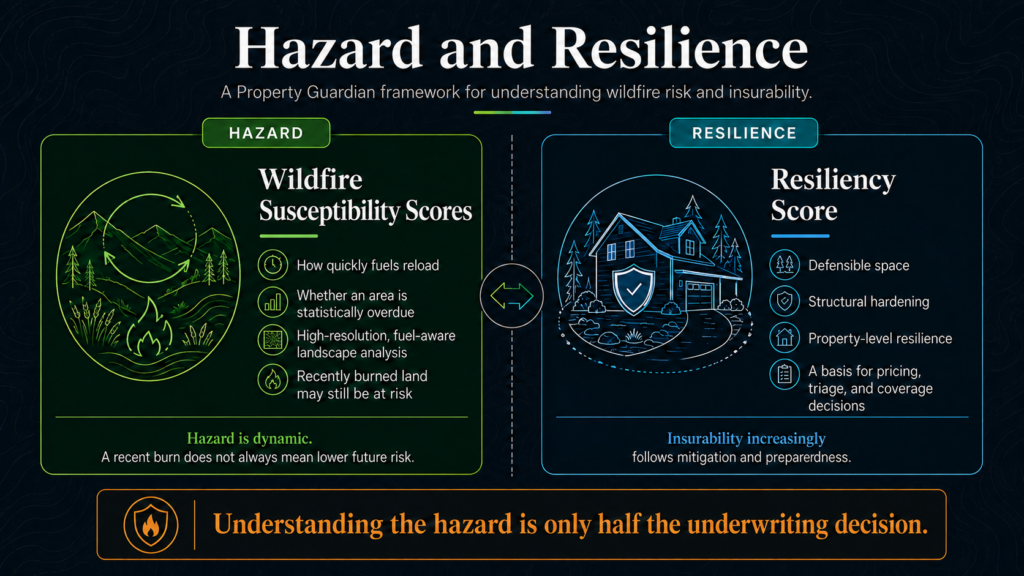
Our Wildfire Susceptibility Scores are designed for precisely the blind spot Lahaina exposed. Rather than treating a recently burned area as safer, it models fire as a recurring cycle, accounting for how quickly a given fuel type reloads and flagging locations that are statistically overdue. In grass-dominated landscapes like leeward Maui, where the ground can be ready to burn again within a single season, that reframing is not academic; it is the difference between seeing the risk and missing it. The score is built on a fuel-aware, high-resolution view of the land, down to hex units far finer than the county-level bands most public hazard maps rely on, so it reflects the street-and-slope reality of how fires actually behave.
Our Resiliency Score addresses the other half of the equation the market has now made unavoidable: not just how hazardous a location is, but how well a specific property is positioned to withstand a fire. As insurability in Hawaii increasingly follows mitigation, a clear, property-level read on resilience gives carriers, MGAs, and reinsurers a defensible basis for pricing, triage, and the coverage decisions that communities like Lahaina depend on.
Three years after the fire, the most fitting way to honor what Lahaina taught us is to act on it: to look closely at the places conventional models overlook, to treat every burn as the beginning of the next risk cycle, and to reward the properties and communities doing the hard work of becoming more resilient. That is the work in front of the industry now, and in Hawaii, it has never mattered more
Sources
MFD / ATF Origin & Cause Report (via Maui Recovers)
NBC News: Downed Power Lines Findings
2023 Hawaii wildfires, Wikipedia (toll, timeline, damages)
USFA/FEMA, After-Action & Phase 3 reports
FSRI, Lahaina Fire timeline & forward-looking report
TIME: Invasive Plants Fueled the Maui Wildfires
Hawaii Invasive Species Council, invasive grasses
CNN: Hawaii Wildfires Timeline
Hawaii Business: Condo Insurance Crisis
