
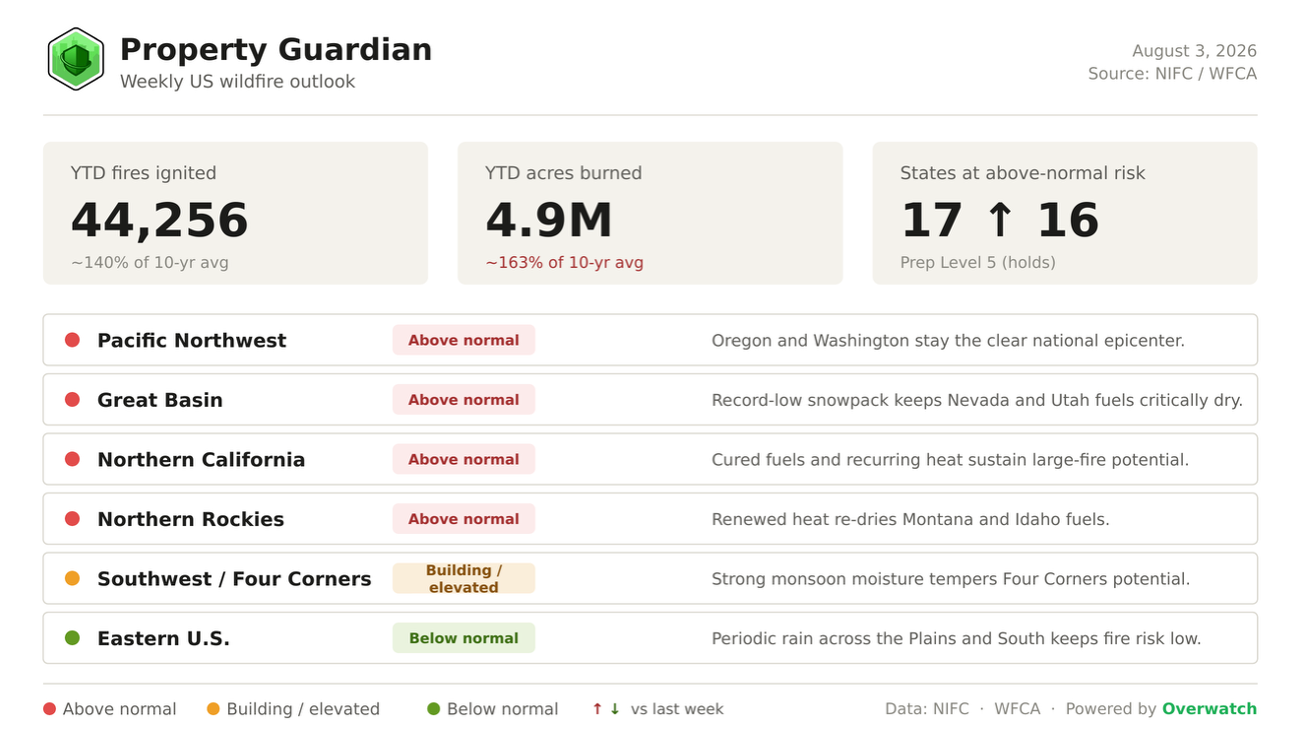
The US enters this week deep in an elevated stretch of fire season: roughly 4.9 million acres have already burned year-to-date (about 163% of the 10-year average) across more than 44,000 fires nationwide, and the week ahead points to sustained, expanding risk across the West.
Heading Into This Week
The National Preparedness Level opens the week at 5, the top of the scale, for a third straight week, and the count of states at above-normal risk edges up from 16 to 17.
No region shifts category as the week begins, but the Pacific Northwest is intensifying as the clear national epicenter: eastern Oregon now hosts the largest active fires in the country, while a cluster of fast-moving fires around Spokane has forced tens of thousands to evacuate and destroyed hundreds of structures. With federal resources fully committed at PL 5, the week ahead opens with little slack in the system.
Major Fires We’re Watching This Week
Several large fires are driving this week’s risk picture across the above-normal regions:
- Big Grass Fire (OR) — 304,229 acres, 21% contained. The largest active wildfire in the nation, burning in remote Malheur County in southeastern Oregon.
- Coleman Creek Fire (OR) — 212,182 acres, 0% contained. Still fully uncontained in Harney County, it is driving heavy smoke across the eastern Oregon high desert.
- Crosswhite Fire (OR) — 189,794 acres, 48% contained. Nearly half contained in Wheeler County after an aggressive suppression push.
- Kaiser Canyon Fire (WA) — 134,167 acres, 38% contained. Lightning-sparked on July 16 on the Colville Reservation, it is the largest active fire in Washington.
- Spokane Complex (WA) — 7,708 acres, 0% contained. A cluster of fast-moving fires (Old Trails, Fairview, Autumn Lane) that destroyed roughly 640 structures and prompted evacuations for about 60,000 Spokane residents.
- Gold Mountain Fire (CO) — 39,507 acres, 72% contained. Nearing containment in Ouray County, the most significant fire in the Southern Rockies this week.
What’s Driving the Week Ahead
Conditions still trace back to a winter that never delivered.
The Western US came out of 2025-26 with record-low seasonal snowpack, and the Southern Rockies in particular finished historically dry, leaving fuels primed months ahead of schedule. Nearly 48% of the Lower 48 is now in drought, with the Southwest running near 90% coverage, and cured grasses and timber across the Great Basin and interior West are burning as readily as they normally would in late August.
Building this week is another round of heat across the northern tier, re-drying fuels in Montana and Idaho just as the Pacific Northwest reaches peak receptivity.
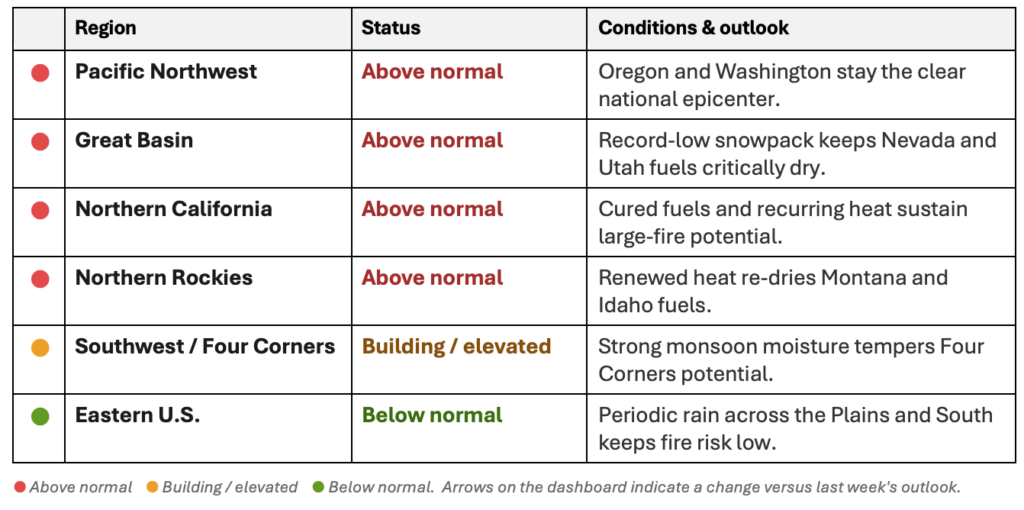
Farther out, the North American monsoon has arrived on a near-normal schedule and is coming in strong at the onset, which should keep a lid on the Four Corners for now, but forecasters expect little of that moisture to reach the northern Rockies or Pacific Northwest. With an emerging El Nino signal and no widespread relief expected until later in the summer, the weeks just ahead remain the most exposed window of the season.
Regional Risk Outlook
What This Means for Property Owners, Insurers, and Risk Managers
For property owners, insurers, and risk managers, a Preparedness Level pinned at 5 and an epicenter actively destroying homes mean the week ahead is the window to verify exposure and harden assets, not later in the season.
Property Guardian’s Overwatch platform tracks these active fires and shifting regional risk in real time, so teams can prioritize the properties and portfolios most exposed as conditions escalate.
Sources
- NIFC Statistics (YTD fires & acres)
https://www.nifc.gov/fire-information/statistics - NIFC National Fire News
https://www.nifc.gov/fire-information/nfn - NIFC/NICC Monthly & Seasonal Outlook (issued Aug 1, 2026)
https://www.nifc.gov/nicc-files/predictive/outlooks/monthly_seasonal_outlook.pdf - NIFC Incident Management Situation Report
https://www.nifc.gov/nicc/sitreprt.pdf - U.S. wildfire season exceeds 10-year average as 99 large fires burn (Axios)
https://www.axios.com/2026/08/03/us-wildfire-season-large-fires-10-year-average - Kaiser Canyon Fire update (KHQ)
https://www.khq.com/news/kaiser-canyon-fire-burning-121-000-acres-containment-shrinks/article_fa65d76b-6086-41b3-8c04-5609a4bd17eb.html - More than 600 structures lost as tens of thousands evacuate in Washington (NBC News)
https://www.nbcnews.com/news/us-news/spokane-washington-wildfire-rcna590469 - U.S. Drought Monitor / Drought.gov current conditions
https://www.drought.gov/current-conditions - 2026 North American Monsoon Season Update (OpenSnow)
https://opensnow.com/news/post/2026-north-american-monsoon-season-update - Snow Drought Current Conditions and Impacts in the West (Drought.gov)
https://www.drought.gov/drought-status-updates/snow-drought-current-conditions-and-impacts-west-2026-04-09
