
May 18, 2026
By Brian Bastian, Head of Product
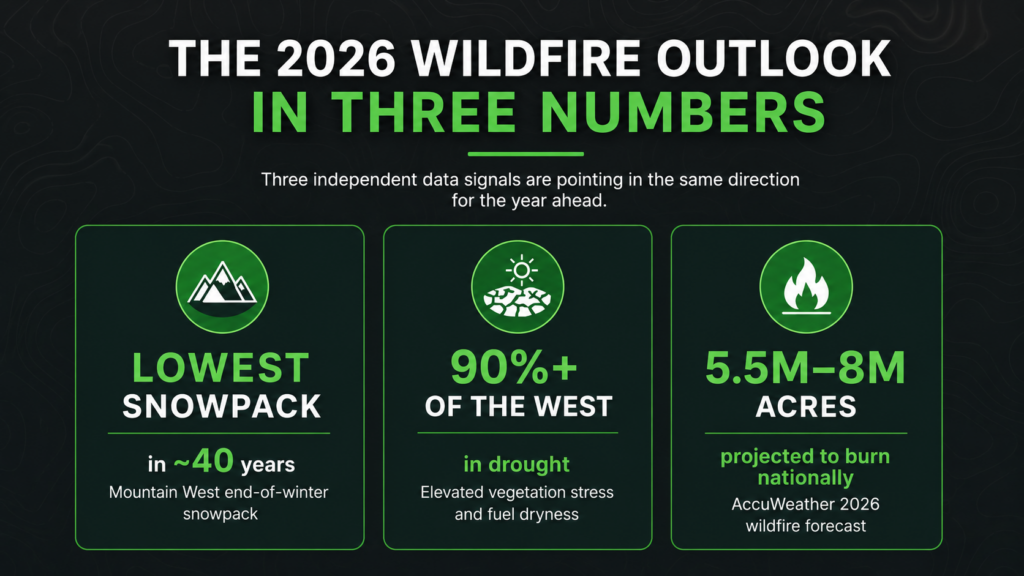
According to AccuWeather’s 2026 wildfire forecast, the mountainous American West just closed out its lowest end-of-winter snowpack in roughly 40 years. The U.S. Drought Monitor now shows more than 90% of the western United States in drought. AccuWeather projects 5.5 to 8 million acres will burn nationally this year. The National Interagency Fire Center’s May 1 outlook calls for above-normal wildfire potential across a band stretching from Arizona and New Mexico north through Utah, Nevada, Idaho, western Montana, and into the Pacific Northwest east of the Cascades.
For commercial property underwriters and risk managers carrying exposure in any of these regions, the 2026 season is not a forecast to scroll past. It is a 90-day operational window in which loss assumptions, accumulation maps, and renewal terms need to be revisited.
What the Data Actually Says
Three independent data streams are pointing in the same direction. First, the snowpack. After a winter that was both warmer and drier than normal across most of the West, mountain snow water equivalent collapsed to a level AccuWeather characterizes as the lowest the region has seen in approximately 40 years. Wildfire Today, summarizing the same underlying NRCS SNOTEL measurements, described this winter’s snow drought as “unprecedented” in the context of the modern fire-season record. Snowpack is the West’s natural buffer against an early, prolonged fire season — and that buffer just lapsed.
Second, the drought map. With the exception of states around the Great Lakes and the mid-Mississippi Valley, most of the country is in drought. In wildfire terms, drought stress means vegetation that burns hotter, faster, and farther. Recent peer-reviewed work in California reinforces that pre-fire fuel conditions — the abundance, moisture, and stress of vegetation — are the primary determinants of burn severity, more so than weather on the day of ignition.
“Stacked together, these data streams describe a fire season with very little margin for error.”
Third, the seasonal outlook. NIFC’s May 1 monthly and seasonal outlook anticipates above-normal temperatures across most of the U.S. through summer, with below-normal precipitation focused in the Northwest and northern Rockies. The Northwest fire season may start near normal but is expected to expand in July and August as fuels dry, mountain snow finishes melting, and dry thunderstorms drop lightning into landscapes primed to ignite.
None of these is, on its own, a forecast of disaster. Stacked together, they describe a fire season with very little margin for error — and a year in which CAT modeling assumptions built on a cooler, wetter prior decade are increasingly unreliable.
Why This Matters for Commercial Portfolios
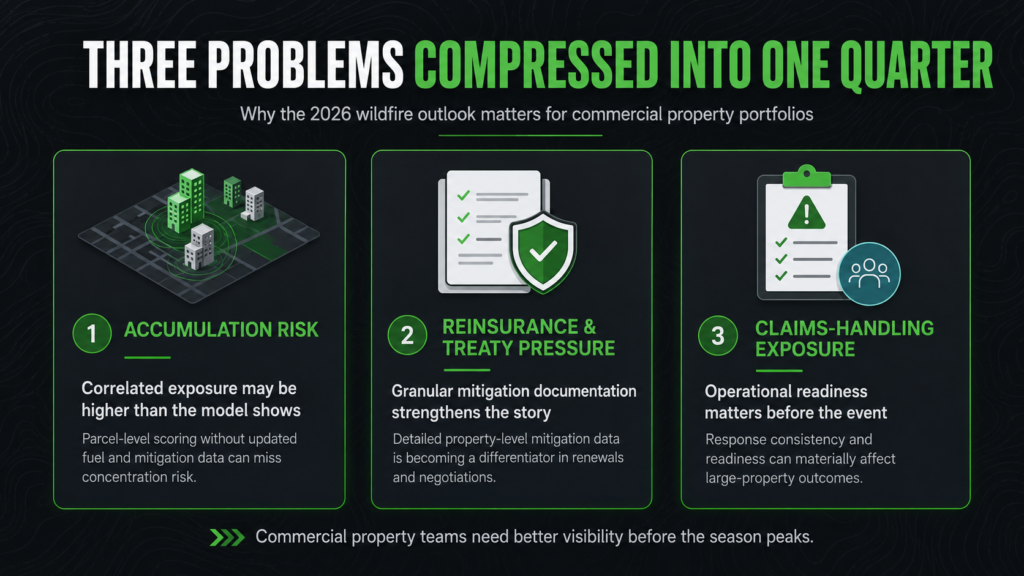
Severe fire seasons do not happen in isolation. They land on top of a property insurance market already under stress from the January 2025 Los Angeles fires, the carrier retrenchments of 2023 and 2024, and an ongoing regulatory reset in Sacramento. For commercial underwriters and risk managers, the 2026 outlook compresses three problems into a single quarter.
Accumulation risk is the first. Books built on parcel-level scoring without an updated view of fuel conditions, defensible space, and Zone Zero compliance may be carrying more correlated exposure than the model shows. A single ember-driven event in a high-density wildland-urban interface (WUI) cluster can produce loss totals that look very different from the average historical loss assumption.
Reinsurance and treaty negotiations are the second. As reinsurers re-price wildfire layers heading into mid-year renewals, primaries that can demonstrate granular mitigation data on their insured properties — not just zip-code-level scores — are in a markedly stronger position. Documentation is becoming the differentiator.
Claims-handling exposure is the third. The May 4, 2026 enforcement action against the largest U.S. property carrier sent a clear signal that slow or inconsistent claims handling will be treated as a legal matter, not a service issue. Commercial carriers face an adjacent version of the same dynamic with their large-property, habitational, hospitality, and senior-living insureds.
What Underwriters and Risk Managers Can Do Before the Season Peaks
The good news is that the science of property hardening is unusually clear about what works. Most structure losses in wildland-urban fires are not driven by walls of flame. They are driven by embers landing on or near the structure and finding something to ignite. That means the highest-leverage mitigation actions are observable, verifiable, and capturable at the policy level.
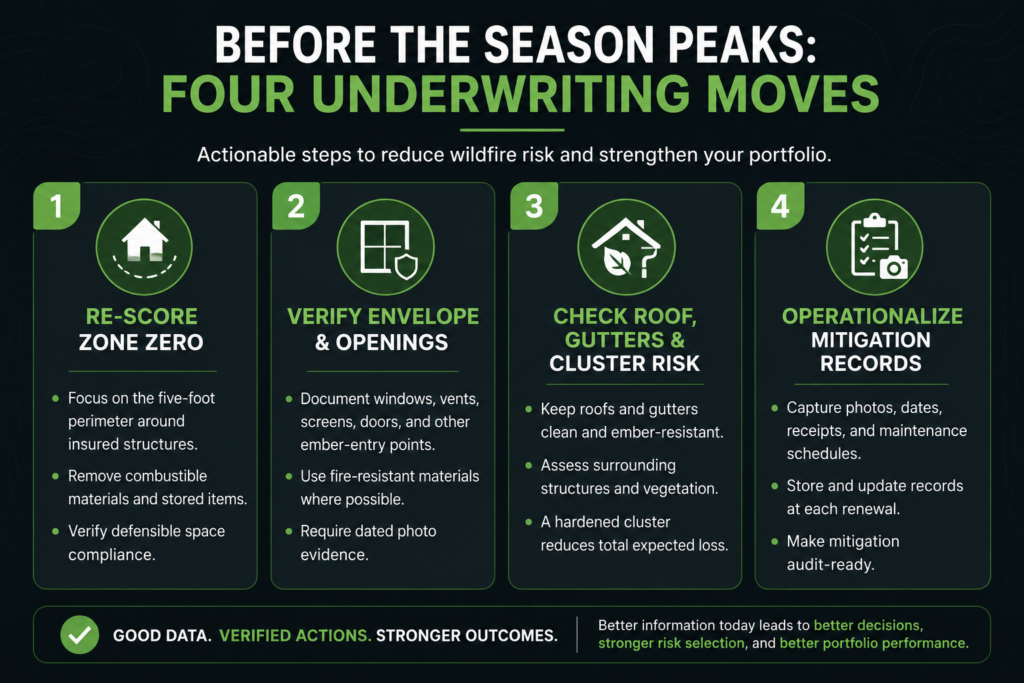
1. Re-score exposed accounts on Zone Zero specifically. The five-foot perimeter around an insured structure is the single most predictive area on any property. For commercial habitational, multifamily, hospitality, and senior-living risks in the WUI, an updated walk-down or aerial survey of Zone Zero compliance — gravel or hardscape in place of combustible mulch, no stored materials against siding, no overhanging branches — is the highest-ROI underwriting refresh of the quarter. California’s new Safe Homes Act (AB 888) is funding this work because the loss-prevention math is so strong.
2. Require parcel-level documentation of envelope and opening hardening. Windows are one of the most common ignition pathways. Double-pane tempered glass is roughly four times more resistant to breaking under radiant heat than standard single-pane glass. Exterior metal mesh screens on windows and vents — openings no larger than one-eighth inch — dramatically reduce ember entry. Build the requirement into the submission and renewal process: photo evidence, with dates and locations, of these features on each insured structure.
3. Look at the roof, the gutters, and the surrounding cluster. Class A fire-rated roofing remains the single highest-impact long-term mitigation. In the short term, debris-free gutters and valleys during peak season are what separate an ember-resistant structure from a structure that ignites on its own roof. A growing body of research also shows that mitigation is multiplicative at the neighborhood scale: a hardened building next to an unhardened one still benefits, but a cluster of hardened buildings dramatically reduces total expected loss in the event of an incursion. Underwriters who consider community-level mitigation context, not just the individual parcel, build better-correlated portfolios.
4. Operationalize mitigation expectations with insured operators. For property managers, REIT operators, and corporate risk owners on the receiving end of these underwriting moves, the most useful actions mirror the priorities above. Clear Zone Zero across each portfolio property before the end of the month and photograph the result. Confirm vent screens and window assemblies. Maintain a documented schedule for clearing gutters and roof valleys throughout fire season. Hold a current inventory of contents and a written record of every mitigation improvement, with dates and receipts. These records carry material value at claim time, at renewal, and at disposition.
Treat the Season Like It Is the New Baseline
It is tempting to read each year’s forecast as a one-off and hope the weather breaks the right way. The data of the last decade does not support that hope. The 2026 outlook is severe, but it is consistent with a multi-year trend of warmer winters, lower snowpack, longer fire seasons, and increasingly stressed vegetation. Portfolios priced and reserved against the baseline of twenty years ago carry hidden exposure. Portfolios priced and reserved against today’s baseline — and against verifiable, parcel-level mitigation data — are the ones that perform through a difficult season.
“We can’t change the snowpack. We can change how confidently your team underwrites against it.”
How Property Guardian Fits In
Property Guardian is built for exactly this moment. Our wildfire risk assessment, mitigation tracking, and active fire intelligence products give commercial property underwriting teams and corporate risk managers a parcel-level view of exposure, mitigation status, and in-season fire activity — the level of detail needed to price, retain, and defend a book of wildfire-exposed property in 2026 and beyond. We can’t change the snowpack. We can change how confidently your team underwrites against it.
Sources
Wildfire Today: ‘Unprecedented’ snow drought sets up extreme wildfires for Western US in 2026
NIFC: May 2026 Monthly and Seasonal Outlook (May through August)
Phys.org: Want to predict wildfire severity? Look to the state of vegetation
California Wildfire & Forest Resilience Task Force: New laws strengthen property hardening
