


The Quick Read
On September 15, 2026, Governor Newsom signed a four-bill wildfire recovery package that creates the nation’s first enforceable standards for smoke damage claims. Assembly Bills 1642 and 1795 direct state agencies to build testing and remediation protocols for lead and asbestos contamination from wildfire smoke, require insurers to cover both the testing and the full remediation cost, and bar insurers from cutting off Additional Living Expense coverage until a home is actually remediated and safe to occupy. A companion pair of bills, AB 1842 and AB 1847, makes mortgage forbearance protections from the 2025 Los Angeles fires permanent and doubles the forbearance window to 24 months.
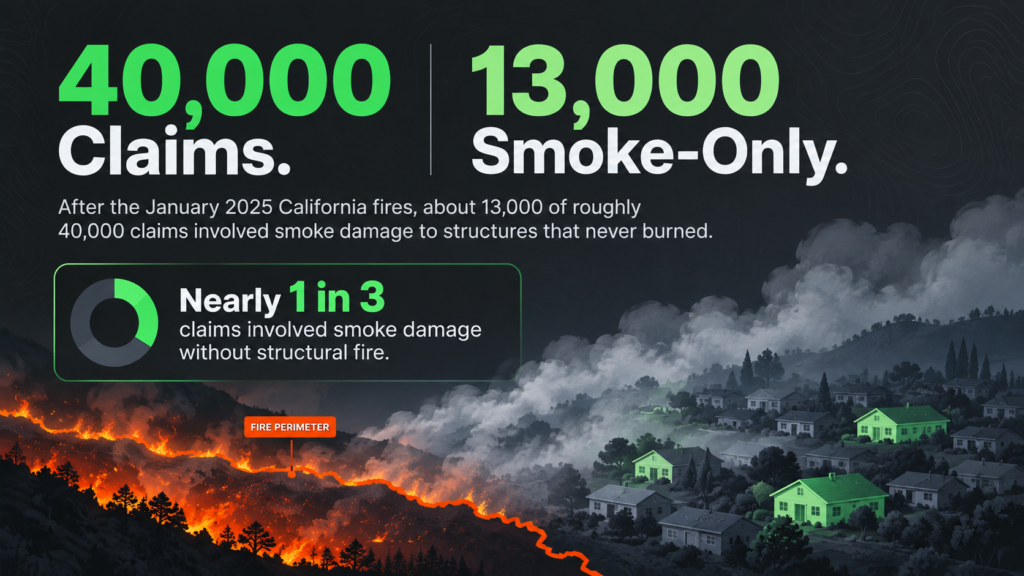
The state’s own numbers explain why this mattered enough to move fast: of roughly 40,000 claims filed after the January 2025 fires, the Department of Insurance estimates about 13,000 involve smoke damage to structures that never burned. That is a claims category insurers have historically underwritten, documented, and priced with far less rigor than fire damage itself, and it is now getting its own rulebook. Commercial property teams with exposure in California should expect claims practices, documentation requirements, and possibly premium structures for smoke-affected assets to shift as these standards take effect.
How Property Guardian Helps: Our wildfire risk insight reports give commercial property teams a documented, defensible pre-loss and post-event exposure record, the kind of granular data trail that speeds claims resolution and supports smoke-related damage assessments long before a dispute reaches an adjuster’s desk.
Insurance regulation rarely moves this quickly. Most wildfire-related reform in California has taken years of hearings, model litigation, and incremental rulemaking to reach a governor’s desk. This package went from investigation to signed law in about eight months, and it was built directly on the evidence gathered from real claims files. For commercial property underwriters and risk managers, that speed is itself a signal. When a regulator can point to tens of thousands of documented smoke-only claims and use them to justify new mandates in under a year, it tells you the claims data existed, the problem was real, and the state was willing to act on it without waiting for the next fire season to prove the point twice.
What the New Standards Actually Require
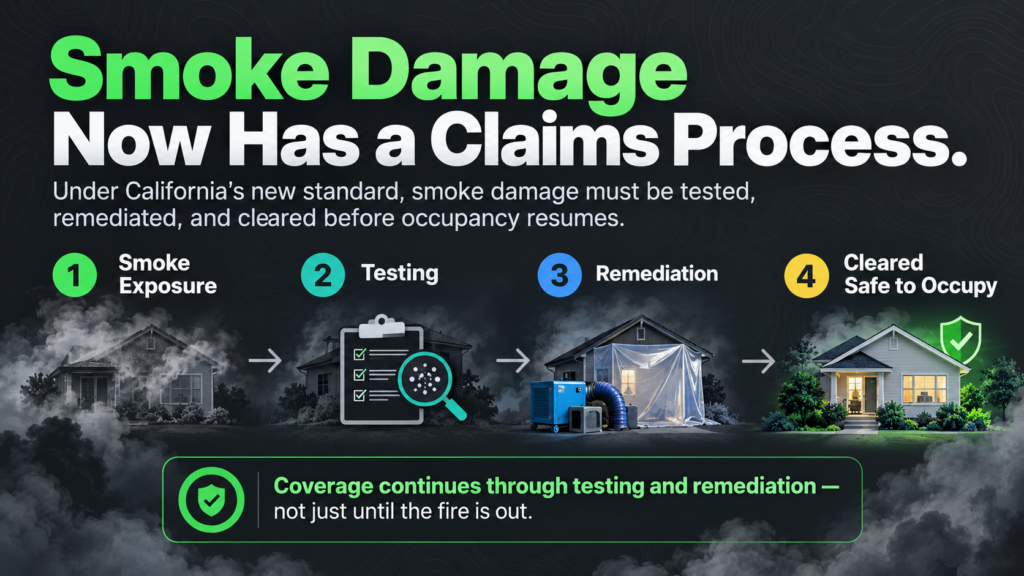
The core of AB 1642 and AB 1795 is deceptively simple: smoke damage has to be tested, not assumed. The bills direct the Department of Toxic Substances Control and the California Air Resources Council to develop protocols for testing, remediation, and restoration of lead and asbestos contamination specifically tied to wildfire smoke exposure in structures located within designated fire zip codes. Once those protocols are finalized, insurers writing policies that cover smoke damage will be required to pay for the testing itself, not just remediation after a positive result, and to fund full remediation rather than a partial or estimated payout.
The provision most likely to change day-to-day claims handling is the restriction on Additional Living Expense coverage. Under the new law, insurers cannot terminate ALE payments until a property has actually been tested, remediated, and confirmed safe to occupy. For homeowners this closes a gap where families were pushed back into contaminated structures, or into paying out of pocket, while testing and remediation dragged on. For commercial property owners, the same logic extends naturally to business interruption and extra expense coverage: a tenant space or operating facility that has not been cleared as safe to occupy is not a space a business can safely reopen, whatever the physical fire perimeter looked like on a map.
The companion mortgage bills, AB 1842 and AB 1847, are aimed primarily at residential borrowers, but they matter to commercial risk managers too. They signal a broader state posture: after a declared wildfire disaster, financial protections that used to require emergency executive action will now trigger automatically and last longer. Portfolio owners with mixed residential and commercial holdings, or with tenants whose personal financial stability affects lease performance, should read these as part of the same policy direction.
Why This Matters for Commercial Property Managers & Risk Managers
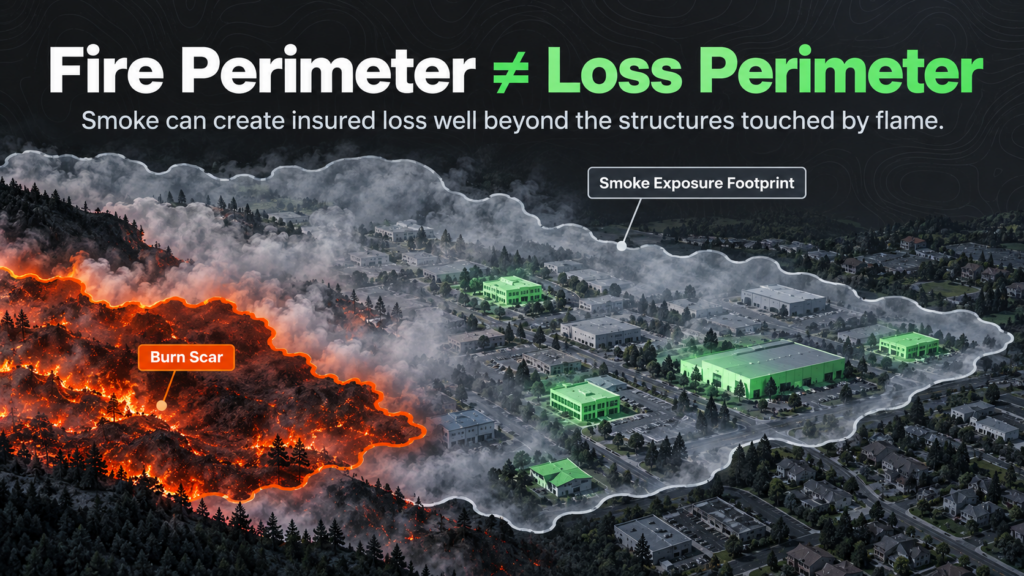
Smoke damage has been the quiet, underpriced cousin of wildfire risk for years. Structural fire perimeters are mapped, modeled, and priced with increasing precision, but smoke intrusion into HVAC systems, insulation, and building materials in structures well outside the burn scar has largely been handled ad hoc, claim by claim, adjuster by adjuster. That inconsistency is exactly what regulators pointed to when building this package, and it is exactly the kind of inconsistency that tends to get formalized into mandatory protocol once a state decides to act.
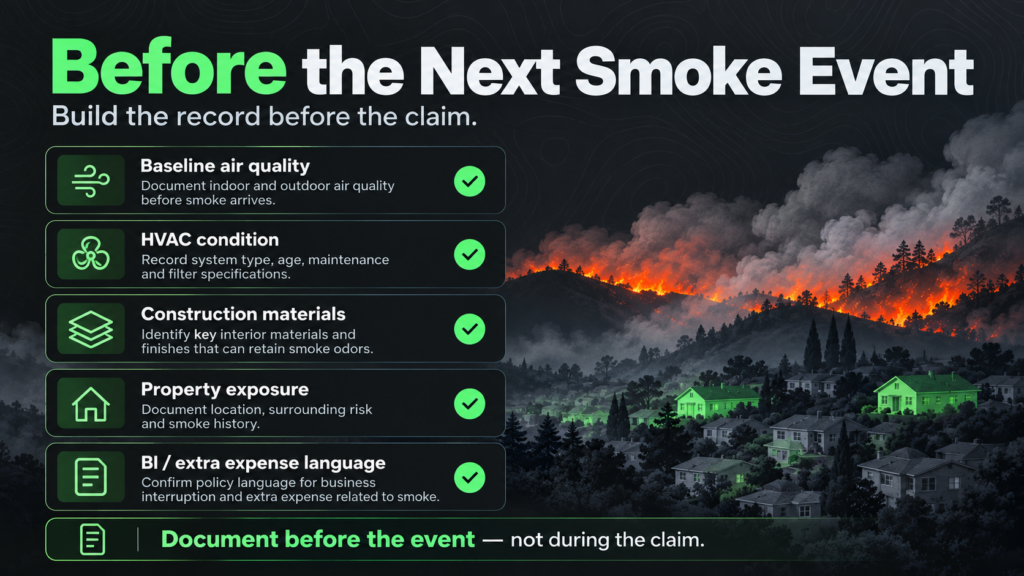
For underwriting teams, the practical implications are worth working through now, before the DTSC and CARB protocols are finalized. First, expect testing and remediation costs for smoke-affected properties to become a more visible, more standardized line item in claims data, which should over time improve loss modeling for this peril rather than leaving it as a rounding error inside broader wildfire loss figures. Second, expect claims duration on smoke-only losses to extend, since insurers can no longer close out ALE or extra expense coverage on an assumed or estimated timeline. Third, and most immediately actionable, expect scrutiny to increase on the pre-loss documentation a property owner can produce. A building with a clear record of its baseline air quality, HVAC condition, and construction materials is in a materially stronger position to move through a testing and remediation process quickly than one with no such record, and that speed translates directly into avoided extra expense and business interruption costs.
Risk managers overseeing multi-property portfolios in or near fire-prone zip codes should treat this as a prompt to review two things. The first is whether current business interruption and extra expense language accounts for a “tested and cleared” occupancy standard rather than a purely physical damage trigger, since that is now effectively the state’s expectation for how residential claims will be handled, and commercial policy language that lags behind will create friction at exactly the moment a fast resolution matters most. The second is whether the properties in the portfolio have any documented baseline environmental or construction data at all. Many do not, and building that record now, while conditions are normal, is far cheaper and far faster than trying to reconstruct it under the pressure of an active claim.
None of this is a reason for alarm. It is a reason for preparation. California has effectively told the market that smoke damage will be treated as a distinct, documented, and regulated category of wildfire loss going forward, not an informal add-on to structural fire claims. Commercial property teams that get ahead of that shift, by tightening documentation, reviewing coverage language, and understanding their real exposure footprint before the next fire season tests it, will be the ones moving fastest when a claim actually comes in.
That is precisely the gap Property Guardian’s wildfire risk insight reports are built to close. By giving commercial property teams a structured, pre-loss picture of a property’s condition and exposure, paired with active fire intelligence when an event is unfolding, we help risk managers walk into a claims conversation with documentation already in hand rather than scrambling to assemble it after the fact. As smoke damage becomes its own regulated claims category, that kind of preparation stops being a nice-to-have and starts being a competitive advantage at renewal.
Sources
California Governor Signs Act to Create Smoke Damage Presumption, Claims Journal.
California sets pioneering testing standards for wildfire-affected homes, The Press Democrat.
