


The Quick Read
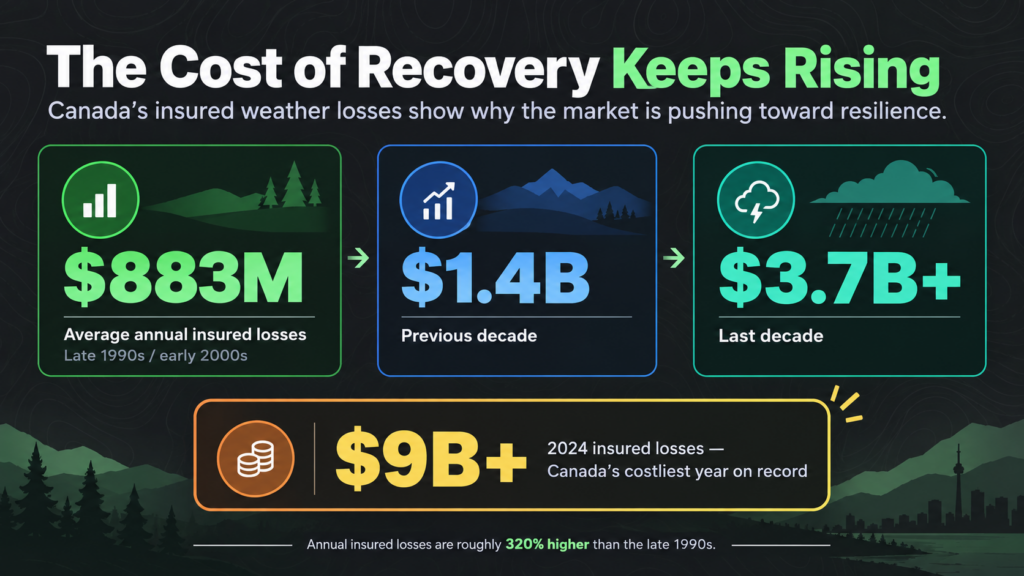
Following the federal government’s 2026 National Adaptation Strategy Progress Report, the Insurance Bureau of Canada is pressing for a fundamental shift from disaster recovery to disaster prevention. IBC represents Canada’s home, auto and business insurers, so this is an all-lines message, not a single-segment one. Insured losses from extreme weather now average more than $3.7 billion a year, up from $1.4 billion the prior decade and roughly 320% higher than the late 1990s.
IBC points to a more than $65 billion stormwater and wastewater infrastructure deficit and argues that every dollar spent on resilience today avoids far larger recovery costs tomorrow. The core claim for the industry is simple: investing in resilience keeps insurance affordable and available. For context, 2024 was the costliest year on record, with insured losses exceeding $9 billion.
How Property Guardian Helps: Property Guardian’s Canadian Wildfire Risk Score + Insights turns the prevention-first ambition into something underwriters can act on, giving teams across home, commercial and specialty lines a forward-looking, property-level read on wildfire exposure to guide pricing, mitigation and portfolio decisions.
When the national insurance association starts talking less about paying claims and more about preventing them, it is worth paying attention. Following the release of the Government of Canada’s 2026 National Adaptation Strategy Progress Report, the Insurance Bureau of Canada welcomed the progress but drew a sharp line: Canada can no longer afford to treat extreme weather as a series of emergencies to respond to after the fact. The message applies across the whole book, because IBC speaks for home, auto and business insurers alike.
What IBC Said, and Why Now
IBC’s vice-president of federal affairs framed this summer’s flooding in Manitoba, Ontario and Quebec, alongside significant wildfire activity in British Columbia and Ontario, as evidence of a widening gap between climate risk and community resilience. The association’s position is that these events are not anomalies but part of a long-term pattern of increasingly severe and costly disasters, and that the answer is a deliberate move from recovery spending to prevention and resilience investment.
“Canada can no longer afford to treat extreme weather as a series of emergencies to respond to after the fact.”
The timing is not incidental. The federal progress report is a natural moment to press governments on implementation, and IBC’s core argument is a financial one: adaptation plans need investment to deliver results, and every dollar spent today helps avoid greater recovery costs tomorrow. For an industry whose loss experience keeps climbing, that is not advocacy for its own sake. It is loss-cost management at a national scale.
The Loss Trend Behind the Ask
The numbers explain the urgency. Over the last decade, insured losses from extreme weather in Canada have averaged more than $3.7 billion a year, up from $1.4 billion the previous decade and $883 million the decade before that. Annual losses have risen roughly 320% since the late 1990s and early 2000s, even after adjusting for inflation. In 2024, Canada recorded its costliest year on record, with insured losses from extreme weather exceeding $9 billion. Wildfire is a major driver of that trend, and it is the peril where the gap between exposure and community resilience is widening fastest.
IBC also highlights a more than $65 billion stormwater and wastewater infrastructure deficit, with many systems in poor condition and increasingly vulnerable. That is a flood point rather than a wildfire one, but it illustrates the broader thesis: aging, under-invested infrastructure turns severe weather into severe loss, and the same prevention-first logic applies to wildfire through building codes, community mitigation and land-use planning.
Why Prevention Matters to Every Line of Business
A recovery-first system shows up on every underwriting desk. When losses rise faster than resilience, carriers respond with higher premiums, larger deductibles, and more sub-limits and coverage caps, and eventually with reduced appetite in the highest-risk areas. IBC’s own framing is direct: investing in resilience keeps insurance affordable and available. That is a personal lines statement, a commercial statement and a reinsurance statement at once.
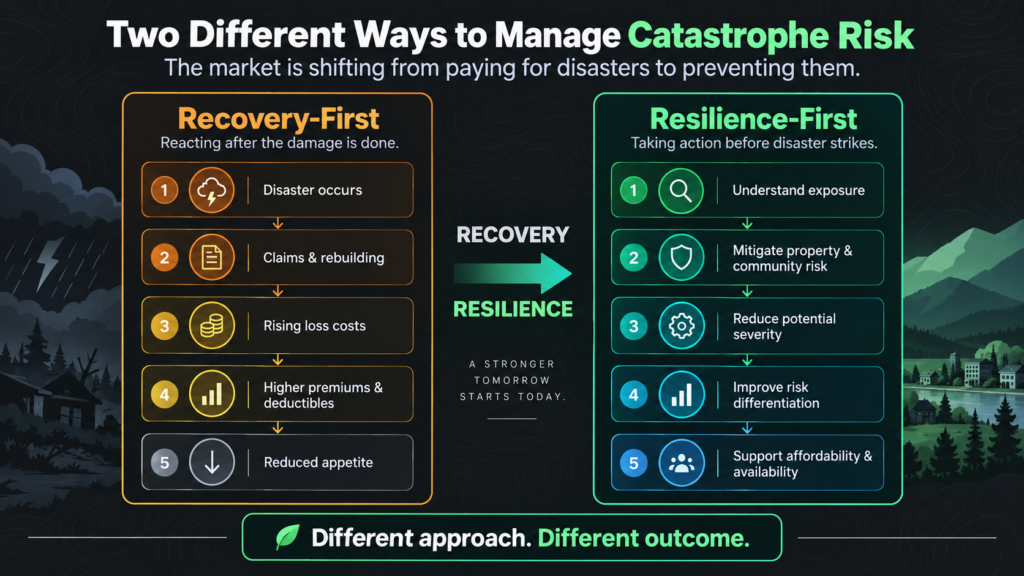
For homeowners and their insurers, prevention is what keeps high-risk zones insurable at all. For commercial property and specialty lines, resilience investment protects the assets, supply chains and business-interruption exposures that sit behind a policy. For reinsurers and the capital behind the market, a national shift toward prevention is what bends the long-term loss curve that ultimately sets capacity and price. There is no line of business that benefits from waiting for the next disaster to pay for it.
A Caution on Implementation
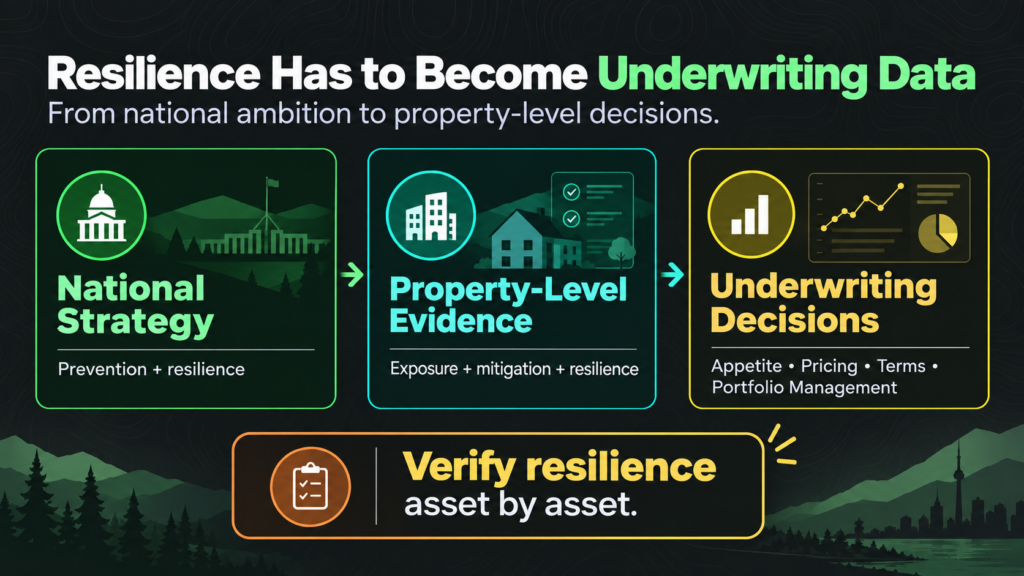
Endorsing a strategy is easier than delivering one. As IBC notes, the priority now is implementation, and the record on mandatory resilience measures is mixed. Jasper adopted non-combustible building standards after its 2024 fire, while Lytton adopted and then rescinded fireproofing bylaws after its 2021 fire over cost and rebuilding-delay concerns. Prevention policy can be walked back under political pressure, particularly right after a disaster. For insurers and risk managers, that means resilience cannot be assumed from a policy announcement. It has to be verified on the ground, asset by asset.
What This Means for Underwriters and Risk Managers
First, treat the prevention shift as a signal about where the market is heading, not a change to coverage today. Standard policies still respond to loss regardless of a community’s adaptation status. But appetite, pricing and terms will increasingly reflect which risks are genuinely resilient.
Second, do not wait for national frameworks to price resilience. The insurers and risk managers who benefit first are the ones who can already see exposure and mitigation at the individual-property level, across whichever lines they write, rather than relying on broad regional assumptions.
Third, for corporate risk managers and property owners, the adaptation conversation is an opening. Documented, property-specific resilience is the most credible way to argue for capacity and terms in a market that is being told, from the top, to reward prevention.
The Bottom Line
IBC is asking Canada to stop paying for disasters after the fact and start preventing them. It is the right ambition, and it touches every line of business, because affordability and availability depend on it. The gap between the ambition and the underwriting desk is data: the ability to see, at the property level, which risks are actually resilient.
“The gap between the ambition and the underwriting desk is data.”
That is what Property Guardian’s Canadian Wildfire Risk Score + Insights is built to provide. By giving underwriters and risk managers a forward-looking, property-level read on wildfire exposure across home, commercial and specialty lines, it turns a prevention-first strategy into pricing, mitigation and portfolio decisions that can be made today.
