

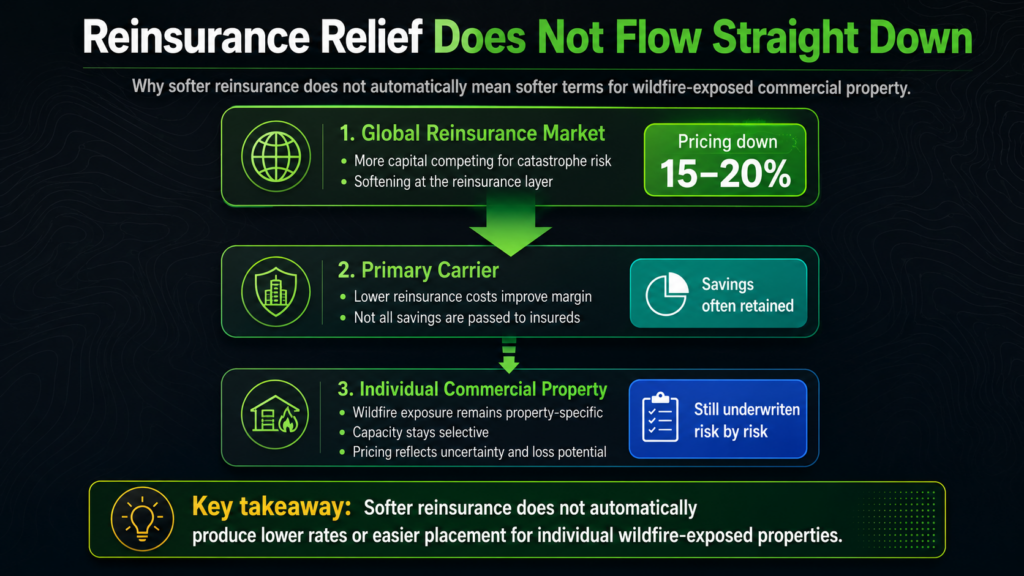
Mid-year reinsurance renewals closed on July 1, and the top-line numbers read like relief. Global property catastrophe reinsurance pricing came in down 15 to 20 percent against the prior year, a faster decline than the 10 to 15 percent recorded at the January 1 renewals. Aditya Dutt, president of Aeolus Capital Management, told equity analysts that outcomes are skewing toward the worst end of that range, with the most intense pressure on US nationwide accounts and Florida the single most competitive market. Alongside that, the catastrophe bond market broke every issuance record in the first half of 2026, pushing risk capital outstanding to new highs.
For anyone responsible for a commercial property portfolio in the West, this creates a fair question. If reinsurers are competing to place capacity, and if investors are pouring money into catastrophe bonds, why does wildfire-exposed commercial property still feel so difficult to place and so costly to insure?
The short answer is that capital does not flow evenly from the top of the reinsurance tower to the individual risk at the bottom. Reinsurance protects insurers against large, aggregated losses. When that layer softens, primary carriers tend to keep more of the savings than they pass along. Dutt made exactly this point: cedants are holding the margin they gain on cheaper reinsurance rather than buying materially more cover or cutting primary rates. He also noted that it typically takes an event large enough to remove roughly 20 percent of industry capital, on the order of a 135 billion dollar loss, to turn the market hard again. In other words, the current softening reflects an over-capitalized reinsurance sector, not a reassessment of how dangerous wildfire has become.
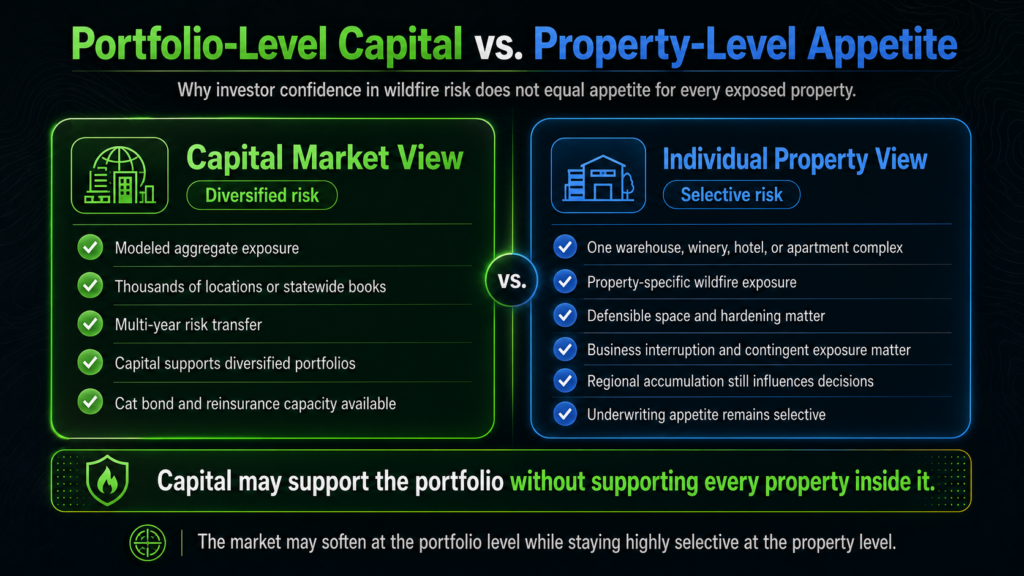
Wildfire’s rise inside the capital markets tells the same story from a different angle. Not long ago, wildfire sat buried as a secondary peril inside earthquake and hurricane bonds. After the 2025 Los Angeles losses, it became its own category, and 2026 has already produced dedicated wildfire catastrophe bonds. The California FAIR Plan alone has secured more than 1.15 billion dollars of multi-year wildfire reinsurance through its Golden Bear Re catastrophe bonds. That is a meaningful vote of confidence from investors, but it is a bet on a modeled, diversified, state-level book of risk. It is not the same thing as an appetite for any single wildfire-zone warehouse, winery, or apartment complex in the admitted market.
That gap is why the primary picture still looks tight. Several major carriers have pulled back from California commercial property in the segments most exposed to wildfire and large-loss scenarios. The surplus lines share of California commercial property has climbed to roughly 20 percent, up from about 6 percent a decade ago, and excess and surplus lines is now the primary channel for wildfire-zone commercial risk. The E&S market is showing early signs of selective softening, but it remains the market of last resort for the hardest accounts, and it prices for the uncertainty it is being asked to absorb.
The practical implication for commercial property teams is that the 2026 softening is real, but it is happening at a layer removed from the risks you actually place. Waiting for reinsurance relief to arrive at the individual property level is not a strategy. The accounts that benefit first are the ones that can demonstrate, in underwriting terms, why they are better than the portfolio average.
Practical Takeaways for Commercial Property Teams
For underwriters, this is a moment to separate the account from the market narrative. Softer reinsurance does not change the loss potential of a given location, so pricing discipline on genuinely wildfire-exposed risk still matters. The differentiator is granularity: property-specific exposure data, current mitigation status, and a clear view of how a single risk contributes to your broader accumulation in a given fire-prone region.
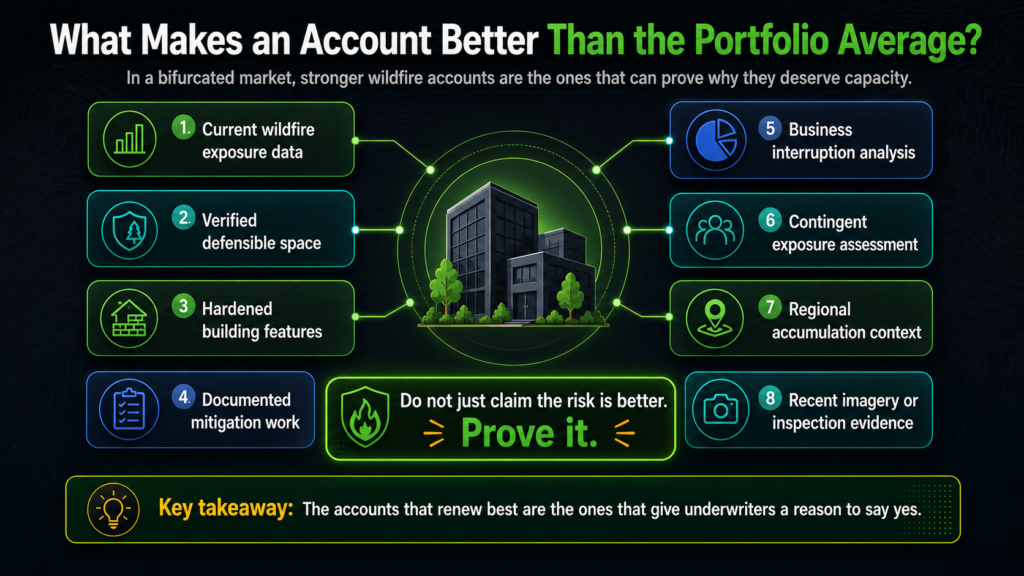
For risk managers on the insured side, the message is to come to renewal with evidence rather than optimism. Documented mitigation, verified defensible space, hardened building features, and a credible view of business interruption and contingent exposure give brokers something concrete to market. In a bifurcated market, the accounts that move are the ones that give an underwriter a reason to say yes.
For portfolios, the wildfire cat bond boom is a reminder that capital rewards measurable, well-understood risk. The same logic applies inside a book of business. Knowing where your wildfire accumulation actually concentrates, and being able to show it, is increasingly the difference between capacity that renews and capacity that walks.
How Property Guardian Can Help
This is where Property Guardian focuses. Our wildfire risk insight and portfolio exposure views help commercial property underwriters and risk managers see where wildfire risk accumulates across a book, and quantify individual locations with the kind of property-specific detail that a softening reinsurance market does not provide on its own. When capital is plentiful but discerning, the teams that can measure and articulate their exposure are the ones that turn a soft reinsurance cycle into real terms for their own accounts.
Sources
Artemis, Mid-year renewals seen down 15-20%+, cat bonds more of a competitive threat (Aeolus).
Artemis, California FAIR Plan secures $400m wildfire reinsurance from second Golden Bear Re cat bond.
Insurance Business, Is California’s E&S market the future of property insurance?
