

The Quick Read
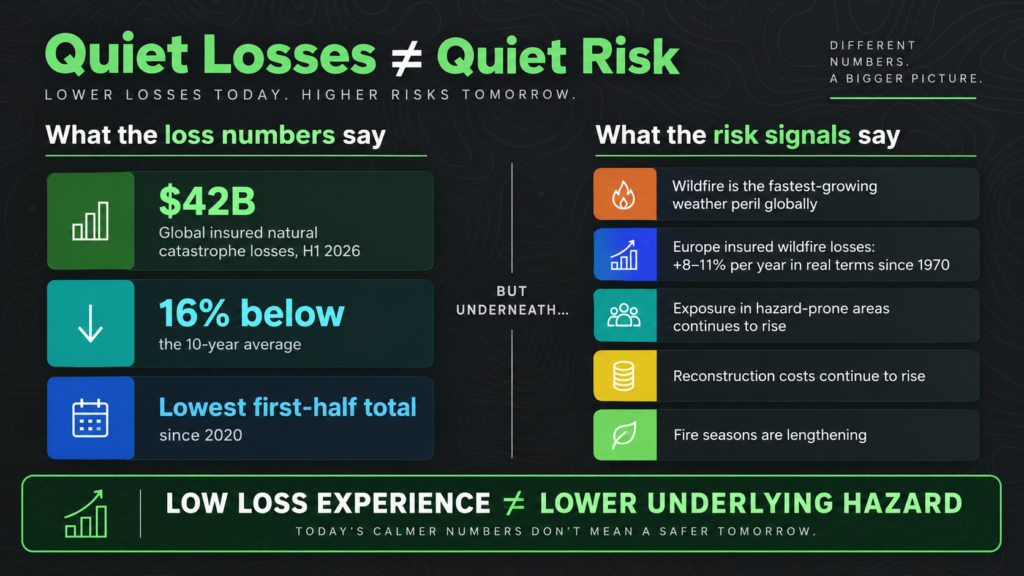
Swiss Re Institute reported on August 11 that global insured natural catastrophe losses in the first half of 2026 came in around $42 billion USD, 16 percent below the 10-year average and the lowest first-half total since 2020. On the surface, that reads like a break for the market. Beneath it, the report carries a sharper message: a calmer six months does not mean the risk has receded, and wildfire in particular is the fastest-growing weather peril in the world.
For commercial property teams, the danger in a benign loss year is that it invites the wrong conclusion. Insured wildfire losses in Europe have grown an estimated 8 to 11 percent per year in real terms since 1970, fire seasons are lengthening, and exposure keeps rising in hazard-prone areas. A low half-year loss number reflects where events happened to strike, not a reduction in the underlying hazard sitting inside a portfolio.
How Property Guardian Helps: Our property-level wildfire risk insight and portfolio exposure views let underwriting and risk teams judge a book on its actual accumulated hazard, not on last quarter’s loss run, so a quiet stretch does not get mistaken for a safe one.
There is a particular kind of risk that shows up when the numbers look good. When losses run low, pressure builds to relax terms, chase growth, and read a calm stretch as evidence that the exposure was overstated. Swiss Re Institute’s mid-year catastrophe report, published on August 11, 2026, is a useful corrective, because it does two things at once: it confirms that the first half of the year was genuinely quiet, and it explains, in the same breath, why that quiet says almost nothing about the risk still in the ground.
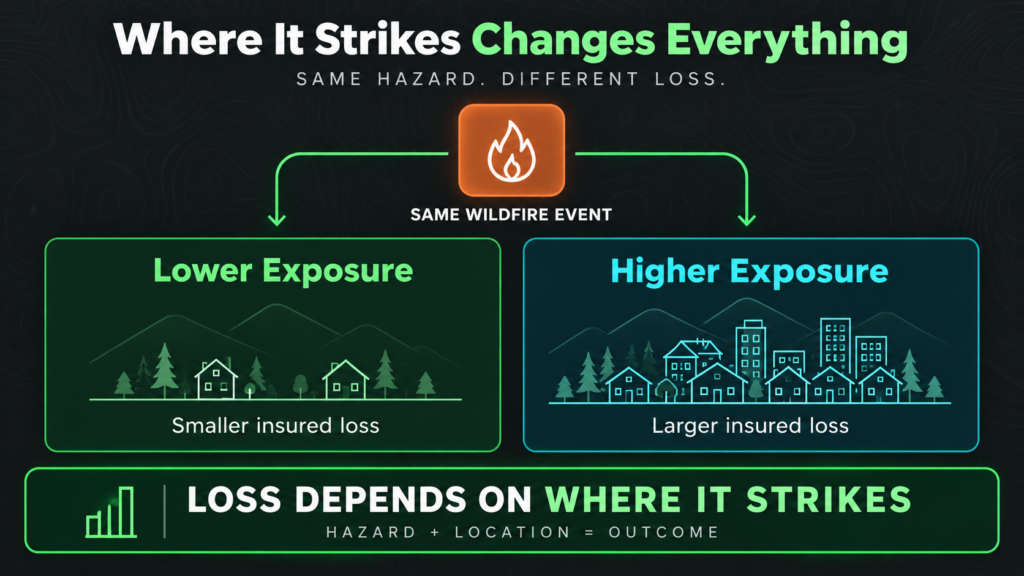
The headline figure is striking. Global insured natural catastrophe losses for the first half of 2026 came in at an estimated $42 billion USD, 16 percent below the 10-year average and the lowest first-half total since 2020. Severe convective storms, usually the workhorse of insured losses, drove roughly $28 billion of that, also below trend. The reason is not that storms were rare. Activity across the United States was actually above average. It is that the biggest events largely missed Texas, the Southern Plains, and the Southeast, the places where storms and dense insured value collide to produce the largest bills. As Swiss Re put it, insured losses depend not only on how severe events are, but on where they strike.
Losses Follow Geography, Risk Does Not
That single point is the whole story for wildfire underwriters. A low loss year is often a geography story, not a hazard story. The fire did not come to the portfolio this half. That is luck about location and timing, and luck is not a risk control.
The report is direct about the trajectory underneath. Balz Grollimund, Head of Catastrophe Perils at Swiss Re, framed it plainly: a less costly first half does not mean the risk has gone away, and one major hurricane, earthquake, or wildfire can change the picture quickly. On wildfire specifically, the institute identifies it as the fastest-growing weather peril globally. In Europe, insured wildfire losses have climbed an estimated 8 to 11 percent per year in real terms since 1970. June brought record heat and persistent dryness to western Europe, setting up an active fire season that hit France and Spain hard in July, with some blazes breaking modern records for area burned. The pattern the report describes is not a bad month. It is longer fire seasons, more frequent fire-conducive conditions, and fire reaching regions that were historically less exposed.
What Europe’s Wildfire Trend Means for the American West
For anyone underwriting commercial property in the western United States, the parallels are uncomfortable and instructive. The same forces the report attributes to Europe’s fires, heat, drought, and more assets built in exposed areas, are the forces shaping the American West. Seasonal forecasts for 2026 have called for fires that ignite less often but spread faster, grow larger, and prove harder to contain, with above-normal risk across the interior Northwest, the Rockies, the Southwest, and interior California. And the recent baseline is severe: 2025 produced the costliest single year of wildfire insured losses on record. A soft first half of 2026 sits on top of that baseline, not in place of it.
Three Lessons for Commercial Property Teams
So what should commercial property underwriters and risk managers take from a quiet six months?
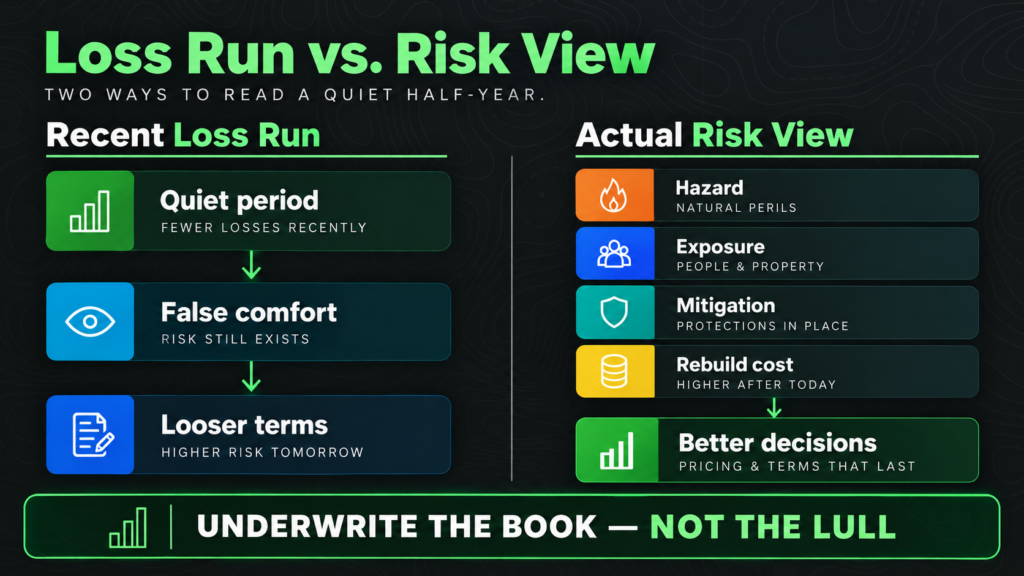
The first takeaway is to separate loss experience from hazard. A benign half-year is an outcome, not a diagnosis. The right question is not “what did we lose this period,” but “what would we lose if a large fire reached our most exposed concentrations,” and that question is answered by the property and portfolio, not by the loss run. Teams that let a low loss number soften their appetite are, in effect, pricing off of where fires did not go.
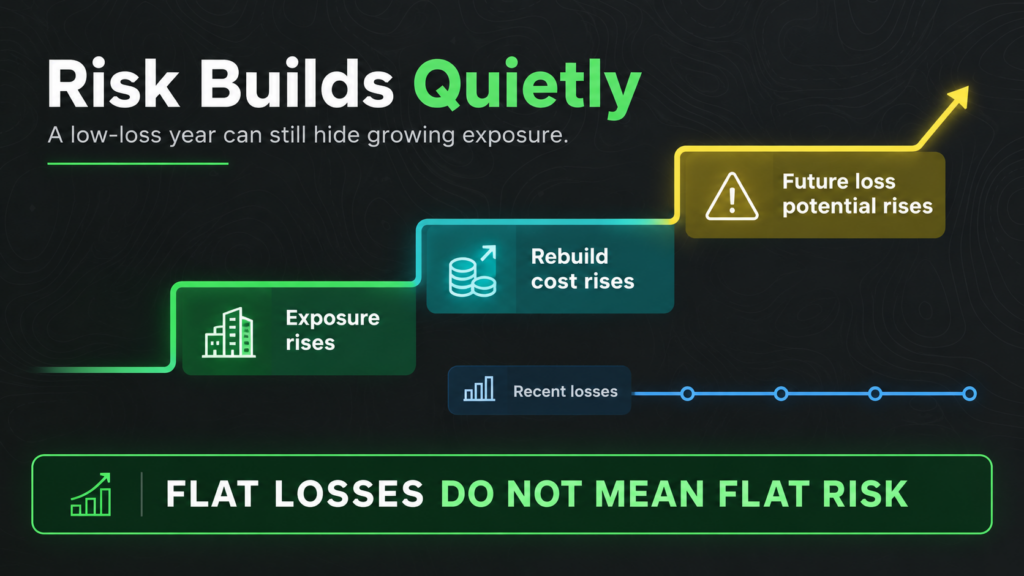
The second takeaway is that exposure is compounding even when losses are not. The report is explicit that the long-term drivers of catastrophe loss, growing exposure in hazard-prone areas and rising reconstruction costs, remain unchanged. Every new building added to a wildfire-exposed submarket, and every increase in rebuild cost, raises the loss that a future event will produce, regardless of how calm the current year feels. A flat loss year with rising exposure is not stability. It is accumulating risk that has not yet been billed.
The third takeaway is timing. Historically, the second half of the year accounts for around 58 percent of global insured catastrophe losses. A quiet first half, in other words, is not even a full read on the year in progress, let alone on the years ahead. Decisions made in the calm are the ones tested in the next severe season.
Use the Quiet Period to Prepare for the Next One
The practical response is not alarm, it is discipline. For the operators of insured commercial properties, a low-loss year is the ideal window to invest in hardening and defensible space while the pressure is off, so the improvements are in place before conditions turn. For underwriters and portfolio managers, it is the moment to stress-test accumulation against a large-fire scenario rather than against recent experience, to confirm that pricing reflects the hazard embedded in the book, and to resist the pull to loosen terms on exposure that has not changed simply because the calendar has been kind.
The Market Caught a Break, Not a Reduction in Risk
Swiss Re’s mid-year message, stripped down, is that the market caught a break on location and timing, not on risk. Wildfire is still the fastest-growing weather peril in the world, the conditions that drive it are intensifying, and the exposure inside western commercial portfolios keeps rising. The teams that use a quiet stretch to sharpen their view of that exposure will be far better positioned than the ones that use it to relax.
Underwrite the Exposure, Not the Recent Loss Run
That is the view Property Guardian is built to provide. Our property-level wildfire risk insight reports and portfolio exposure views let underwriting and risk teams see the hazard actually accumulated across their book, property by property, independent of last quarter’s loss run. When the loss numbers are low, that is precisely when a clear picture of underlying exposure is most valuable, because it keeps a quiet year from being mistaken for a safe one.
Sources
Swiss Re Institute, First-half 2026 catastrophe loss estimates (published Aug 11, 2026).
Record-breaking European wildfires and climate attribution (Carbon Brief, Aug 4, 2026).
2026 US wildfire season forecast (AccuWeather).
Climate risk pricing and catastrophe model updates, 2025 and 2026 loss context (Risk Coverage Hub).
