


The Quick Read
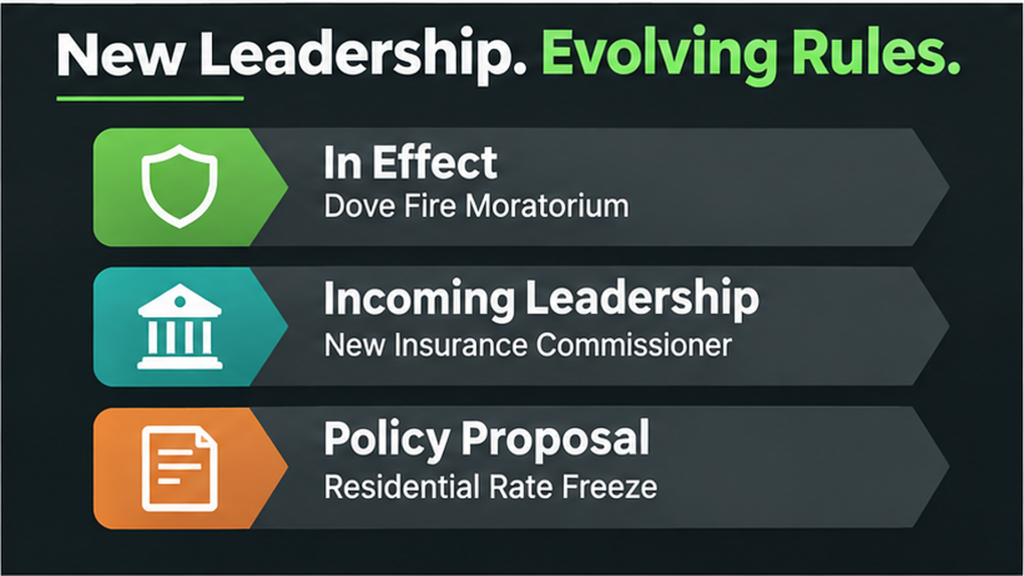
California is heading into a regulatory transition. Jane Kim won the race for insurance commissioner on a platform of affordability, nonprofit insurance options, and a public disaster insurance program that would reinvest in wildfire mitigation. Governor-elect Xavier Becerra has said he will pursue a freeze on home insurance rates, though details are unsettled and legal hurdles are likely under Proposition 103.
Meanwhile, on November 13, outgoing Commissioner Ricardo Lara ordered a one-year nonrenewal moratorium covering about 50,000 policies in 15 ZIP codes across Tuolumne, Stanislaus, and Calaveras counties after the Dove Fire. The order reaches certain commercial policies, including homeowners associations, apartment complexes, condominium associations, student housing, and senior living facilities. For habitational and mixed portfolios, moratoriums are now a recurring operational constraint, not a rare event.
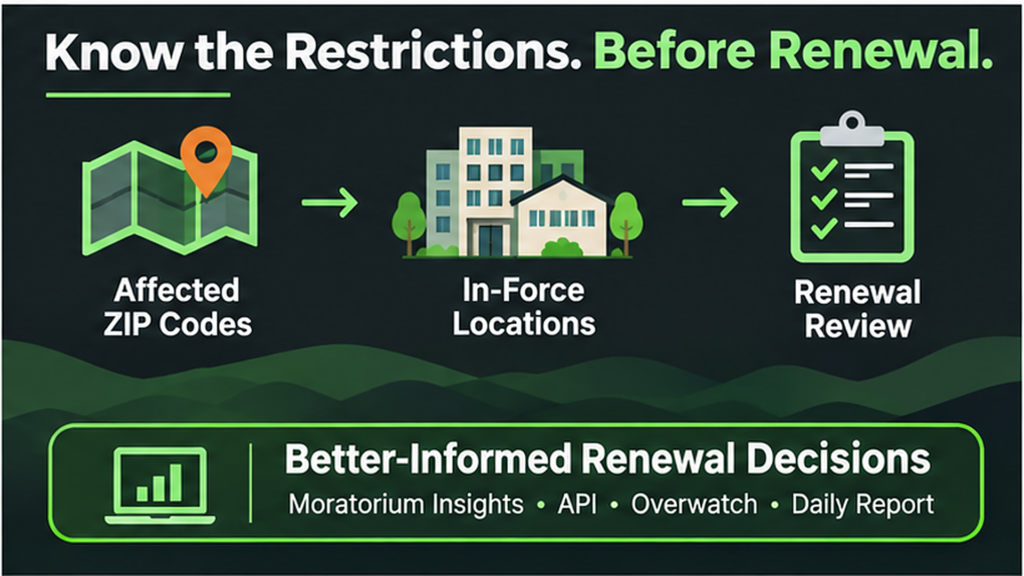
How Property Guardian Helps: Property Guardian’s Moratorium Insights identify which ZIP codes are under a wildfire moratorium and flag the in-force locations affected, so underwriting and renewal teams can plan around restrictions instead of discovering them at renewal.
California’s insurance market spent the last two years in a slow stabilization effort: new rules allowing catastrophe models and reinsurance costs in ratemaking, commitments from carriers to write more in high-risk areas, and a FAIR Plan that kept growing anyway. Verisk reports that California FAIR Plan exposure has risen 250% since 2022, reaching $768 billion in June 2026.
Now the people setting the direction are changing. The November election produced a new insurance commissioner and a new governor, both of whom campaigned on affordability. At the same time, the outgoing commissioner issued another post-fire moratorium that reaches into commercial habitational business. Each development is manageable on its own. Together, they signal that regulatory uncertainty will remain part of the California wildfire picture for commercial property teams through 2027.
“For habitational and mixed portfolios, moratoriums are now a recurring operational constraint, not a rare event.”
What the New Commissioner Has Said
Jane Kim, a progressive Democrat, defeated State Senator Ben Allen in the commissioner race. In an interview with KCRA published November 15, Kim said her campaign focused on affordability and outlined priorities for her first 100 days. She wants a more public-facing department with staff across the state.
Several of her stated goals bear on the commercial market. She aims to expand nonprofit insurance programs and to develop a public disaster insurance program that reinvests profits in wildfire mitigation, while acknowledging that a universal natural disaster program is complex and will take time to build. On the debate over utility wildfire liability, she said she had not yet been brought into those conversations, but she is open to discussing limits on insurers’ subrogation rights, with consumer affordability coming first.
“Any change to how those recoveries work would affect the net economics of wildfire exposure, and therefore pricing and capacity.”
She also committed to ensuring insurers do not deny, delay, or underpay valid claims.For commercial carriers and MGAs, the subrogation point deserves attention. Recoveries from utilities have been an important offset to wildfire losses in California. Any change to how those recoveries work would affect the net economics of wildfire exposure, and therefore pricing and capacity.
The Rate Freeze Question
Governor-elect Becerra has said he will pursue a freeze on home insurance premiums and utility bills, according to a spokesperson quoted by The Sacramento Bee on November 9. The form that action would take is unclear. Observers have noted that Proposition 103 requires the commissioner’s approval for rate changes, and that California courts have historically allowed rate freezes or rollbacks only where insurers retain an opportunity for relief. Kim has said she did not run on a rate freeze, though she would explore affordability tools, including freezing rates after a claim is filed.
Coverage of the proposal so far focuses on homeowners insurance, not commercial lines. Commercial teams should still watch it carefully. Policy signals in personal lines shape carrier appetite for the whole state, and habitational commercial business (condominium associations, HOAs, and apartment communities) often sits close to the line between the two.
The Dove Fire Moratorium Reaches Commercial Habitational Risks
The most concrete development of the week came on November 13. Commissioner Lara ordered a one-year moratorium barring insurers from canceling or nonrenewing about 50,000 residential policies in 15 ZIP codes within or around the Dove Fire perimeter, across Tuolumne, Stanislaus, and Calaveras counties. The fire forced evacuations near Sonora in late July, and the order follows the governor’s October 15 emergency declaration.
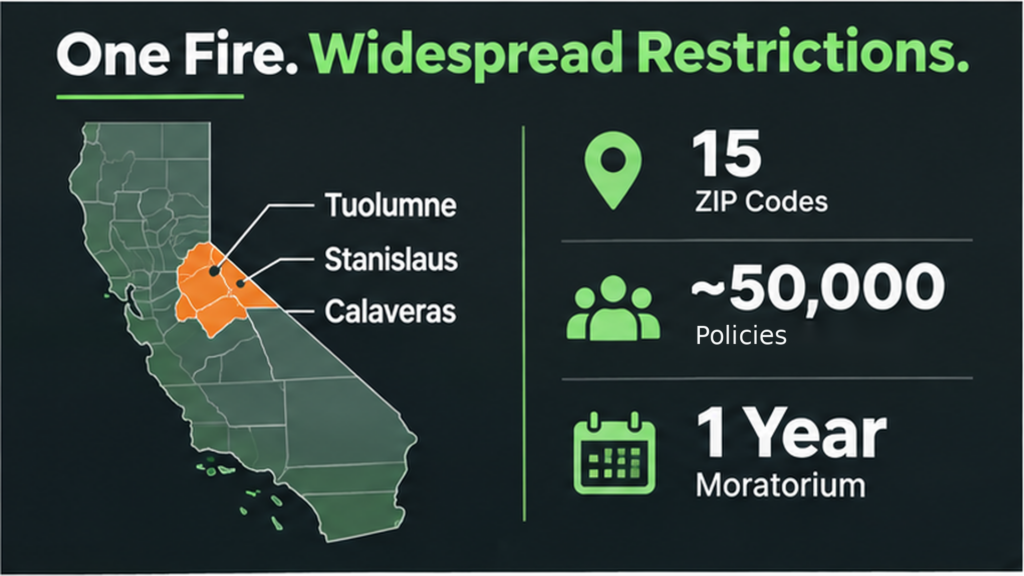
Three details matter for commercial property teams. First, the moratorium applies whether or not a property suffered a loss. Second, it extends to certain commercial property policies: those covering homeowners associations, apartment complexes, condominium associations, student housing, and senior living facilities. Third, insurers that sent wildfire-related cancellation or nonrenewal notices on or after the emergency declaration must offer to rescind them and reinstate or renew eligible policies.
Moratoriums are not new. The Department of Insurance says they protected more than 1.2 million policyholders in 2025 and over 4 million since the law took effect in 2019. What is notable is how routinely they now touch commercial habitational books, and how a relatively contained fire can still trigger a multi-county, year-long restriction.

Practical Takeaways for Commercial Property Underwriters & Risk Managers
- Treat moratoriums as a standing renewal constraint. Build a process to check every California habitational renewal against active moratorium ZIP codes, especially for HOA, condo, apartment, student housing, and senior living accounts.
- Audit recent notices. If your team issued wildfire-related nonrenewal or cancellation notices in the affected ZIP codes on or after October 15, confirm that rescission offers have gone out.
- Watch subrogation. Any shift in utility liability or insurers’ subrogation rights changes the net loss picture for California wildfire. Model scenarios with lower recovery assumptions.
- Separate personal lines noise from commercial signal. A residential rate freeze would not directly govern commercial pricing, but it can change carrier appetite and capacity statewide. Track appetite changes among your key markets.
- For corporate risk managers with California habitational assets: expect continued scrutiny at renewal, and come prepared with documented mitigation and property-level risk detail. Documentation is the best counterweight to uncertainty.
- Plan for 2027 now. The new administration takes office in January. Leave room in renewal timelines and program structures for rule changes in the first half of the year.
Where Property Guardian Fits
Regulatory change is hard to predict, but its operational effects can be managed. Property Guardian’s Moratorium Insights track which ZIP codes are under a wildfire moratorium and identify the in-force locations they affect, delivered through an API, within Overwatch, and as a daily report. That gives underwriting and renewal teams a clear view of where restrictions apply before a renewal decision is made. As California’s new leadership sets its agenda, our goal is to help commercial property teams stay compliant, informed, and ready to write the business they want.
Sources
- California Orders Insurance Nonrenewal Moratorium for 50,000 Following Dove Fire (Insurance Journal, November 13, 2026).
- State Insurance Commissioner-elect Jane Kim on her plans, wildfire liability, possible insurance rate freeze (KCRA, November 15, 2026).
- Gov.-elect Becerra’s rate freeze plan could pit him against powerful interests (The Sacramento Bee via InsuranceNewsNet, November 9, 2026).
- Verisk: Wildfire Insurance Claims Surge Despite Decline in Acres Burned (ProgramBusiness, November 11, 2026).
- Dove Fire incident coverage (CalMatters, July 2026).
