

The Quick Read
For years, formal wildfire mitigation stopped at the single-family front door. On June 9, 2026, IBHS closed that gap, releasing Wildfire Prepared Multifamily and Wildfire Prepared Neighborhood standards, the first parcel and community-scale wildfire mitigation benchmarks. Multifamily now carries Essential and Enhanced designation levels, and buildings three stories or less above grade are included as qualified structures.
This matters because multifamily is commercial property, and it is one of the segments carriers retreated from hardest. A designation tied to a published standard turns mitigation from an unverifiable claim into a documented, comparable data point an underwriter can actually price, while the Neighborhood standard targets the home-to-home spread that drives the largest accumulation losses.
How Property Guardian Helps: Property Guardian wildfire risk insight reports connect property-level mitigation to a clear, defensible view of a specific asset’s wildfire exposure, so underwriters can price what has actually been done and operators can see where their next dollar of mitigation will do the most good.
For most of its short history, formal wildfire mitigation stopped at the single-family front door. A homeowner could earn a recognized designation for hardening a house, but the owner of an apartment community or the developer of a new subdivision had no comparable third-party benchmark to point to. That gap mattered, because multifamily and community-scale properties are exactly the assets where wildfire losses can compound. On June 9, 2026, the Insurance Institute for Business and Home Safety (IBHS) closed it.
IBHS rounded out its Wildfire Prepared program with two new standards, Wildfire Prepared Multifamily and Wildfire Prepared Neighborhood, alongside updated requirements for single-family homes. For commercial property underwriters, brokers, and the operators of insured assets, this is a meaningful development. Parcel and community scale mitigation now has a defined, research-based credential that an underwriter can actually recognize.
What the New Standards Cover
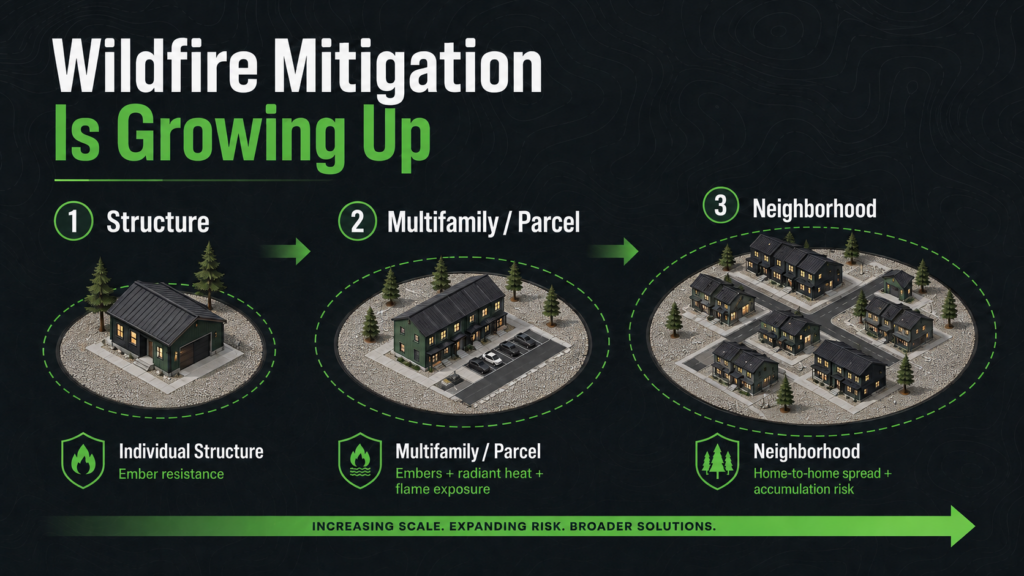
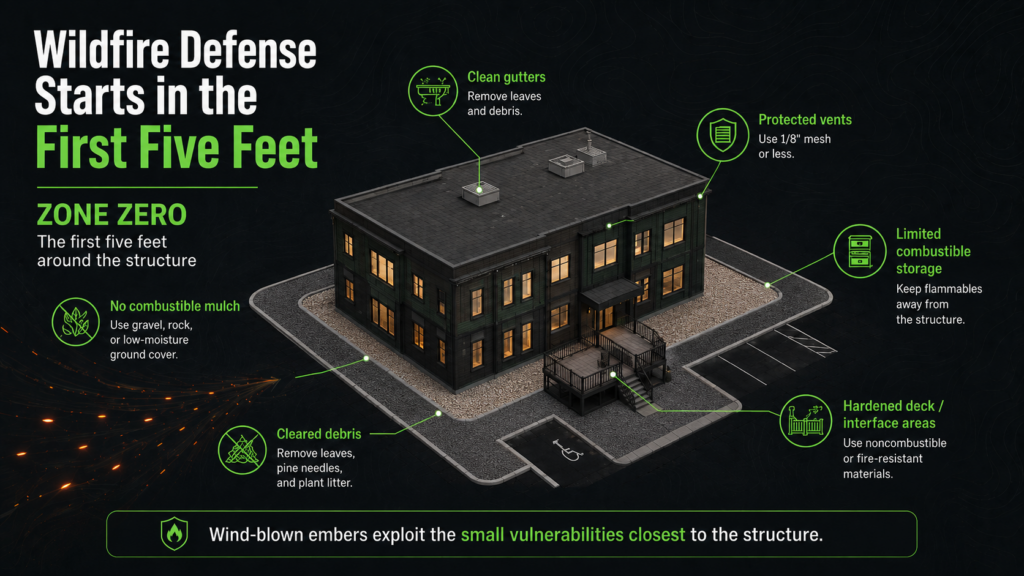
Wildfire Prepared Multifamily sets mitigation requirements for owners of duplexes, townhomes, apartments, and condominiums. It offers Essential and Enhanced designation levels that mirror the principles already used in the single-family program: cut off the pathways by which wind-blown embers ignite a structure, then add protection against radiant heat and direct flame contact at the higher tier. The 2026 update expands the list of qualified structures so that multifamily buildings three stories or less above grade are now included.
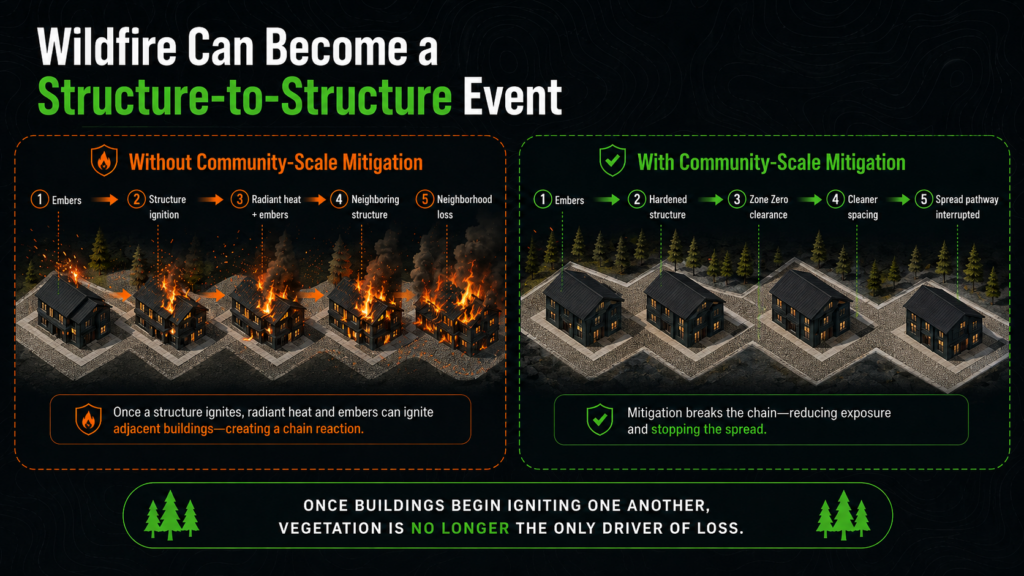
Wildfire Prepared Neighborhood takes the logic up a level. It is designed to reduce home-to-home wildfire spread, the mechanism that turns a single ignition into a conflagration once structures start igniting one another regardless of the surrounding vegetation. The neighborhood standard was first piloted with national homebuilder KB Home at sites in both Southern and Northern California. IBHS also expanded the overall Wildfire Prepared program to ten additional states earlier in 2026, bringing the total to fourteen, which widens the footprint where these designations are available.
This does not mean wildfire is suddenly cheap to cover. It means the pool of capital available to absorb wildfire losses is deeper and more diverse than it was even two years ago. For a peril that pushed multiple carriers out of California commercial property, that is a structural change worth understanding.
Why This Is Grounded in Real Fire Science
The standards are not a checklist for its own sake. IBHS research, built on post-event field investigations, full-scale experiments, and small-scale testing, consistently finds that most structures ignite from wind-blown embers landing in vulnerable spots rather than from a wall of flame. Gutters full of debris, mulch beds pushed against siding, unscreened vents, and gaps under decks are the recurring culprits. The area within the first five feet of a structure, often called Zone Zero, is the most vulnerable of all during an ember-driven event.
That science is why a neighborhood standard is more than a marketing wrapper. In a dense multifamily or subdivision setting, one poorly maintained building can throw embers and radiant heat onto its neighbors, defeating the mitigation those neighbors invested in. Addressing risk at the parcel and community scale is the only way to break the home-to-home chain that drives the largest interface losses.
Why Commercial Property Teams Should Care
Multifamily is commercial property. It is also one of the segments that carriers pulled back from hardest as wildfire losses mounted. Apartment and habitational portfolios in wildfire-exposed markets have faced non-renewals, shrinking admitted appetite, and a migration to the excess and surplus market. Until now, an owner who had genuinely hardened a complex had no standardized way to prove it, and an underwriter had no standardized way to reward it. A defined Multifamily designation begins to change that dynamic by turning mitigation from an unverifiable claim into a documented, comparable data point.
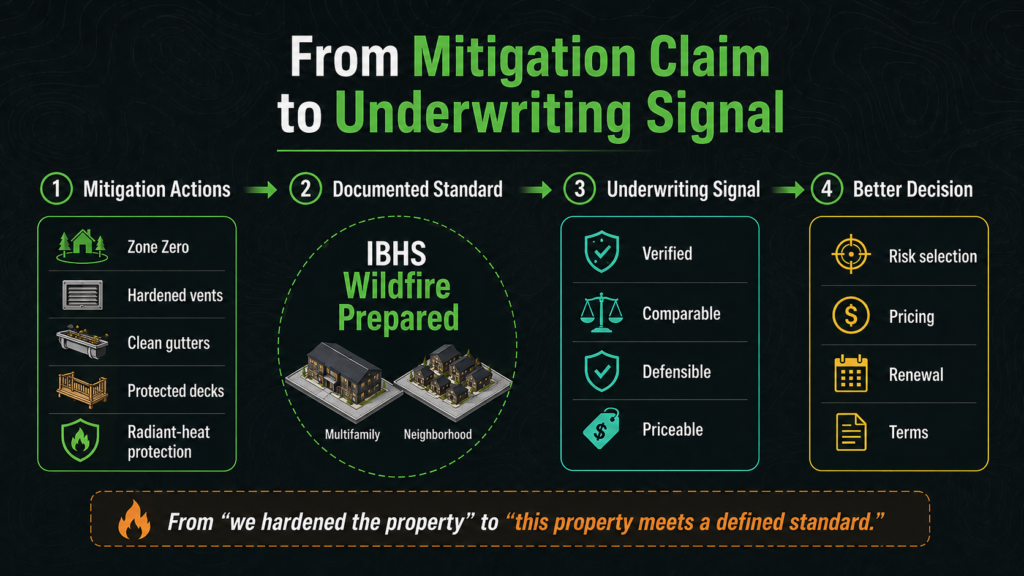
For underwriters, that is a cleaner signal. A designation tied to a published standard is easier to price and easier to defend than a broker narrative about defensible space. For risk managers and asset operators, it is a lever. Pursuing a designation can support renewal conversations, differentiate a property in a thin market, and, at the community scale, reduce the accumulation risk that makes wildfire so punishing for insurers in the first place.
Practical Takeaways
For underwriters and brokers, start treating the Multifamily and Neighborhood designations as recognized inputs where they appear, and ask for them on habitational and community-scale risks in wildfire-exposed states. A property pursuing Enhanced-level mitigation is telling you something specific about radiant-heat and flame-contact resilience, not just ember defense.
For owners and operators of insured commercial properties, identify which assets in high-risk states are candidates for a Multifamily designation, and prioritize the Zone Zero and ember-entry fixes that the research shows matter most. Where you control adjacent parcels or a whole community, the Neighborhood standard is worth evaluating because it targets the home-to-home spread that individual-building hardening cannot fully solve.
For everyone, remember that a designation is a snapshot. Mitigation degrades as vegetation regrows, debris accumulates, and tenants alter balconies and storage. The value of the credential depends on maintaining the condition it certified, which argues for periodic reassessment rather than a one-time sign-off.
The Bottom Line
The arrival of standardized multifamily and neighborhood mitigation is a quiet but important maturation of the wildfire market. It gives commercial property teams a common language for something that has been frustratingly hard to verify, and it does so at exactly the scale where wildfire losses concentrate. In a market where mitigation increasingly decides not just price but whether a risk gets written at all, a credible standard is a tool worth using.
At Property Guardian, this is the kind of signal we build into our wildfire risk insight reports for commercial property teams: connecting property-level mitigation to a clear, defensible view of a specific asset’s wildfire exposure, so underwriters can price what has actually been done and operators can see where their next dollar of mitigation will do the most good. As the standards mature, the teams that pair them with sharp, property-specific risk insight will be the ones setting terms rather than reacting to them.
Sources
IBHS, Wildfire Prepared program rounded out with Neighborhood and Multifamily standards (June 9, 2026).
HousingWire, IBHS adds neighborhood and multifamily wildfire standards for Western builders.
Insurance Business, IBHS expands Wildfire Prepared program to cover multifamily properties.
Milliman, Zone Zero in wildfire mitigation: an introduction to defensible space.
Property Guardian, The Two-Speed Wildfire Market Is Here.
