

The Quick Read
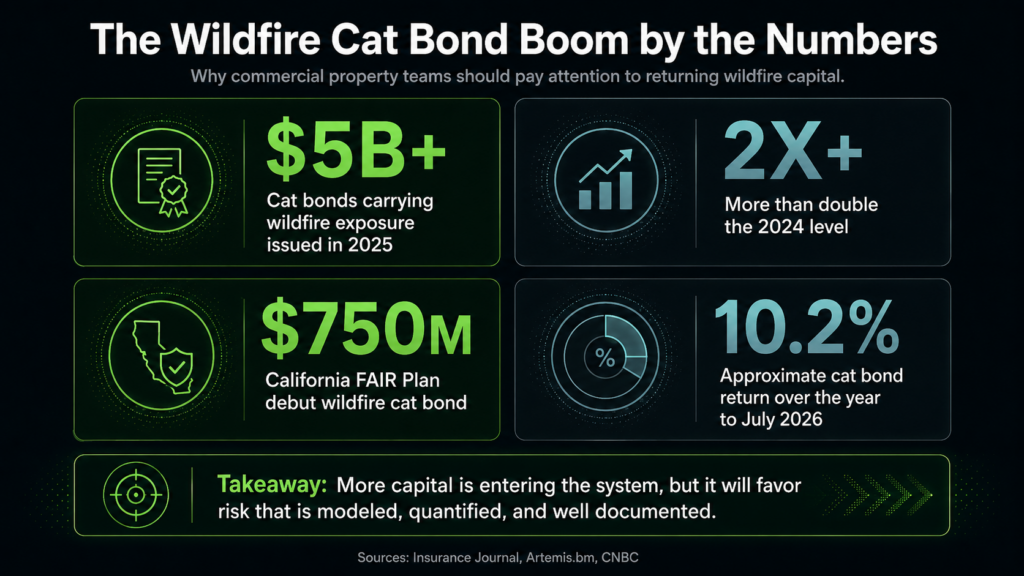
Wildfire has gone from a peril capital markets avoided to a category investors actively want. In 2025 insurers issued more than 5 billion dollars of cat bonds with wildfire exposure, over double the prior year, and in December the California FAIR Plan sponsored a debut 750 million dollar wildfire cat bond, the largest ever brought to market.
This capital does not buy vague exposure. It buys modeled, documented, location-specific risk, and that same expectation is flowing into how individual commercial accounts get underwritten. Precise, well-documented risk attracts competition. Black-box risk keeps paying for the uncertainty.
How Property Guardian Helps: Property Guardian wildfire risk insight reports and portfolio-level exposure and accumulation views give underwriting and risk teams the location-specific, modeled detail capital markets now expect, so your accounts compete on facts rather than fear.
For most of the last decade, wildfire was the peril that capital markets preferred to avoid. It sat quietly inside broader earthquake and hurricane catastrophe bonds, rarely named on its own and rarely priced on its own. Investors treated it as too unpredictable to model and too correlated with a warming climate to hold. That reluctance is now breaking down, and the change carries real consequences for anyone underwriting or managing commercial property in the West.
In 2025, insurers issued more than $5 billion in catastrophe bonds carrying some level of wildfire exposure. That is more than double the level of 2024. Wildfire has moved from a footnote to a category of its own, and dedicated investors are lining up to take the risk on.
The clearest signal came from an unlikely sponsor. In December 2025, the California FAIR Plan, the state insurer of last resort, priced its debut wildfire catastrophe bond and secured 750 million dollars of reinsurance through the Golden Bear Re Series 2026-1 issuance. It was the largest wildfire cat bond ever brought to market, and the deal has since become the reference point everyone else measures against.
When the market backstop itself taps the capital markets directly, it tells you two things. Traditional reinsurance alone is no longer enough to carry the load, and investors who once considered wildfire untouchable are now willing to price it, buy it, and hold it.
Why Investors Changed Their Minds
The shift is not a leap of faith. It follows a steady improvement in wildfire catastrophe modeling. Newer models capture fuel conditions, ember transport, and the specific ways fire moves through the wildland-urban interface, giving fund managers enough confidence to underwrite the risk rather than shy away from it. Once a peril can be modeled with credibility, it can be priced, and once it can be priced, capital follows.
The returns have helped the case. Catastrophe bonds returned roughly 10.2 percent over the year to July 2026, a strong result that has drawn fresh money into insurance-linked securities broadly. As spreads have narrowed, the cost of issuing a bond has fallen, and 2026 issuance is expected to be heavy. In plain terms, more capacity is entering the system, and a meaningful share of it is now willing to stand behind wildfire risk.
“Once a peril can be modeled with credibility, it can be priced, and once it can be priced, capital follows.”
This does not mean wildfire is suddenly cheap to cover. It means the pool of capital available to absorb wildfire losses is deeper and more diverse than it was even two years ago. For a peril that pushed multiple carriers out of California commercial property, that is a structural change worth understanding.
What It Means for Commercial Property Teams
The arrival of alternative capital does not lower anyone premium on its own. What it does is reward precision. Catastrophe bond investors do not buy vague exposure. They buy modeled, quantified, well-documented risk. That same expectation is flowing downstream into how commercial property is underwritten. The accounts that can show clean, location-specific risk data will find more markets willing to compete for them. The accounts that cannot will keep paying for the uncertainty.
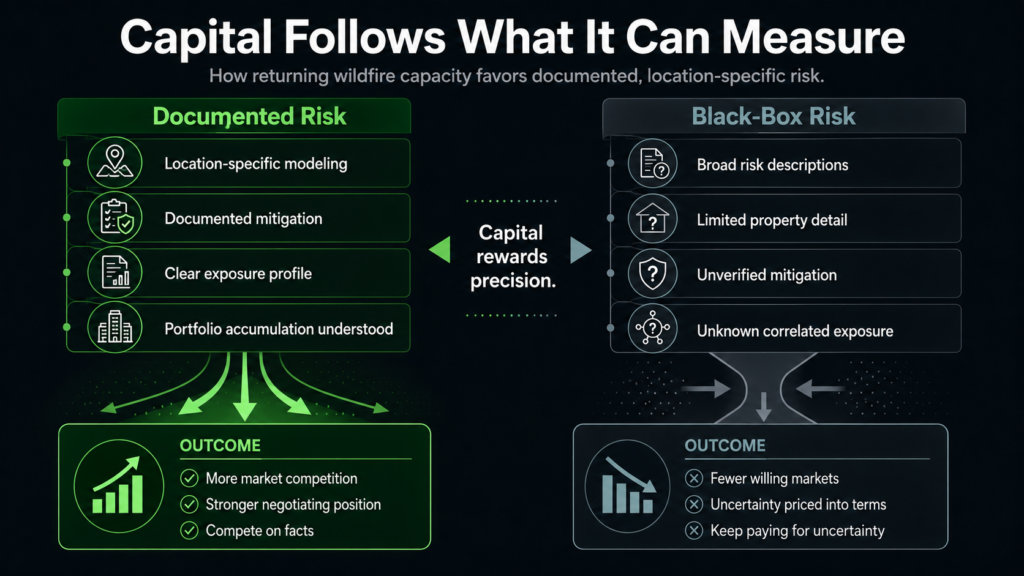
There are a few practical implications for underwriters, risk managers, and the operators of insured commercial properties. First, expect the data bar to keep rising. As more wildfire risk is financed through instruments that demand granular modeling, the underwriting questions asked of individual properties will grow more specific, not less. Portfolios described in broad strokes will be treated as riskier than portfolios described in detail.
Second, watch how capacity is distributed rather than just how much exists. Fresh capital tends to flow toward the risks it can measure and away from the risks it cannot. A commercial property with documented mitigation and a clear exposure profile sits on the right side of that flow. A property that looks like a black box does not, regardless of how much total capacity is in the market.
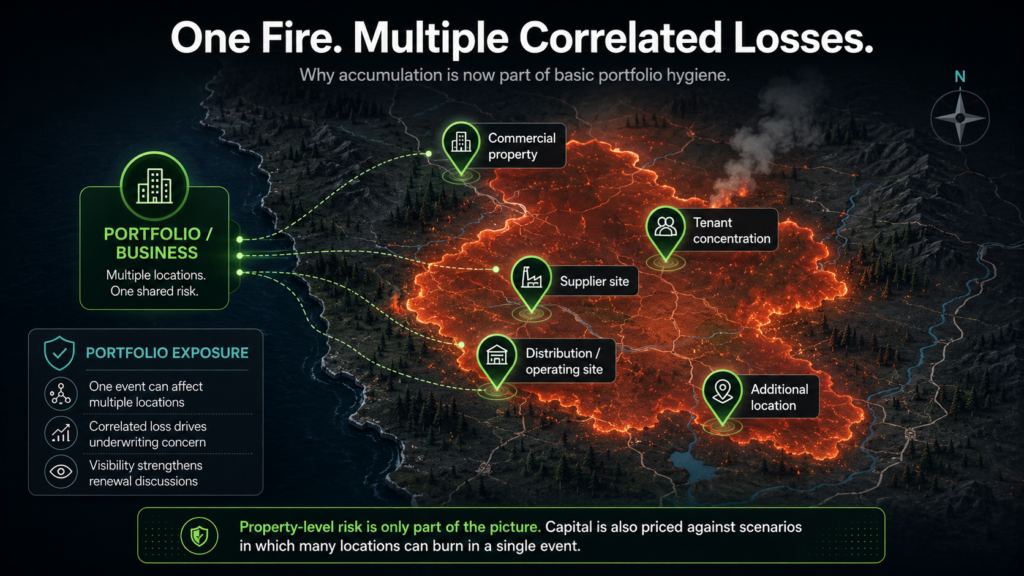
Third, treat accumulation as a first-order concern. Alternative capital is priced against modeled loss scenarios that assume many properties can burn in a single event. Risk managers with multiple locations, tenants, or supplier sites in the same fire-prone region should understand their combined exposure the way an investor would, before a renewal forces the conversation. Knowing where your correlated risk sits is now part of basic portfolio hygiene.
Finally, use the moment. A market with more capital and more competition is a market where good information earns better terms. The teams that invest in understanding and documenting their wildfire exposure now will be the ones positioned to negotiate from strength as capacity keeps rebuilding.
The Bottom Line
The catastrophe bond boom is a vote of confidence in the idea that wildfire risk can be measured. That confidence rewards specificity at every level of the market, from the largest reinsurance tower down to the individual commercial account. The question for property teams is no longer whether capital will show up. It is whether your exposure is documented well enough to attract it on favorable terms.
At Property Guardian, this is the gap we help close. Our wildfire risk insight reports and portfolio-level exposure and accumulation views give underwriting and risk teams the location-specific, modeled detail that capital markets now expect. When your risk is clearly quantified, you are no longer competing on fear. You are competing on facts.
Sources
Insurance Journal, Catastrophe Bonds Linked to Wildfires Lose Untouchable Status
Artemis.bm, California FAIR Plan debut 750m cat bond
CNBC, Why the catastrophe bond market is so hot right now
World Economic Forum, Catastrophe bonds are helping insurers manage climate risks
