
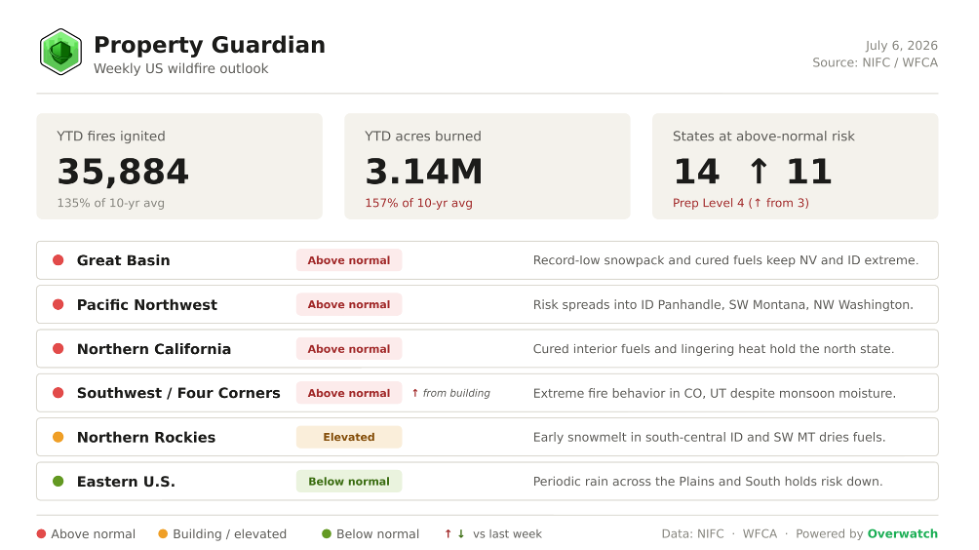
The U.S. enters this week deep in an intensifying fire season. 3.14 million acres have already burned year-to-date — 157% of the 10-year average — across roughly 35,900 fires nationwide, and the week ahead opens with national resources stretched thin across the West.
Heading Into This Week
NIFC opens the week at National Preparedness Level 4, up from 3, as fire activity across the Great Basin, central Rockies, and Southwest pushes national resources into heavy commitment. The number of states at above-normal fire risk climbs from 11 to 14, as the Southwest/Four Corners region re-escalates to above normal, joining sustained above-normal conditions across the Great Basin and Pacific Northwest.
Major Fires We’re Watching This Week
Six large fires anchor this week’s Preparedness Level 4 posture across the Four Corners region:
- Cottonwood (UT) — 94,400 acres, 23% contained. More than 150 structures lost; now the 6th-largest fire in Utah history.
- Babylon (UT) — 87,600 acres, 0% contained. Burning near Bears Ears National Monument; Canyonlands National Park’s Needles District remains closed.
- Aspen Acres (CO) — 89,100 acres, 13% contained. Colorado’s 7th-largest fire on record, with evacuations spanning Beulah, Colorado City, Rye, San Isabel, and Wetmore.
- Ferris (CO) — 41,300 acres, 7% contained. Threatening Dolores, Lone Mesa State Park, and the McPhee Dam corridor.
- Gold Mountain (CO) — 26,400 acres, 0% contained. Sparked by a downed power line near Ouray; evacuations remain active around Ridgway.
- Pocket (AZ) — 25,200 acres, 38% contained. Burning north of Sedona; flight restrictions remain in place at Flagstaff.
What’s driving the week ahead
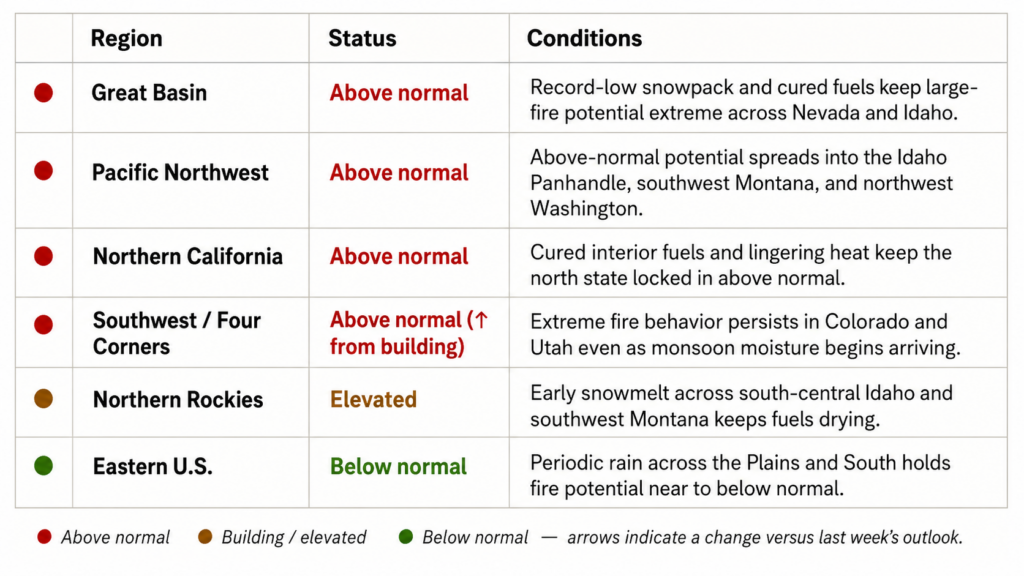
Conditions still trace back to a historically thin snowpack. Western snow water equivalent bottomed out near 65% below the 1991–2020 normal this spring — the lowest on record in Arizona, Colorado, Idaho, Nevada, New Mexico, Oregon, Utah, and Wyoming — and it has been fully spent for weeks. Roughly 48% of the Lower 48 remains in drought, and fuels across the Great Basin and Rockies are critically cured. Building this week is a strengthening El Niño (the Niño 3.4 index near +1.7°C and still climbing) that is reinforcing hot, dry conditions across the Northwest even as Southwest monsoon moisture starts to arrive.
That same El Niño pattern favors a near-to-above-normal Southwest monsoon this month, but forecasters don’t expect it to meaningfully offset the deep Great Basin and Northwest drought until mid-to-late summer, leaving those regions the most exposed over the next several weeks.
Regional risk outlook
What This Means for Property Owners, Insurers, and Risk Managers
A National Preparedness Level of 4 and a newly above-normal Southwest mean the week ahead is the time to verify exposure and harden assets, not in August. Property Guardian’s Overwatch platform keeps that picture current as conditions shift, region by region, week by week.
Sources
National Interagency Fire Center (Statistics, National Fire News, Incident Management Situation Report, National Significant Wildland Fire Potential Outlook), Drought.gov, Climate Central, NOAA Climate Prediction Center, and the National Weather Service.
