
Event Snapshot
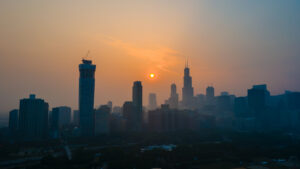
As of Thursday, July 16, 2026, wildfire smoke from more than 800 active fires burning across Canada, combined with at least 17 wildfires burning across Minnesota’s Superior National Forest, has triggered air quality alerts stretching from the Great Lakes to the Mid-Atlantic. Pennsylvania’s Department of Environmental Protection has declared a statewide Code Red air quality action day for fine particulate pollution, Michigan’s entire state is under an alert, and the densest surface smoke has been forecast to reach as far south as the Washington, D.C. area. Meteorologists in the Northeast are calling it the most significant smoke event to hit the region since the historic orange-sky event of June 2023.
The Fires Behind the Smoke
Two separate fire complexes are driving this event, one in Canada and one in northern Minnesota, and both are burning under nearly identical conditions.
In Canada, fire activity picked up sharply in late June and early July after a slow start to the season. As of mid-July, almost 850 fires were burning nationwide, more than 180 of them in Ontario. Northwestern Ontario has been hit hardest, with 185 active wildfires (148 in the northwest region, 37 in the northeast) reported on July 15, 69 of which remain uncontrolled. Evacuation orders have hit multiple First Nations communities, including Armstrong, Whitesand First Nation, Lac des Mille Lacs First Nation, Collins First Nation, and Cushing Lake, and a rail crew had to be evacuated from a CN train after fire closed in around it. Manitoba has also seen significant activity, with Lynn Lake among the communities forced to evacuate, and a plane crash during firefighting operations near Fort Simpson, Northwest Territories, killed a pilot and three firefighters. Canada has burned roughly 1.9 million hectares (4.7 million acres) year to date, still below the extreme seasons of 2023 and 2025, but activity is accelerating, with above-average temperatures forecast into August.
In Minnesota, a lightning storm on July 6 ignited a cluster of fires across the Superior National Forest and the Boundary Waters Canoe Area Wilderness (BWCAW). Extreme heat, drought, and wind then drove explosive growth that officials say the region has not experienced in over two decades. The U.S. Forest Service closed the entire BWCAW to the public on July 14. As of this week, at least 17 fires have burned more than 33,000 acres, led by the Bear Trap Fire (roughly 12,900 acres) and the Thumb Fire (roughly 12,300 acres, both of which have since crossed into Canada), the Sioux Fire (roughly 6,900 acres), and the Wolfpack Fire (roughly 2,200 acres).
Conditions Driving It
Both fire zones share the same ingredients: severe drought, record or near-record heat, and dry, gusty winds. Columbia University climate scientist Dan Westervelt described the setup as a perfect storm of dry conditions providing ample fuel. That combination explains why fires that started within the past ten days have already grown into five- and six-figure acreage events, and why the resulting smoke has traveled thousands of miles instead of dissipating locally.
Air Quality Impact Across the Country
The smoke plume has covered an unusually wide footprint. Toronto’s air quality was rated the worst in the world on July 15. Boston’s skies turned an ominous brown-yellow, and residents in Maine reported yellowish, brownish skies of their own. Michigan’s entire state, most of Minnesota, multiple counties in western and central New York, and now Pennsylvania statewide have all been placed under air quality alerts. Health officials across the affected states are giving largely the same guidance: limit outdoor exertion, keep windows closed, run air conditioning on recirculation or a HEPA purifier, and wear an N95 mask for any unavoidable time outside. Fine particulate matter (PM2.5) from wildfire smoke is among the most toxic forms of air pollution, and researchers have linked chronic wildfire smoke exposure to tens of thousands of premature deaths annually in the U.S.
Historical Context
Millions of people across the Midwest and Northeast are affected, a scale increasingly reminiscent of June 2023, when Quebec wildfire smoke turned New York’s skies orange and grounded flights up and down the East Coast. That event reshaped how insurers, risk managers, and regulators think about wildfire exposure outside the traditional Western U.S. wildland-urban interface. This week’s event suggests that shift is becoming the new normal rather than a one-off.
What This Means for the Industry
For underwriters, this is a reminder that wildfire risk is no longer a regional peril confined to California, the Mountain West, or even the wildland-urban interface generally. Smoke, and the business interruption it triggers, now travels independently of the fire line, and it is landing on portfolios in Philadelphia, Detroit, Boston, and Washington that were never modeled for wildfire exposure at all.
The insurance and legal fallout from smoke-only events is still unsettled. Courts have split on whether smoke infiltration without structural damage satisfies the direct physical loss or damage trigger that most commercial property and business interruption policies require. In Bottega LLC v. National Surety Corporation, a court found coverage where smoke odor and soot demonstrably altered a restaurant’s usability. In Gharibian v. Wawanesa General Insurance Co., a court went the other way, finding that smoke and ash were easily cleaned or removed and did not constitute physical loss. One widely cited industry account describes a Great Lakes facility with an undamaged building that still lost days of operation to hazardous air quality from Canadian wildfire smoke, only to have its business interruption claim denied outright because the policy required physical damage the smoke never caused. California’s Department of Insurance has convened a task force specifically to study smoke damage remediation standards, and Nevada has already moved to let insurers strip wildfire coverage out of standard policies entirely.
The practical takeaway for carriers, MGAs, and risk managers: civil authority coverage, dependent property extensions, and non-damage business interruption endorsements are the tools that actually respond to a smoke-only event, and most standard policies do not include them by default. Portfolios in states that have never been thought of as wildfire exposed deserve the same scrutiny on these endorsements that Western portfolios have received for years.
Forward Look
Neither the Canadian nor the Minnesota fire complexes are expected to reach containment soon. Forecasters expect smoky conditions to persist into Friday, with relief arriving only behind a storm system this weekend. Canada’s own seasonal outlook points to above-average fire danger continuing into August across the Northwest Territories, Manitoba, and northern Ontario and Quebec, meaning this is unlikely to be the last smoke event to reach the East Coast this summer. For an industry still calibrating how to underwrite a peril that increasingly ignores state lines, that persistence is the real headline.
Sources
- The Philadelphia Inquirer, “Wildfire smoke and a Delco junkyard fire raise concerns about Philly air quality amid high temps,” July 15, 2026
- PhillyVoice, “Philly region’s air quality to be impacted by Canadian wildfires,” July 15, 2026
- CBS Philadelphia, “Hazy and humid weather in Philadelphia Thursday, air quality alert in effect from Canadian wildfire,” July 16, 2026
- CBS News / AP, “Wildfires expose millions in Midwest, Northeast to dangerous smoke,” July 15, 2026
- WHYY News, “Wildfire smoke sparks Code Red air quality warning for Pennsylvania,” July 16, 2026
- NASA Earth Observatory, “Ontario Wildfire Smoke Moves East,” July 2026
- CP24 / CTV News, “Nearly 200 wildfires burning in northern Ontario amid evacuations, highway closures,” July 15, 2026
- CBC News, “Wildfires prompt multiple evacuations in northwestern Ontario amid extreme heat,” July 14, 2026
- ABC News, “At least 17 forest fires force evacuations in Minnesota as smoke spreads,” July 14, 2026
- MNICS.org, Superior National Forest Wildfires Fact Sheet, July 15, 2026
- Environment + Energy Leader, “The Insurance Exclusions That Facilities Teams Are Not Seeing Coming,” 2026
- Anderson Kill P.C., “Business Interruption Coverage for the Los Angeles Wildfires,” and Risk Management Magazine, “Coverage for Business Interruption Loss from L.A. Wildfire Smoke Damage”
- California Department of Insurance, Smoke Claims & Remediation Task Force Report, 2026
