
Wildfire Resiliency Score
Granular wildfire risk scores and mitigation insights designed to enhance underwriting, portfolio management, and risk mitigation strategies. Seamlessly integrate these data into your systems to supercharge risk selection and reduce reinsurance costs.
Scale & Enhance Selection for Every Risk
Measuring what matters in wildfire risk — because resilience decides outcomes
Ready to transform your approach to wildfire risk analysis? Our methodology goes beyond basic hazard scoring to evaluate mitigation quality and site vulnerability — showing how resilient a property is when wildfire occurs, not just how exposed it is. With fast, secure endpoints, you’ll access a derived score built from 150+ underlying risk data points, capturing the four foundational resolutions that influence catastrophe modeled losses and reinsurance costs: structure, parcel, community, and region. It’s more than data — it’s the clarity you need to enhance selection, streamline workflows, and improve profitability.

Fast, Confident Risk Validation
Quickly validate wildfire risk at submission; reduce turnaround time while maintaining confidence.

Scalable Appetite Expansion
Expand acceptance of high-value wildfire risks previously slowed or declined due to uncertainty.

Consistent, Defensible Decisioning
Improve internal alignment and confidence when explaining wildfire decisions to management, committees, and stakeholders.
Key features and benefits include:
- Resilience-Focused Score: Evaluates mitigation quality and vulnerability to reflect real-world survivability, not just exposure.
- Four-Dimension Risk Profile: Captures multiple dimensions of risk:
- Structure: Roof condition/materials, roof debris, tree overhang
- Parcel: Tree density, building density, slope, position on slope
- Community: Conflagration risk, fire protection, ember potential, ease of access
- Region: State/national relativity, wind region, seasonality
- Key Mitigation Modifiers: Quantify defensible space, fire-resistant materials, and other mitigation attributes — and their influence on catastrophe modeling credits.
- Fast, Secure API Endpoints: Leverage three endpoints to return scores, modifiers, or all results. Every request is authenticated for top-tier security.
- Developer-Centric Onboarding: Easy onboarding with documentation and a dedicated development endpoint for smooth integration. SwaggerUI available to try it out.
Wildfire Resiliency Score By The Numbers
advanced wildfire data points used in our insights
week onboarding to get you quickly up and running
states where Wildfire Risk Insights are available
seconds to receive comprehensive wildfire risk insights
Resilience Changes the Math

Wildfire Risk Is a Two-Stage Problem
Area factors determine whether fire arrives; parcel conditions help determine whether a property survives direct exposure.

Parcel Conditions Drive Survival
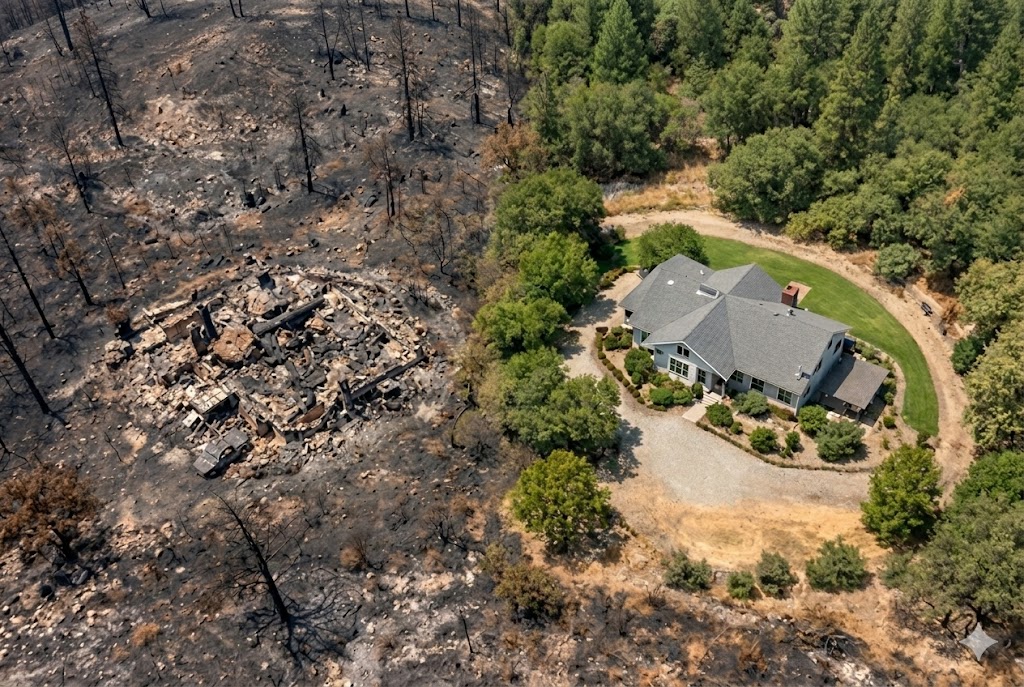
Fire-exposed properties with poor parcel conditions have approximately 114-124× higher destruction odds than well-managed parcels.

Mitigation Can Reduce Destruction Odds ~99%
Improving parcel conditions from high-risk to low-risk reduces destruction odds by roughly two orders of magnitude.
Discover How Our API Services Can Transform and Elevate Risk Selection
What is an API?
The acronym API stands for Application Programming Interface and in practical terms is a format through which data is exchanged between two companies/endpoints. In simple terms, one company “calls” out for some information and the other responds to that request.
How does the data exchange happen?
An API has request parameters or a clear definition of the data available. The user makes a call out to our system looking to pull that data set back into their system, using the returned data in whatever format they prefer. Every client pulls/receives the same data from Property Guardian. We do not yet provide bespoke data for individualized requests, we define the data set that’s available.
What information is needed to initiate an API call?
To get the optimal result a user is expected to provide the latitude and longitude of the property in question, as well as the street address. We will geocode the location off the street address using Google if latitude and longitude are not provided.
What happens when Property Guardian receives a data call?
Each time we receive an API call we reach out to our best-in-class data providers to get the needed information and pass it back to the user in the same format every time. We don’t simply pass this data along, instead we aggregate and translate the data in our own unique way to optimize the API deliverable. This approach also adheres to the contractual parameters we’ve established with our handpicked data sources. It’s worth noting that each call that we initiate to our data sources generates fees that we must pay, as such during testing of a new integration we establish a QA endpoint to limit the incursion of these costs.
Can the Property Guardian API integrate with third-party platforms?
Many insurance clients will use a third-party platform to manage their underwriting process, so Property Guardian must be able to integrate with these platforms. We would expect the third party to authenticate in the same way as the end user/client. And our relationship would be with the client using our data, not the third party that’s passing that data along. The third party defines where in the application the outreach to Property Guardian appears to the user. The rules around how/where our data appears is of no consequence to us.
Example: An integration between Property Guardian and the client might be a “call” button to our score and modifiers that is activated on an underwriter’s screen whenever Hazard Hub returns a score of 70 or higher for a specific location.
Can anyone access the data?
No, only credentialed external users can access the Property Guardian URL. We have an established authentication method that is employed every time an external user makes a data request. An external user is assigned a specific set of credentials (email and password) and an access token that must be provided before each request for data can be processed. This methodology also allows us track usage levels per client.
What makes our API experience different?
Unlike other options that offer just a score, Property Guardian provides deeper insights. Property Guardian provides an overall score AND the breakdown of that score. Our output exposes the primary risk factors driving each of the four foundational scores (structure, parcel, community, and region) that ultimately shape our overall resiliency score. We also provide insight on secondary modifiers that help drive reinsurance costs.
Revolutionize Risk Assessment!
Explore the Property Guardian difference and unlock the power of deeper risk insights. Connect with us today to learn more about our Wildfire Resiliency Score!