
Nebraska’s Wildfire History Is a Warning About the Future
March 16, 2026
By Brian Bastian, Head of Product
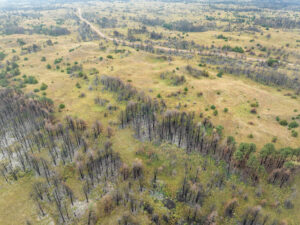
Wildfires have always been part of Nebraska’s landscape. But the fires burning across the state today — including the widespread spring 2026 wildfires that triggered emergency actions and burn bans — reflect a wildfire risk environment that is rapidly evolving.
Longer fire seasons, volatile wind-driven grassfires, expanding woody fuels, and limited firefighting resources are converging across the Great Plains.
To understand why Nebraska is seeing more destructive fires, it helps to look at three interconnected forces:
- The state’s natural fire history
- Changing landscapes and climate conditions
- The structure of Nebraska’s firefighting system
Together, they reveal a crucial reality: wildfire risk in Nebraska is increasing at the same time response capacity is stretched thin.
Fire Is Part of Nebraska’s Ecological DNA

For thousands of years, fire shaped Nebraska’s grassland ecosystems.
Lightning ignitions and Indigenous burning practices created a frequent prairie fire regime, particularly in the Sandhills. Historical research indicates fires occurred roughly every four to five years, maintaining open grasslands and preventing widespread tree growth.
These fires were typically fast-moving but low in intensity because they burned primarily through grasses rather than dense forests.
Fire played several ecological roles:
- Maintaining prairie biodiversity
- Recycling nutrients in grassland soils
- Preventing woody encroachment
In many ways, Nebraska’s landscape evolved alongside fire.
Settlement Altered the Fire Cycle
European settlement fundamentally changed how fire behaved across Nebraska.
Agriculture, fencing, roads, and organized fire suppression fragmented the landscape and reduced the frequency of fires. One documented example shows fire intervals increasing from roughly 3.5 years in the late 1800s to about 8.5 years by the mid-20th century.
That shift allowed woody vegetation to expand into areas historically dominated by grasslands.
One species has played a particularly important role: Eastern Red Cedar.
Without regular fires, redcedar spreads aggressively across rangeland, transforming fuel structures and creating conditions for hotter, more destructive fires.
This change in vegetation is now recognized as a key contributor to catastrophic wildfire behavior in Nebraska.
Nebraska’s Largest Wildfires Have Happened Recently
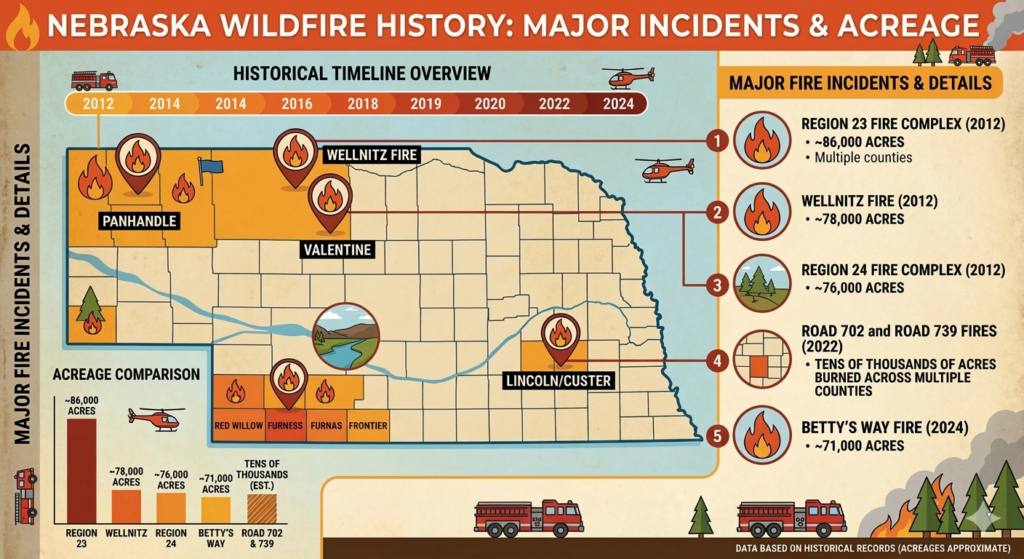
While fire has always been present in Nebraska, some of the largest wildfires in state history have occurred within the past two decades.
Major events include:
- Region 23 Fire Complex (2012): ~86,000 acres
- Wellnitz Fire (2012): ~78,000 acres
- Region 24 Fire Complex (2012): ~76,000 acres
- Betty’s Way Fire (2024): ~71,000 acres
- Road 702 and Road 739 Fires (2022): tens of thousands of acres burned across multiple counties
The year 2012 stands out as a watershed moment, when more than 503,000 acres burned statewide, a 1,286% increase over the previous year.
These fires demonstrated how quickly Nebraska’s grasslands can produce massive wildfire events when drought and wind align.
The Wildfire Season Is Expanding
Historically, Nebraska’s wildfire season was concentrated in summer and fall.
That pattern is changing.
Recent fires — including the recent, large spring wildfires in 2026 — show how cured grasses and strong winds can produce dangerous fire conditions well before traditional wildfire season.
Environmental officials increasingly describe Nebraska’s wildfire risk as year-round, reflecting the influence of drought, wind events, and fuel changes.
These shifts mean that large fires are now possible during:
- Late winter
- Early spring
- Summer drought periods
- Autumn wind events
The Three Forces Driving Nebraska Wildfire Risk
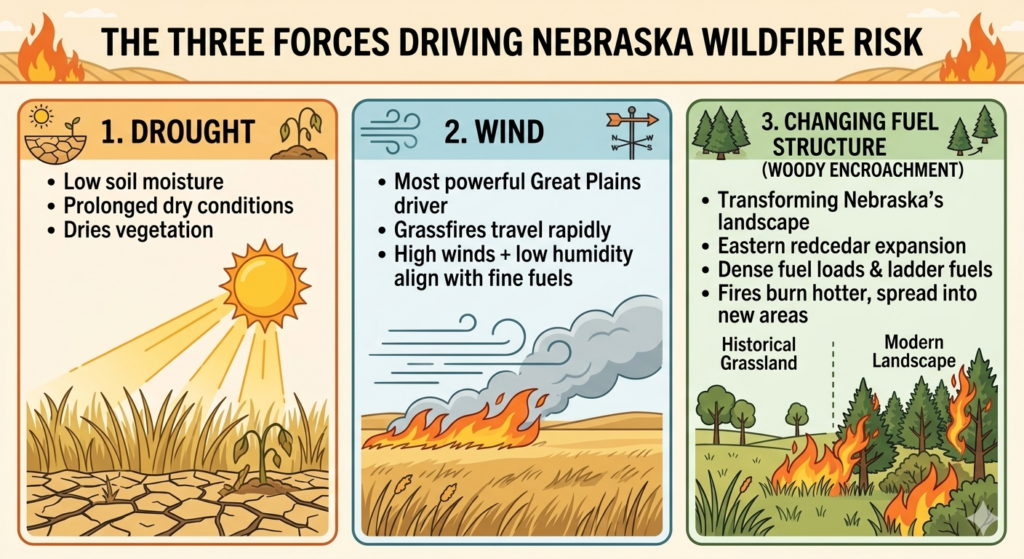
Across Nebraska’s recent wildfire events, three drivers consistently appear.
1. Drought. Low snowpack and prolonged drought reduce soil moisture and dry vegetation. Recent analyses show that much of Nebraska has experienced drought conditions in recent years, creating ideal conditions for wildfire ignition and spread.
2. Wind. Wind is arguably the most powerful wildfire driver in the Great Plains. Grassfires can travel miles in a single afternoon when strong winds align with fine fuels. Incident reports from major fires repeatedly cite high winds and low humidity as factors behind rapid fire growth.
3. Changing Fuel Structure. Woody encroachment — particularly eastern redcedar expansion — is transforming Nebraska’s fuel landscape. These trees create dense fuel loads and ladder fuels that allow fires to burn hotter and spread into areas historically dominated by grassland fire regimes.
Nebraska’s Firefighting System Is Built on Volunteers
While wildfire risk is increasing, Nebraska’s fire response system relies overwhelmingly on volunteer firefighters.
State data shows:
- 449 all-volunteer fire departments
- 23 combination paid/volunteer departments
- Only six fully paid departments statewide
Those career departments are located primarily in larger cities such as Omaha, Lincoln, Bellevue, and Grand Island, meaning much of rural Nebraska depends on volunteer responders.
Nebraska also ranks #1 in the United States for the percentage of volunteer fire departments, with roughly 92% of departments operating on a volunteer basis.
In total, Nebraska has roughly:
- 1,491 paid firefighters
- More than 15,000 unpaid volunteer firefighters
That means about 90–95% of firefighters in the state are volunteers.
Nebraska also ranks #1 in the United States for the percentage of volunteer fire departments, with roughly 92% of departments operating on a volunteer basis.
This system has protected Nebraska communities for more than a century, but it also creates challenges when large wildfires occur.
Rural Fire Response Is Stretched Thin
Nebraska’s firefighting system reflects the realities of a sparsely populated state.
Volunteer departments provide protection to more than 99% of Nebraska’s land area, particularly across rural ranching and agricultural regions where large wildfires are most common.
However, several structural challenges are emerging:
- Volunteer recruitment is declining. Many rural departments report aging volunteer rosters and difficulty recruiting younger firefighters.
- Large fires overwhelm local resources. Major incidents often require mutual aid from dozens of departments, along with state and federal assistance.
- Response distances are large. In rural Nebraska, fire departments may cover hundreds of square miles, increasing response times.
During major wildfire seasons, these factors combine to strain response capacity.
When Large Fires Break Out, Coordination Expands Quickly
When fires exceed local capacity, Nebraska activates a multi-agency response that can include:
- Nebraska Emergency Management Agency (NEMA)
- Nebraska Forest Service wildland teams
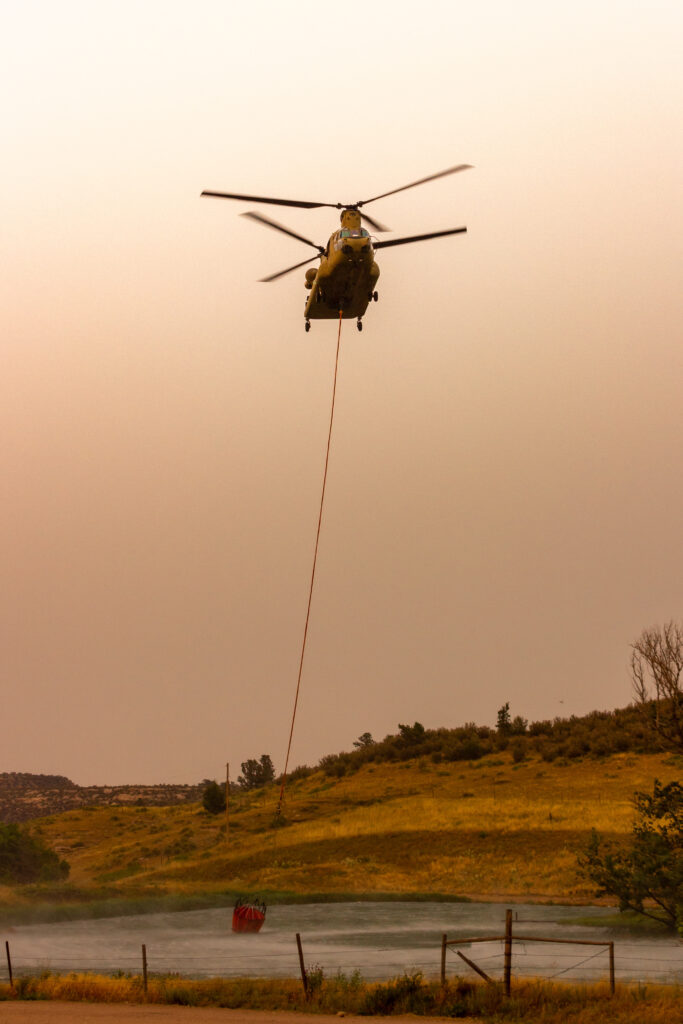
- National Guard aviation support
- Type II Incident Management Teams
- Mutual aid from dozens of volunteer departments
Major wildfire events frequently involve hundreds of firefighters from multiple counties.
But the backbone of that response is still volunteer fire departments.
What the 2026 Fires Tell Us About Future Risk
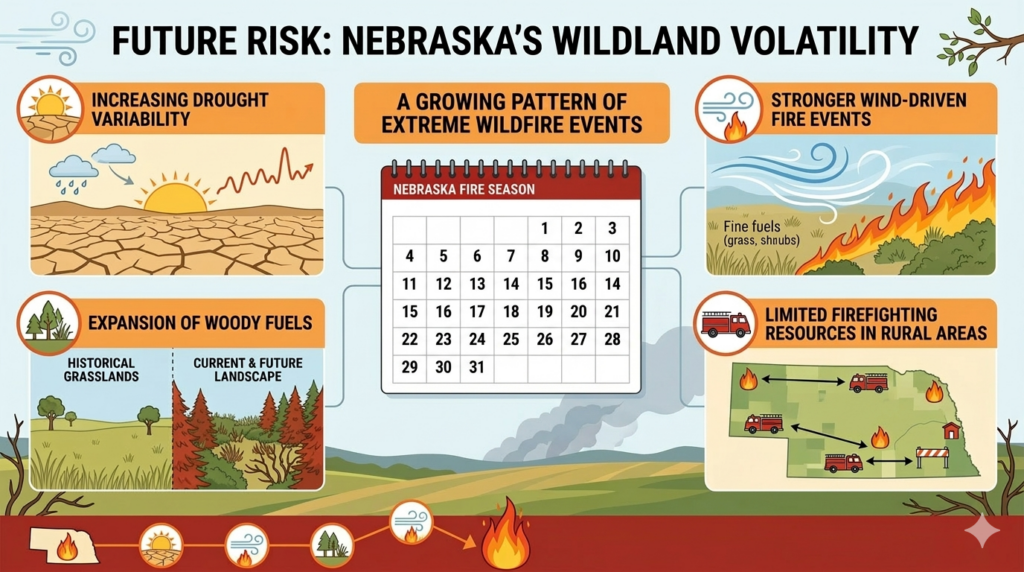
The spring wildfires in Nebraska this year reinforce a growing pattern:
Wildfire risk in the Great Plains is becoming more volatile.
The key factors driving future risk include:
- Increasing drought variability
- Stronger wind-driven fire events
- Expanding woody fuels
- Limited firefighting resources in rural areas
Together, these forces create a landscape where rare but extreme wildfire events dominate the risk profile.
In Nebraska, just a handful of extreme fire days can account for the majority of acres burned in a given year.
The Role of Wildfire Risk Intelligence
Understanding wildfire risk in Nebraska requires more than historical fire data. Risk emerges from a complex interaction between:
- Climate conditions
- Vegetation changes
- Ignition sources
- Landscape connectivity
- Response capacity
Modern wildfire risk analytics can help communities move from reactive response to proactive planning by identifying:
- Areas with elevated wildfire hazard
- Landscapes with recurring fire activity
- Locations where fuel buildup increases fire severity
- Communities most exposed to future fires
In regions like Nebraska — where volunteer firefighters protect vast rural landscapes — better risk intelligence can help guide fuel treatments, preparedness planning, and infrastructure protection.
Nebraska’s Fire Story Is Still Being Written
Fire has shaped Nebraska for thousands of years.
But the wildfire challenges facing the state today are different from those of the past.
The combination of changing fuels, extreme weather, and a volunteer-driven firefighting system means that Nebraska’s wildfire risk is evolving.
And the fires we’re seeing today — from the major complexes of the past decade to the emerging fires of 2026 — are signals of what the future may hold.
The question is not whether Nebraska will continue to experience wildfires.
It’s whether communities will be prepared for the fires that are coming next.
Frequently Asked Questions About Nebraska Wildfires
1. Are wildfires common in Nebraska?
Yes. While Nebraska is not typically associated with large forest fires like western states, wildfire is a natural and recurring part of the state’s Great Plains grassland ecosystem. Historically, lightning and Indigenous burning produced fires roughly every 4–5 years in the Sandhills region, helping maintain prairie landscapes.
Today, Nebraska experiences regular grassfires, particularly during dry and windy conditions.
2. When is wildfire season in Nebraska?
Historically, Nebraska’s wildfire season ran from early summer through mid-autumn, when vegetation was dry and lightning storms were more common.
However, wildfire risk has increasingly become year-round due to drought conditions, dry winters, and strong wind events that can rapidly spread fires across grasslands.
Large fires now frequently occur during late winter and early spring, when cured grasses and high winds create dangerous fire conditions.
3. What causes most wildfires in Nebraska?
Wildfires in Nebraska can be caused by both natural and human sources, including:
- Lightning storms
- Power line failures
- Agricultural equipment
- Vehicle sparks
- Controlled burns that escape
- Mowing or land-management activities
For example, the Betty’s Way Fire in 2024 was reportedly caused by mowing operations during high-wind conditions.
4. Why are Nebraska fires often so large?
Many of Nebraska’s largest fires are wind-driven grassfires. Unlike dense forests, prairie landscapes contain fine fuels that can ignite easily and spread rapidly.
Three factors frequently combine to produce large fires:
- Strong winds
- Drought-stressed vegetation
- Continuous grass fuels
When these conditions align, fires can grow extremely quickly and cover tens of thousands of acres.
5. Does Nebraska rely on volunteer firefighters?
Yes. Nebraska’s firefighting system relies heavily on volunteer responders.
Approximately 90–95% of firefighters in Nebraska are volunteers, and the vast majority of the state’s fire departments operate on a volunteer basis. Only a small number of fully paid departments exist, primarily located in larger cities such as Omaha and Lincoln.
Volunteer firefighters protect most of Nebraska’s rural landscape, which includes many of the areas most vulnerable to large grassfires.
6. What are the biggest wildfire risks facing Nebraska today?
Several long-term trends are increasing wildfire risk across the state:
- Expansion of eastern redcedar and other woody fuels
- More frequent drought conditions
- Stronger wind-driven fire events
- Expanding development in fire-prone landscapes
These factors are creating conditions where large, fast-moving wildfires are becoming more likely.
About the Data and Research
This article draws on a combination of historical research, state wildfire reports, and federal environmental data to understand wildfire risk trends in Nebraska.
The analysis integrates multiple categories of information, including:
Historical fire ecology research
Studies of fire regimes in the Great Plains show that Nebraska historically experienced frequent grassland fires driven by lightning and Indigenous burning practices. These fires helped maintain prairie ecosystems and limited woody vegetation expansion.
State wildfire records
Modern wildfire events and acreage estimates were compiled using official reporting from Nebraska agencies such as:
- Nebraska Emergency Management Agency (NEMA)
- Nebraska Forest Service
- Nebraska State Fire Marshal
- Nebraska Legislature wildfire statutes and policy documents
These sources provide incident reports, wildfire acreage summaries, and emergency response data.
Environmental and climate data
Additional wildfire risk context comes from federal and academic sources, including:
- USDA Forest Service forest health reports
- University of Nebraska–Lincoln research programs
- National Interagency Fire Center wildfire statistics
These datasets help explain how drought conditions, fuel changes, and weather patterns influence wildfire behavior across the Great Plains.
Limitations
Wildfire data can evolve during active incidents. Acreage estimates often change as fires are mapped more precisely after containment.
Additionally, many historic prairie fires from the 19th century lack standardized acreage measurements, making direct comparisons with modern wildfire events difficult.
Despite these limitations, the available data clearly shows that Nebraska’s wildfire risk is influenced by a combination of climate variability, vegetation change, and response capacity.
Sources
- Nebraska Emergency Management Agency (NEMA). 2012 Annual Report – Wildfire Activity Summary.https://govdocs.nebraska.gov/epubs/m2200/a001-2012.pdf
- Nebraska Emergency Management Agency (NEMA). 2022 Annual Report.https://nema.nebraska.gov/admin/assets/files/public/annual-reports/2022_Annual_Report.pdf
- Nebraska Forest Service. Nebraska Wildfire Control Act Program Overview. https://nfs.unl.edu/nebraska-wildfire-control-act/
- Nebraska Legislature. Wildfire Control Act Statutes (Neb. Rev. Stat. §§81-825–81-828).https://nebraskalegislature.gov/laws/statutes.php?statute=81-826
- Nebraska Department of Environment and Energy. Wildfires and Their Impacts in Nebraska.https://dee.nebraska.gov/wildfires-and-impacts-nebraska
- Nebraska Forest Service. Eastern Redcedar Expansion and Fire Risk. https://nfs.unl.edu/redcedar-eastern/
- USDA Forest Service. Forest Health Highlights 2022 – Nebraska.https://www.fs.usda.gov/foresthealth/docs/fhh/NE_FHH_2022.pdf
- Nebraska Public Media. Grassfires in Nebraska Lead to Multiple Evacuations.https://nebraskapublicmedia.org/en/news/news-articles/grassfires-in-nebraska-lead-to-multiple-evacuations/
- High Plains Journal. Nebraska Governor Issues Emergency Because of Wildfires (2026).https://hpj.com/2026/03/13/nebraska-governor-issues-emergency-because-wildfires/
- Nebraska State Fire Marshal. Nebraska Fire Department Statistics. https://sfm.nebraska.gov/fire-departments/general-information
- Nebraska State Volunteer Firefighters Association. Volunteer Firefighter Statistics.https://www.nsvfa.org/volunteer
- University of Nebraska–Lincoln. Nebraska Forest Service Rural Fire Department Programs.https://ianrnews.unl.edu/nebraska-forest-service-announces-grants-rural-fire-departments
- National Park Service. Indigenous Fire Practices and Landscape Management.https://www.nps.gov/subjects/fire/indigenous-fire-practices-shape-our-land.htm
- U.S. Fish and Wildlife Service. Using Fire to Manage Grasslands. https://www.fws.gov/story/2024-05/using-fire-manage-grasslands
- Tall Timbers Research Station. Historical Fire Regimes in the Great Plains. https://talltimbers.org/wp-content/uploads/2018/09/179-Bragg1998_op.pdf
- Bragg, T.B. Fire in the Nebraska Sandhills. Ecological research on historical fire frequency. https://www.jstor.org/stable/2425792
- National Interagency Fire Center. Fire Information and Historical Fire Data. https://www.nifc.gov/fire-information/maps
- Nebraska Wildfire Risk Assessment Portal (WRAP). https://wrap.nebraskawildfirerisk.com/Map/Public/
- AirNow. Fire and Smoke Map. https://fire.airnow.gov/
History of Wildfires in Nebraska: Fire Regimes, Land Use, Policy Evolution, and Future Risk (Research compilation). .1029/2025EF006935
