
• Skip to main content
  • Skip to header right navigation
  • Skip to site footer
A green hexagon logo with a shield and cityscape design, next to the text “PROPERTY GUARDIAN” and below it, “A Green Shield Company” on a light gray background.

Property Guardian

  • About Us
    • About Us
    • Our Team
    • Our Partners
  • Solutions
        • Risk & Insurance Solutions

        • Underwriting
        • Loss Control
        • Portfolio Insights
        • Real Estate Solutions

        • Property Guardian InsurAble
        • Commercial Property Owners
        • View All Products
  • Resources
    • Brochures
    • White Papers & Case Studies
    • Videos
  • News
  • Contact Us
    • Contact Us
    • Support
    • Request a Demo
  • Request a Demo
  • LinkedIn
  • YouTube
  • LinkedIn
  • YouTube
Request a Demo
Aerial view of a residential neighborhood showing widespread destruction from a wildfire; most houses are reduced to rubble and foundations, with some trees and a few undamaged buildings visible in the background.

Wildfire Risk Is Not Just About the Wildland

March 10, 2026

By Brian Bastian, Head of Product

Wildfire risk is often framed as a landscape problem.

Models typically focus on fuels, vegetation, drought, weather, and topography. These factors unquestionably determine where fires start and how they spread across landscapes.

But when it comes to what actually burns, the story is more nuanced.

A recent paper published in Nature Communications examined structural losses across several major California wildfires, including the Camp Fire, Tubbs Fire, and Glass Fire. The researchers used post-fire damage assessments and machine learning models to understand which factors most strongly influence whether structures survive or are destroyed.

Their conclusion reinforces something many practitioners have long observed in the field:

Wildfire risk to buildings is not purely a landscape problem.

It is also a structure and neighborhood problem.
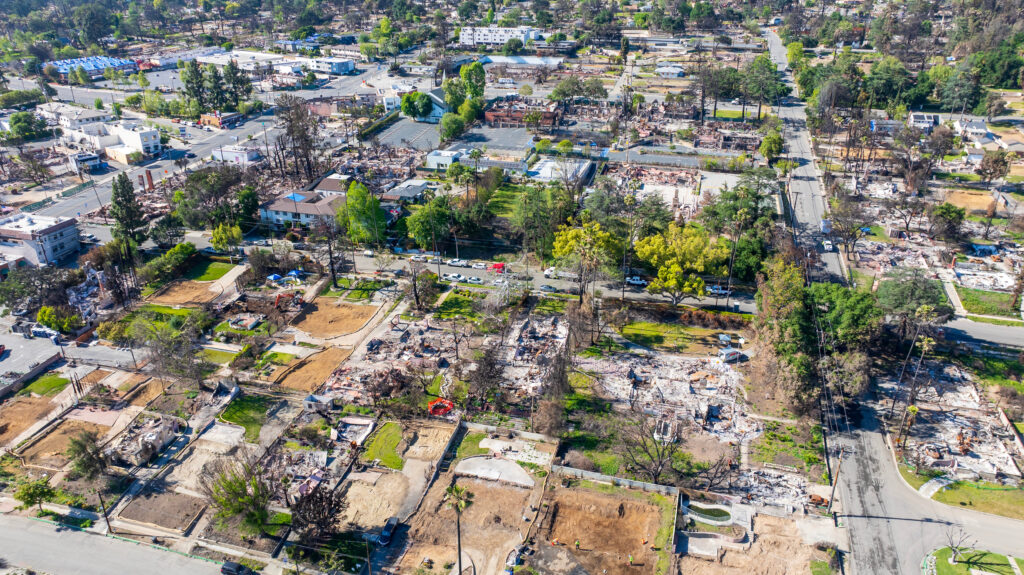
Aerial view of a residential neighborhood showing widespread destruction from a wildfire; most houses are reduced to rubble and foundations, with some trees and a few undamaged buildings visible in the background.
Aerial shot of fire damaged businesses and homes on Lake Street in Altadena, California

The Four Drivers of Structural Loss

The study identified four primary drivers of structural loss:

  1. Spacing between structures
  2. Fire exposure intensity
  3. Structure hardening
  4. Defensible space

Each of these elements contributes to whether a structure ignites. But the research highlights an important dynamic: these variables interact with each other.

For example:

  • Homes located close together increase the likelihood of structure-to-structure fire spread.
  • Even well-hardened buildings can be vulnerable if neighboring structures ignite.
  • Defensible space helps reduce ignition risk, but its effectiveness depends on local exposure conditions.

This reinforces an emerging understanding in wildfire science: community layout and parcel-level conditions matter just as much as the surrounding wildland.


The Neighborhood Effect

One of the most striking insights from the research is the role of structure density and proximity.

Once a fire reaches developed areas, the primary driver of destruction often becomes house-to-house ignition.

This creates a cascade effect:

  1. Wildfire reaches the edge of a community.
  2. A small number of structures ignite.
  3. Radiant heat and ember showers ignite nearby buildings.
  4. Fire spreads through the built environment.

In this phase, wildfire behaves less like a vegetation fire and more like an urban conflagration problem.

This means that assessing wildfire risk purely at the regional or landscape scale misses an important piece of the puzzle.


Why Parcel-Level Risk Matters

For insurers, municipalities, and property owners, the relevant question is not simply: Is wildfire possible in this region?

Instead, the more actionable question is: What is the ignition risk for this specific structure?

That risk depends on a combination of factors, including:

  • Construction materials
  • Roof and vent design
  • Vegetation immediately surrounding the structure
  • Parcel configuration
  • Distance to neighboring structures
  • Local fuel patterns and historical fire activity

These factors exist at the parcel and structure level, not just the landscape level.

This is where high-resolution risk assessment becomes essential.
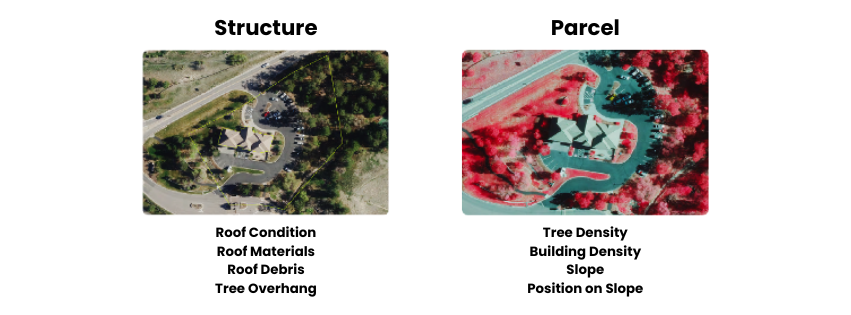
Two overhead images of a property: one labeled "Structure" showing a building with visible roof details, the other labeled "Parcel" in false color emphasizing tree cover and land features. Lists of analysis criteria are shown below each image.

Moving Beyond Landscape-Only Models

Traditional wildfire hazard models are extremely valuable for understanding where fire is likely to occur.

But when the objective shifts to predicting structural loss, the modeling framework needs to evolve.

Effective structural risk assessment requires combining multiple layers of information, including:

  • Hazard exposure
  • Local fire history and recurrence
  • Proximity to fuels
  • Structure characteristics
  • Parcel configuration
  • Neighborhood structure density

The goal is not simply to map wildfire hazard, but to understand how that hazard interacts with the built environment.


The researchers estimate that combining structure hardening and defensible space could reduce structural losses by roughly 50% in similar wildfire scenarios.

What This Means for Mitigation

Perhaps the most encouraging result of the study is that mitigation measures matter.

The researchers estimate that combining structure hardening and defensible space could reduce structural losses by roughly 50% in similar wildfire scenarios.

This underscores an important point: Wildfire risk is not just something that must be endured. It is something that can be measured, managed, and reduced.

But doing so requires the right level of analysis.


The Path Forward

Wildfire risk management is increasingly moving toward structure-level intelligence.

Understanding wildfire behavior across landscapes will always be essential. But as communities expand into fire-prone regions, the next frontier of risk modeling lies in understanding how fire interacts with individual structures and neighborhoods.

Recent research continues to reinforce this shift.

And as data, modeling techniques, and parcel-level insights improve, the ability to identify actionable mitigation opportunities at the property level will continue to grow.

Because in the end, wildfire risk is not just about where the fire burns.

It is about what ignites when it arrives.

Share this post:
Category: Blog
A man with short brown hair and a beard is smiling, wearing a light gray suit with a white shirt and a dark polka dot tie. The background is plain white.

About Brian Bastian

Brian Bastian, Head of Product for Property Guardian, is a seasoned product leader and catastrophe risk management professional with deep expertise in wildfire risk solutions and enterprise SaaS development. As a key driver at Green Shield Risk Solutions, Brian has spearheaded the creation of the Property Guardian platform, delivering cutting-edge tools for superior risk selection, portfolio management, and active loss control. With a foundation built at industry leaders like Guy Carpenter and JLT Re, Brian brings a proven track record of transforming complex risk analytics into actionable insights that enhance resilience and drive value for clients. Passionate about innovation and collaboration, Brian also serves on the board of the International Society of Catastrophe Managers, where he champions technology advancements in catastrophe risk management.

Sidebar

Recent Posts

  • Wildfire Risk Is Not Just About the Wildland
  • When the Fire Behaves Like a City Firestorm: What the Public Often Misses About Firefighting Efforts
  • One Year Since the Palisades & Eaton Wildfires: Remembering, Honoring, Rebuilding
  • Property Guardian and Allied Disaster Defense Partner to Scale Data-Driven Wildfire Mitigation and Monitoring
  • Information Providers, Inc. Selects Property Guardian to Power Wildfire-Specific Virtual Inspections

Categories

Stay in the Know!

Stay connected with the Property Guardian team! Subscribe to get the latest updates on product launches, feature enhancements, wildfire news, expert mitigation tips, and much more. Don’t miss out on the insights that matter most!

Our Latest Posts

Aerial view of a residential neighborhood showing widespread destruction from a wildfire; most houses are reduced to rubble and foundations, with some trees and a few undamaged buildings visible in the background.
Category: Blog

Wildfire Risk Is Not Just About the Wildland

Firefighters spray water on a burning building at night, with heavy smoke and flames visible. Emergency lights shine, and hoses are spread across the wet street as crews work to control the blaze.
Category: Blog

When the Fire Behaves Like a City Firestorm: What the Public Often Misses About Firefighting Efforts

Silhouettes of palm trees and buildings are set against a dramatic, fiery orange sunset sky, casting an intense glow over an urban cityscape.
Category: Blog

One Year Since the Palisades & Eaton Wildfires: Remembering, Honoring, Rebuilding

Ready to Get Started?

Let us guide you through a personalized demo and create a customized solution that perfectly aligns with your needs. Protect what matters most with a solution built for you.

Request a Demo

Stay in the Know!

Stay connected with the Property Guardian team! Subscribe to get the latest updates on product launches, feature enhancements, wildfire news, expert mitigation tips, and much more. Don’t miss out on the insights that matter most!

Home

About Us

Our Team

Partners

Request a Demo

Contact Us

Risk & Insurance Solutions

Underwriting

Loss Control

Portfolio Insights

Property Guardian InsurAble

Solutions for Communities

Solutions for Commercial Property

All Products

Resources

Brochures

White Papers & Case Studies

Videos

  • LinkedIn
  • YouTube
A green hexagon logo with a shield and cityscape design, next to the text “PROPERTY GUARDIAN” and below it, “A Green Shield Company” on a light gray background.

Headquarters:
2551 N Clark St., Suite 302
Chicago, IL 60614

Copyright © 2026 · Property Guardian · All Rights Reserved · Terms of Use · Privacy Policy· Trust Center

By using this website, you agree to our use of cookies. We use cookies to provide you with a great experience and to help our website run effectively. To find out more, please read our Privacy Policy.